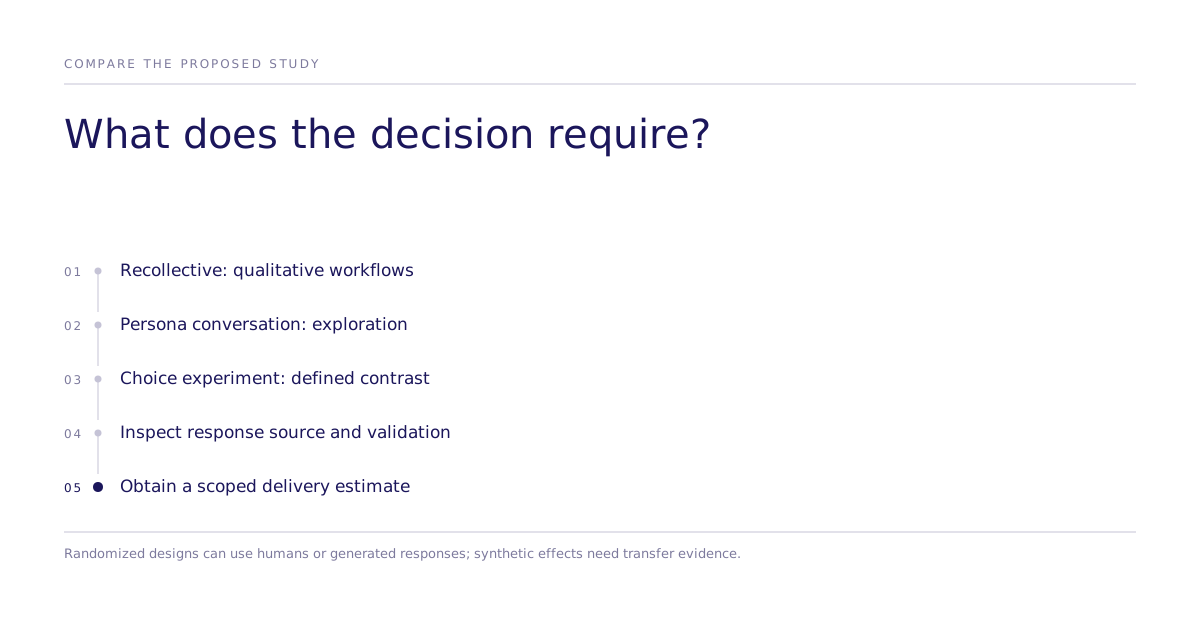
Recollective vs a Causal Testing Platform: Matching the Tool to the Decision
A team choosing a customer-research tool is usually choosing between three different jobs: a moderated online community, a fast AI conversation tool, and a controlled experiment that tests which action actually changes behavior. Picking the wrong one costs a launch cycle, a mispriced product, or a feature investment that never moves the outcome it was built to test.
What does a moderated community platform buy?
Recollective's current product page describes live and asynchronous qualitative research, AI-moderated interviews, diaries, communities, concept testing, and UX tasks. Short-term projects and ongoing communities are both supported. Compare the particular workflow with your question rather than assume every project needs an extended moderated program.
A community can support repeated engagement and emerging questions. A short concept task or interview has different staffing and fielding needs. Obtain an estimate for the actual participants, activities, moderation, and analysis.
What does a fast AI conversation tool buy, and what does it miss?
The other end of the category is a self-serve tool where a team member talks with an AI-generated stand-in for a customer type and gets a same-day response. That speed doesn't solve the evidence problem: a conversation, however fast, still returns stated opinion: what the AI-generated respondent says it would do, not a measured behavioral outcome. Aggregating several such conversations into a summary does not turn stated opinion into a test of whether a specific price, message, or feature actually changes what a buyer does.
The question underneath: opinion or a measured cause
A conversation alone does not estimate an intervention effect. A controlled study can use either human participants or generated responses. Subconscious uses randomized choice designs to estimate effects on generated choices within a simulated task, with uncertainty where supported.
That distinction matters most at the moment of the decision itself: shipping a price, message, or feature change built on community sentiment or AI-conversation output that reads as consensus, but doesn't predict what buyers actually do.
| Recollective (community) | Fast AI conversation tool | Subconscious (causal experiment) | |
|---|---|---|---|
| Evidence | Qualitative responses under the chosen workflow | Exploratory generated reactions | Effects on generated choices under a specified randomized design |
| Delivery | Obtain a project-specific estimate | Verify the proposed workflow and limits | Obtain a design, run, review and analysis estimate |
| Work to define | Participants, activities, moderation and analysis | Profile, prompts and intended use | Population, alternatives, endpoint and estimator |
| Evidence to check | Recruitment, instrument and protocol | Prompt sensitivity and relevant validation | Assignment, uncertainty and matched human transfer |
Inspect the modeled population's provenance for a Subconscious study. The public causal-fidelity paper compares estimated choice parameters with corresponding human studies. A separately scoped human study can check the same alternatives and question, with population and instrument differences documented. This evidence does not guarantee a new project's outcome.
Where does a causal experiment not fit?
The Subconscious study described here compares defined alternatives on modeled stated choice. A standing community can collect discussions, diaries and participant context over time. Specify those requirements separately and ask the selected provider to demonstrate the workflow; a choice estimate alone does not supply longitudinal qualitative evidence.
A practical test before choosing
Name the proposed action, measured endpoint, audience, and decision deadline. A repeated qualitative program, a short concept task, and a randomized choice comparison can each fit different needs. Ask Recollective and any alternative for the design and evidence proposed for that question.
See how the method works in how Subconscious runs a study, review published research and the leaderboard of validated results, or book time to scope one specific decision.