Recruited-Incentive Research vs. a Causal Simulated Experiment First
A product or research-ops lead with a recruiting budget faces the same question before every round of paid, incentive-based sessions: spend that budget now on real participants, or run a causal experiment on a simulated market first to find out which questions are worth paying people to answer.
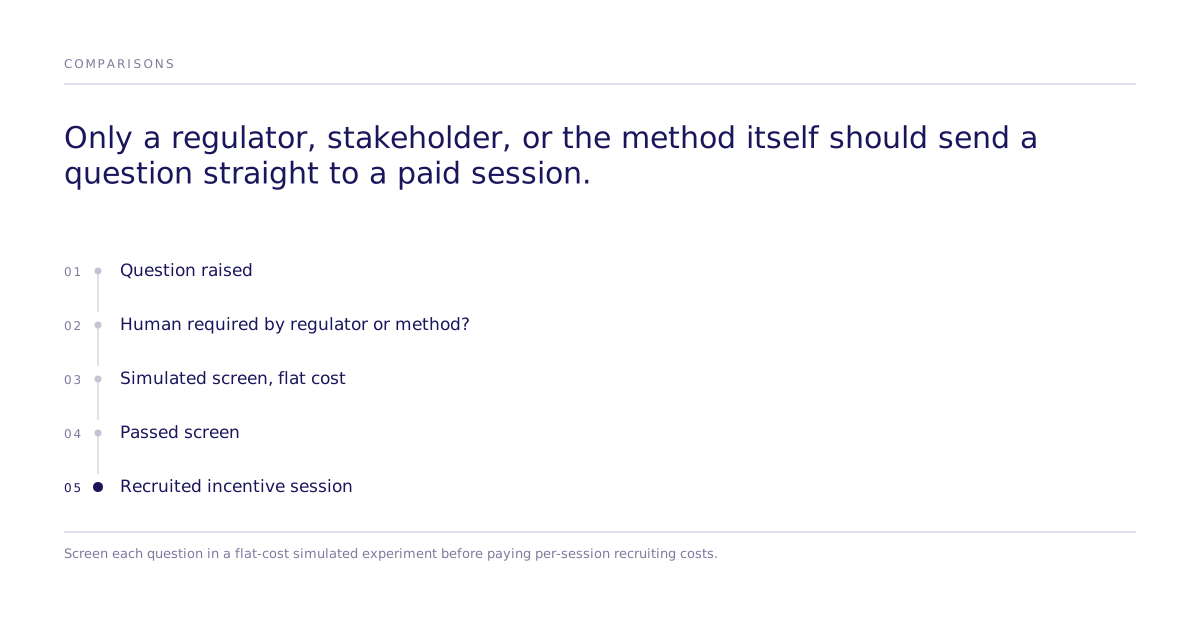
The two things being compared are not substitutes
Recruited research pays real people, screened and scheduled, to sit through a session. The incentive is the cost of their time; the recruiting workflow is the cost of finding and confirming them. This is the right tool when a regulator, a stakeholder, or the method itself requires a real human: usability testing, ethnographic fieldwork, or any study where the record has to show an actual person responded.
A causal simulated experiment runs before any of that spend happens. It tests actions, comparisons, and audience definitions on a simulated market to estimate which ones are worth carrying into a recruited round. It answers a narrower question than a full study: is this concept, message, or price point differentiated enough to justify the incentive and scheduling cost, or should it be cut or reworked first.
The real decision is sequencing: which questions get answered with a simulated pass first, and which go straight to recruited participants because only a real session will do.
Where does the incentive-recruiting workflow actually spend the budget?
Per-session incentive research has two structural cost drivers that scale with volume. The first is the payment itself, sized to session length and audience difficulty. The second is the operational overhead of screening, scheduling, and covering no-shows, which a current industry guide to research incentives documents as a standard part of budgeting a recruited study rather than an edge case (The Ultimate Guide to User Research Incentives, User Interviews). Because both costs are per-session, the total scales roughly linearly with the number of questions a team wants answered, and published per-session and per-seat pricing tiers confirm that recruiting cost tracks volume rather than flattening out (User Interviews pricing, User Interviews).
| Recruited, incentive-paid session | Causal simulated experiment | |
|---|---|---|
| What it produces | A real person's response, usable as evidence of record | A causal estimate of which action moves the outcome, for further screening |
| Cost driver | Scales per session: incentive plus recruiting overhead | Flat regardless of how many questions get tested |
| Where it's required | Usability, ethnographic, or regulator-mandated research | Narrowing which questions deserve that spend |
| Failure mode if skipped | Budget burned on a question that didn't need a real session | A high-stakes, mandated question gets treated as answered when it wasn't |
What does Subconscious do in this sequence?
Subconscious runs controlled causal experiments on a simulated market first, then can test or validate the same question with real human participants when the decision calls for it. That lets a team spend its recruiting budget on the questions that survived the first pass, not on every question it started with.
The proof behind the first pass: our best configuration reaches 87% of the measured human ceiling on one study, 0.832 rank correlation against the published human result, where two independent samples of real humans reach 0.959. Across all 43 studies that pass design filters the mean is 0.73. A number published without its limits is marketing copy. It is a validation result, not a guarantee for a new market (the causal fidelity paper).
Does Subconscious replace the recruited session it's meant to precede?
Subconscious does not recruit, screen, or pay participants, and it does not replace real-respondent research where the method itself or a regulatory mandate requires an actual human session. It is an upstream causal experimentation layer, not a recruiting or incentive-payment platform. When the decision depends on validation, a team can move from the simulated experiment to a real-human test of the same question without changing what was being asked.
Cost of getting the order wrong
The misses go on the page next to the hits so a buyer can check the sequencing themselves. Run recruiting first on every question, and incentive spend plus multi-week scheduling burns on questions a first pass would have screened out or sharpened. Skip the recruited round on a question a regulator or stakeholder requires a real human to answer, and a directional simulated read gets mistaken for confirmation it was never designed to provide. Both failures are sequencing errors, not tool-selection errors.
Next step
Start with the questions on the research list and sort them: which require a real, recruited human session no matter what, and which are candidates for a causal simulated pass first. For the second group, see how the method works, check the research library for study examples, or book time to walk through a live experiment.