Research repository or causal test: choosing the right tool before a launch decision
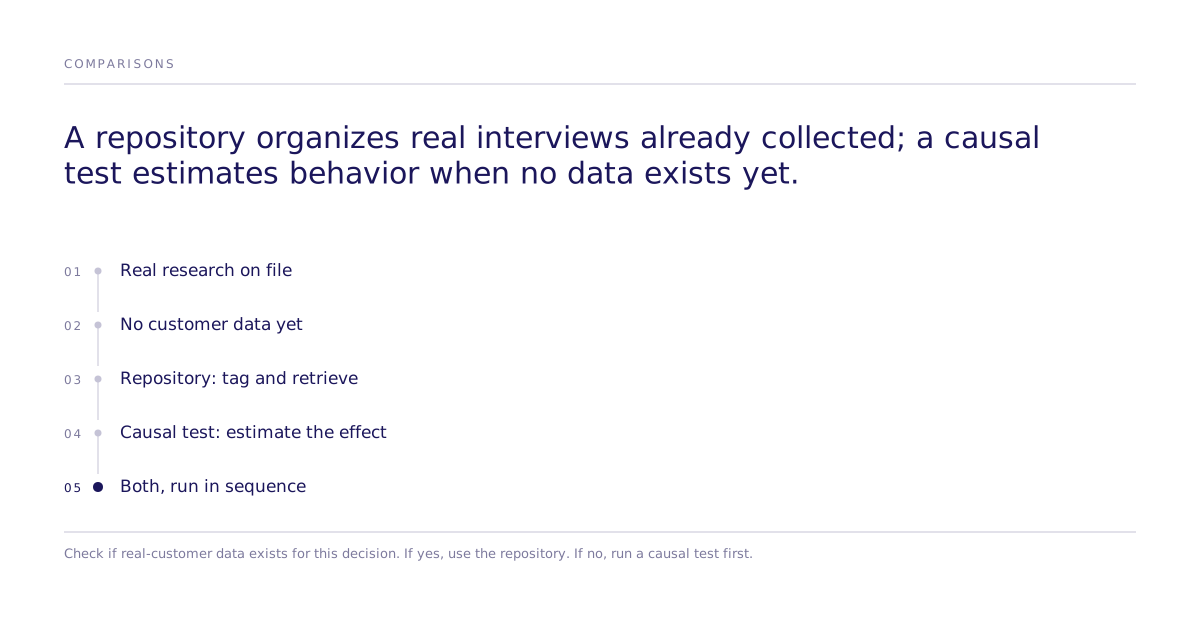
A Head of Product or CMO facing a launch decision usually has two problems: making sense of customer research already on file, and getting a directional answer for a decision with no customer data yet: a new concept, segment, market, or pre-launch positioning. Picking one tool for both is the costliest mistake.
The decision: organize what you have, or test what you don't
If your team is sitting on a backlog of interviews, transcripts, support tickets, and sales-call notes, the job is retrieval: find the pattern, tag the theme, get it in front of product and design. Dovetail does exactly that: a searchable repository where real customer conversations get tagged, clustered, and linked back to the moment they came from.
If the job instead is deciding whether a new price, message, or launch action will change behavior, and no real-customer data exists yet, a repository can't help. That gap is where Subconscious sits: a causal behavioral platform that runs controlled experiments on simulated markets to estimate which action is most likely to move behavior, before the evidence a repository would eventually hold exists.
What happens if you pick the wrong tool?
Teams that wait for the repository to accumulate enough real interviews before testing a new concept ship on stale or absent signal; the launch date arrives before the evidence does. Teams that swing the other way and treat generated opinions as a substitute for any real-customer check commit budget to the wrong price, message, or launch action based on plausible-sounding text, not evidence of what the market will actually do. Neither failure is about which platform is better; it's about running the wrong tool at the wrong stage of the decision.
What each tool actually does
| Repository (Dovetail) | Causal testing (Subconscious) | |
|---|---|---|
| Source of evidence | Real customer interviews, transcripts, tickets already collected | Controlled experiments on simulated markets |
| When it has value | Once your team has research output to ingest | Before you have customers, data, or a fielded study |
| Core question answered | What did our customers already say? | Which action would most likely change behavior? |
| Output shape | Searchable, tagged, evidence-linked library | A causal estimate for a decision that hasn't happened yet |
Neither column replaces the other: a repository organizes what real customers already said, while Subconscious tests the counterfactual for a decision that hasn't happened yet.
Where the proof stands and where it doesn't
A score by itself is a marketing line. Putting it next to the human ceiling turns it into something a buyer can check. Our best configuration reaches 87% of the measured human ceiling on one study: 0.832 rank correlation against the published human result, where two independent samples of real humans reach 0.959. Across all 43 studies that pass design filters the mean is 0.73. It is a validation result, not a guarantee for a new market. See the causal fidelity paper. That figure, and the research behind it, is the extent of the current, defensible accuracy claim. Subconscious can also test or validate a study with real human participants, so a team can move from a simulated read to a validated one without re-running the underlying causal question. What it does not do is organize, tag, or search an organization's existing corpus of real interviews, transcripts, or support tickets. That's the distinct category need Dovetail is built to serve.
Stating the exact scope of an output keeps the claim checkable run by run. Confidence intervals, segment-level breakdowns, and decision memos are study-specific outputs, not universal guarantees on every run. The audience Subconscious can model at the population level is also distinct from a recruited real-human validation study, or from the volume of interviews any one repository holds, worth keeping separate when comparing the two tools.
How do you sequence using both tools?
Most teams that need both jobs done run both tools rather than picking one: the repository keeps organizing what real customers already said; a causal test answers what the library can't: what a customer who hasn't been recruited yet would do. See how a team runs that sequence in practice, or look at applied examples before starting your own test. If the decision in front of you doesn't have real-customer data behind it yet, that's the one worth testing first. See a live demo.