Segmentation, Synthetic Personas, or a Causal Experiment: Choosing the Right Research Method
Choose an audience-segmentation platform to define, reach, and measure a US audience. Choose synthetic-persona research to explore possible language, objections, and hypotheses. Choose a controlled causal experiment when a price, message, or feature must be compared with a defined alternative and measured before it ships. Treating audience classification or an open-ended conversation as proof that an action changes behavior can waste campaign or product budget.
Start with the decision, not the tool
| Buyer question | Audience segmentation | Persona-style exploration | Causal action test |
|---|---|---|---|
| Who should we reach? | Defines and sizes an addressable audience | Explores a plausible archetype | Uses a defined population as an experiment input |
| What language should we investigate? | Adds segment context | Surfaces possible objections and language in one-to-one conversation | Compares defined messages when the decision is ready to test |
| Which action changes choice? | Does not answer this by classification alone | Does not answer this through conversation alone | Compares an intervention with a defined alternative |
| What happens after launch? | Can support activation, measurement, and attribution | Does not measure market delivery | Does not replace in-market measurement |
What can audience segmentation do?
A national consumer-segmentation platform can combine household classification with marketing activation and measurement, according to its current first-party product description.
Use that category when the decision is who to reach, how to activate the audience, and how to measure campaign delivery. Confirm that the current segments and geographic coverage match the proposed campaign.
Segmentation can identify a commercially relevant group. Classification alone does not establish that one proposed message, price, or feature will cause a different choice. The commercial action still needs its own test.
What can persona-style research do?
Persona-style research can support open-ended exploration of possible objections, language, and motivations. It is useful when the team is still shaping the question or deciding which alternatives deserve formal comparison.
A plausible conversation is not a controlled comparison. Use the output to form hypotheses; approving campaign or product spend requires evidence for the proposed action.
When is Subconscious the right fit?
Subconscious fits a specific commercial action that can be expressed as a controlled choice comparison. A synthetic study estimates how the defined alternatives change generated choices within the study. Report uncertainty under that design, then check whether the result transfers to the intended human audience.
The question is narrow: which price, message, feature, or go-to-market action changes choice relative to a defined alternative?
Keep each method in its lane
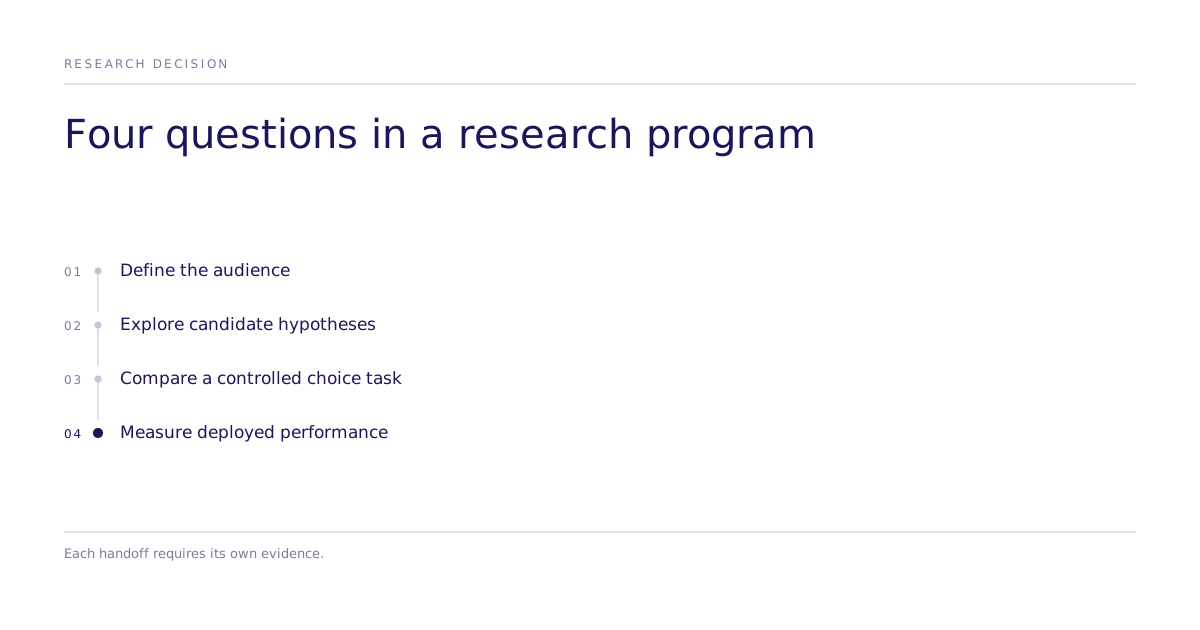
The methods can work in sequence:
- Use segmentation to define the audience.
- Use persona-style exploration to surface language and hypotheses.
- Use a controlled experiment to compare the proposed actions.
- Use activation and market measurement to observe what happened after launch.
The handoffs protect the decision. A controlled comparison estimates the effect of the action; market measurement then shows what happened in deployment.
Evidence standards before budget moves
A study should define the population, alternatives, intervention, outcome, and uncertainty before anyone interprets the result. Read the public causal-fidelity methodology and validation record to inspect what was tested and how the result was evaluated.
Audience activation and experiment evidence are separate procurement requirements. Confirm the proposed scope if the campaign also needs identity resolution, device or email linkage, media delivery, or attribution.
A simulated result is decision-support evidence. It is not recruited human participation or proof of market performance. For a consequential decision, plan a human comparison with aligned populations, alternatives, outcomes, and analysis, and document any changes to the instrument.
If the unresolved decision is a defined action, review how the study process works or book a walkthrough.