Self-Serve Persona Chat vs. Managed Research Advisory: Which One Answers Your Decision?
Self-service access and managed research describe who runs a study. Persona chat, surveys, and randomized comparisons describe what the study does. A buyer comparing these options should check the actual design before assuming that one delivery model produces stronger decision evidence.
Separate delivery from research design
What is the self-serve conversational model?
A conversational workflow lets a team give a synthetic persona a role and context, ask questions, and compare answers. This can help draft alternatives or surface possible objections. Direct software access alone does not determine the study's endpoint or validity.
What does managed research include?
Evidenza's current offer includes synthetic customer surveys and interviews, segmentation, positioning, and creative research. Its full-service team designs studies and presents recommendations; its homepage also describes self-service software access as coming soon. The modeled audience can include B2B buyers and specialist decision-makers, rather than only executive advisers. Confirm current access and engagement terms in the proposal.
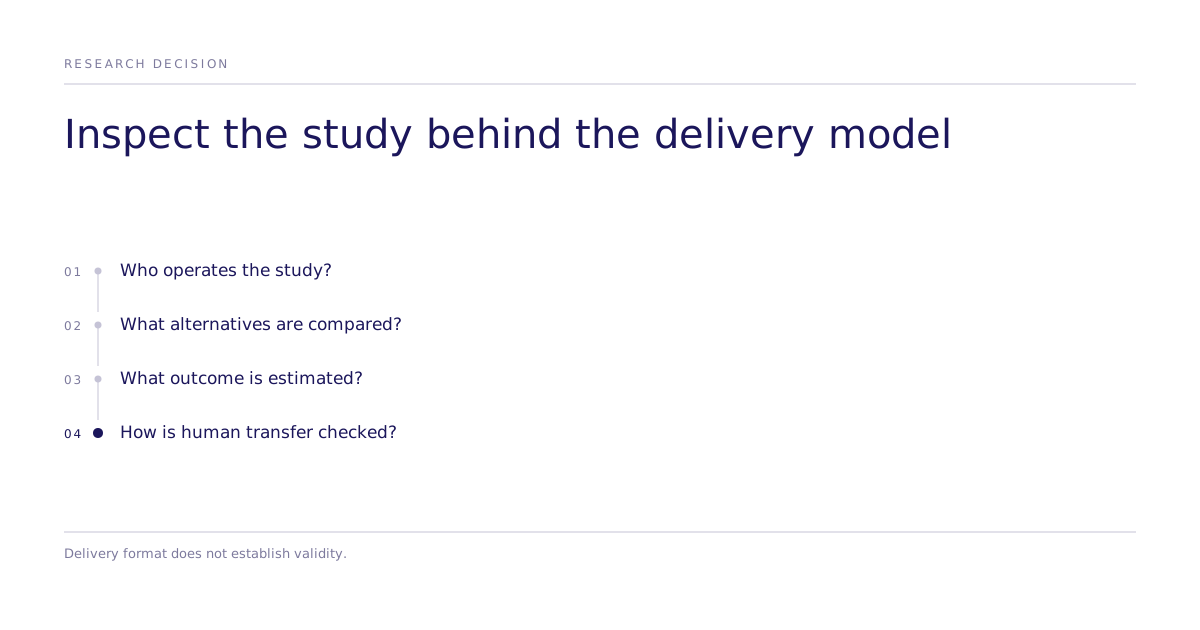
Either delivery model can support a structured study. An open-ended conversation alone does not identify the effect of an intervention, but the presence of analysts does not exclude randomized comparisons. Ask for the alternatives, assignment procedure, measured outcome, uncertainty, and human validation.
What a persona conversation measures, and what it doesn't
A fluent persona answer is not evidence that it predicts a decision. ACM Interactions commentary on the synthetic persona fallacy argues that generated personas can displace the disagreement real user research should surface. A June 2026 study of twins constructed from German panel microdata evaluates held-out survey responses and finds that performance depends on the information supplied and construction method. That survey task does not validate a new pricing intervention.
That is the say-do gap in a new form. A stated opinion, synthetic or human, is not the same thing as a measured change in behavior. Treating a fluent persona response as proof that a pricing move, a message, or a launch decision will work is where the cost of being wrong shows up: budget, positioning, or a go-to-market plan gets committed on an answer with no error bars and nothing to replicate.
Comparing what each approach actually answers
| Approach | Question it answers | Evidence produced | Where it breaks down |
|---|---|---|---|
| Conversational persona workflow | "What might this customer say about this idea?" | A generated conversation or opinion | Conversation alone does not estimate an intervention effect |
| Managed synthetic research, such as Evidenza | "What does the scoped buyer study ask?" | Surveys, interviews, analysis, and a readout as contracted | Delivery by analysts does not establish experimental identification |
| Controlled choice experiment | "How does the defined action change choices under this study design?" | An estimated contrast and design-appropriate uncertainty | Generated-choice results need human transfer checks before market claims |
When does each model fit the decision?
Use conversational exploration to draft message variants or investigate a rough concept. Choose managed delivery when the team needs study design, analysis, or an interpreted readout. Choose self-service access when the team can operate the required method and quality checks itself.
For a pricing change, launch claim, or positioning decision, require an appropriate comparison from whichever delivery model the team selects. Check the same evidence requirements for each proposal.
How a controlled experiment changes the answer
Subconscious's validation record concerns controlled choice studies and their comparison with human results. A randomized synthetic study estimates changes in generated choices; a human follow-up checks transfer to the intended audience. Align the question, alternatives, outcomes, and analysis, and document instrument differences.
The evidence depends on the experiment design and validation task. A strategy presentation or software interface cannot substitute for those checks.
What a controlled experiment does not do
A controlled choice result informs a decision that an accountable person still makes. It does not establish market adoption, sales lift, or a psychological mechanism. Request the current engagement scope if the team also needs interpretation, a strategy deck, or implementation support.
Where to start
Before committing budget to a self-serve session or a managed engagement, identify whether the underlying question is exploratory or a real decision with a measurable cost of being wrong. For the second case, a demo walks through how to design a controlled experiment around that specific decision.