Simulated AI Studies vs. Quantilope: Choosing a Research Path Before a Pricing or Claims Decision
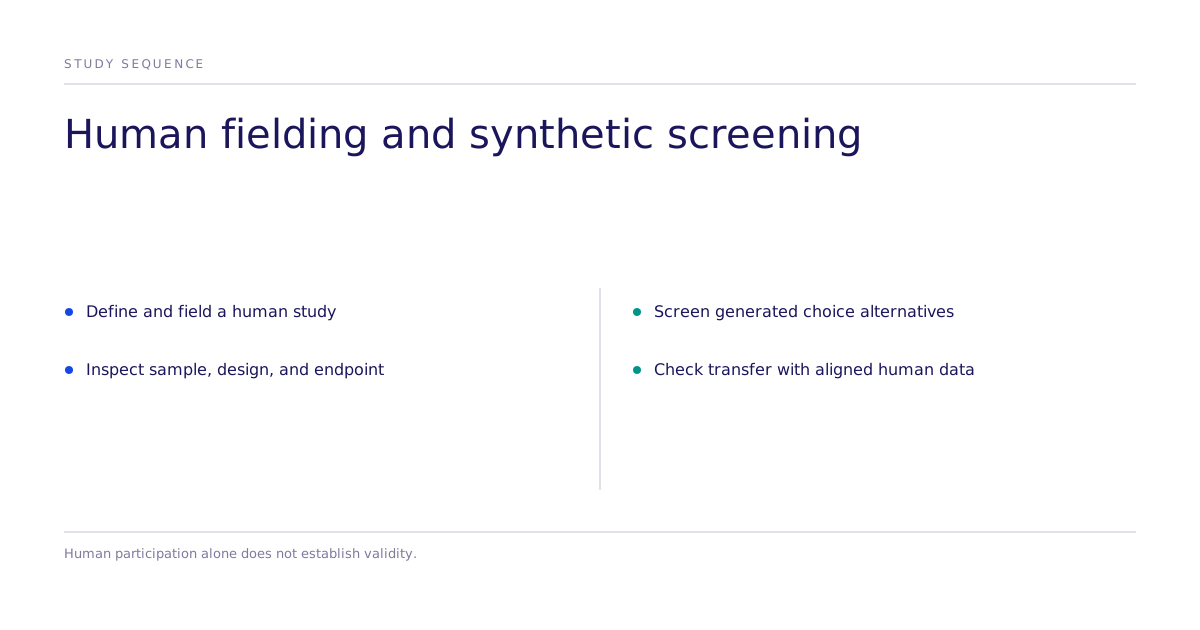
An insights or growth leader choosing a pricing, claims, or segmentation study can field a study to people, or use a synthetic comparison to screen alternatives before a human follow-up. The right sequence depends on the decision's cost, the required endpoint, and the available fieldwork window.
The decision and the cost of choosing wrong
A simulated result can diverge from what people choose. A fielded survey can also miss the intended audience or measure a stated preference instead of behavior. Get a scoped delivery estimate for each proposed study and define the evidence required before the launch decision.
What does an automated real-respondent platform deliver?
Quantilope's platform description includes survey building, panel or customer-list fielding, advanced methods such as conjoint, MaxDiff and TURF, tracking, and AI-assisted analysis. This comparison concerns that survey workflow; the vendor also describes predictive AI asset testing. Human participation and established templates do not by themselves establish sample validity or identify an intervention.
A fielded study fits when the decision requires evidence from people in the intended audience. Review screening, sample quality, experimental assignment where relevant, and the measured endpoint before treating the result as decision evidence.
Where does a fast simulated pass help, and where does it stop?
A synthetic comparison can screen pricing levels, claims, or concepts before a fielded study. Its generated responses have not necessarily been checked against people answering that question. Define the screening rule in advance and confirm delivery time for the actual configuration.
A simulated pass is useful for narrowing options fast. It is not proof that the option it favors is the one real customers will choose.
Where does Subconscious fit?
Subconscious's published method uses controlled choice tasks to compare generated responses with human study results. For a buyer's proposed pricing or claims study, specify the target audience, alternatives, assignment, and outcome. A model-conditional interval does not cover generator bias or market transfer. A human follow-up needs an aligned protocol and a record of any changes to the instrument.
That two-step path answers what an insights leader is actually asking: not whether the simulated read looks plausible, but whether the causal comparison holds once real people answer it.
How the two research paths compare
| Dimension | Automated real-respondent platform (Quantilope) | Simulated study first, real-human validation second (Subconscious) |
|---|---|---|
| Respondent source | Panel respondents or a supplied participant list under the survey workflow | Generated responses first; separately scoped human follow-up |
| Method | Survey methods including conjoint and MaxDiff; inspect the actual design | Controlled choice comparisons; inspect the actual design |
| Evidence to check | Sample quality, assignment, outcome, precision, and relation to behavior | The same design checks, plus generator provenance and human transfer |
| Delivery planning | Fieldwork and analysis estimate for the defined audience | Simulation configuration and human follow-up estimates |
Limitations and failure conditions
Confirm the named methods, outputs, price, and delivery terms in each current proposal. Do not infer feature parity from an automated interface or assume that synthetic respondents constitute a standing recruited human panel. A human survey still needs quality checks, and a synthetic result still needs external validation.
What to do next
Choose the fielded route when human responses are required for the decision. Consider a synthetic screen when narrowing alternatives helps the research program, with a human check planned for the consequential choice. Discuss the study design, book a decision review, or inspect the public causal-fidelity paper and validation record.