Simulated Experiments vs. Respondent.io: Choosing the Right Research Model
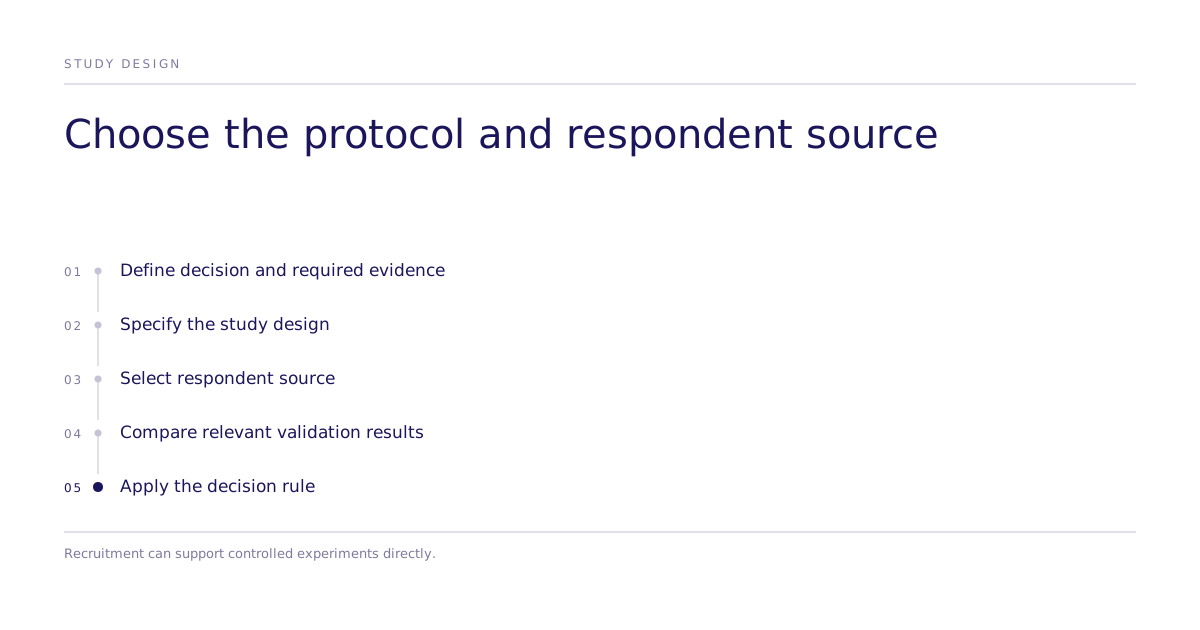
A CMO choosing evidence for positioning, pricing, or a new concept must decide both who responds and what study they complete. Respondent.io recruits people for several research methods. A synthetic experiment can screen alternatives before an aligned human study; recruitment can also support a controlled experiment directly.
Recruitment and experiment design are separate choices
Respondent.io describes participant targeting, screening, scheduling, and payment. Its current scope includes surveys, pricing and conjoint research, usability work, and moderated, unmoderated, or AI-moderated sessions. Recruitment supplies people to a design; it does not confine the study to interviews.
A controlled synthetic study estimates the effect of defined alternatives on generated choices within that study. It can help prioritize hypotheses. A separately scoped human comparison checks whether the result transfers to people in the intended audience.
What Each Model Is Built to Answer
| Dimension | Simulated audience experiment | Respondent.io recruiting |
|---|---|---|
| Who responds | Modeled respondents run against a simulated market | Real, screened people who applied to the study |
| Study format | Generated responses under the specified protocol | Interviews, surveys, usability tasks, or controlled choice designs |
| Evidence produced | A contrast within the synthetic study | Human responses or observed tasks under the selected design |
| Sequence | Can screen alternatives before human fielding | Can support a direct experiment or a follow-up; not inherently downstream |
When Should You Use Recruited Participants Instead of a Simulation?
Choose recruitment when the study requires people with verified eligibility, actual product interaction, or relevant lived experience. Check incidence, screening, incentives, and the design's relationship to the decision. Review Respondent.io's current pricing for the proposed recruit.
When Should a Simulated Experiment Come First?
Consider a synthetic screen when comparing candidate messages, concepts, or prices can reduce the alternatives needing human fieldwork. Record population assumptions and a screening rule before seeing results. Check a sample of rejected alternatives with people if a false negative could discard a valuable option.
How Do You Sequence Simulated Experiments and Real Participants?
Carry the same target audience, alternatives, outcome, and analysis into the human study where feasible. Document instrument differences and compare the results. Human evidence may confirm, contradict, or leave the simulated finding inconclusive; the sequence does not guarantee a winner.
Where the Simulation Stops Being Enough
Real product interaction and lived experience require human evidence. Recruitment alone does not validate the study: sample quality, task design, and the measured endpoint still determine the claim it can support.
Next Step
Teams evaluating this sequencing can see how a controlled experiment narrows a decision before it reaches recruited participants, review research methodology behind the causal estimates, or book a session to test a positioning or pricing question against a simulated market first.