Single-Persona Chat or Multi-Segment Panel: Which Fits Your Research Question
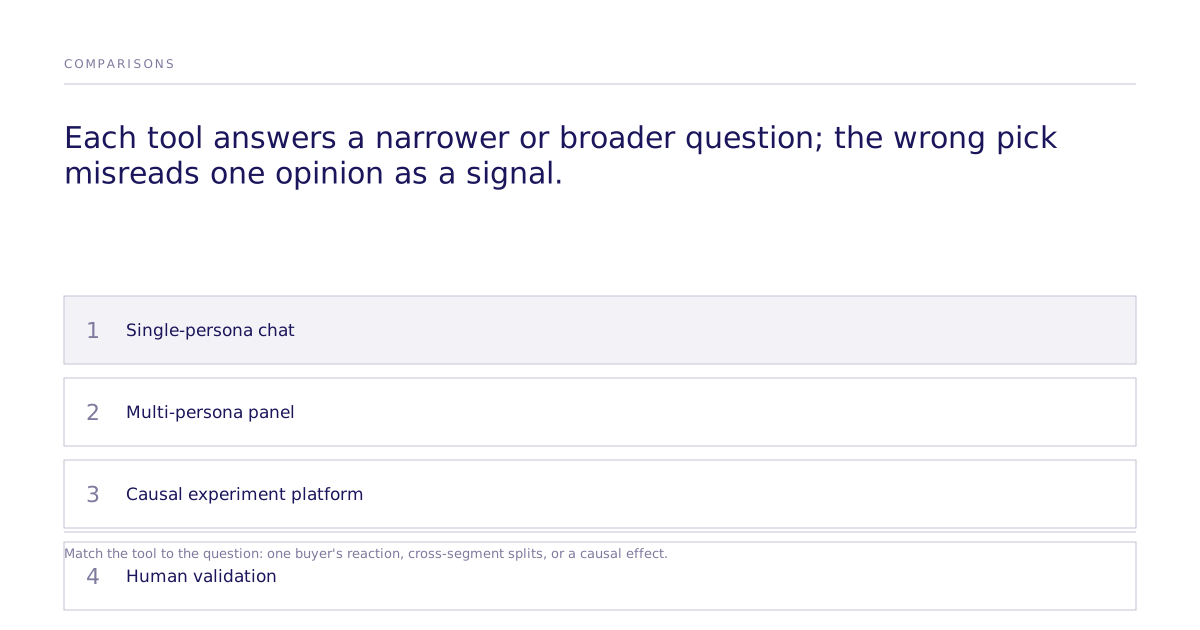
A team comparing AI-persona research tools usually asks which tool is better. The question that actually decides the purchase is narrower: does it need one persona's read on a message, or does it need to see where several distinct segments or stakeholders diverge in reaction? Those are two different jobs, and the tool categories built for them look similar while answering different questions.
Why this decision matters
A single-persona conversational tool lets a team question one simulated buyer about messaging, objections, or positioning: describe a buyer, ask it questions, read its answers. That fits a marketing team stress-testing ICP language before a campaign goes out.
A multi-persona panel platform is built around a different unit: a group of simulated participants reacting together, so a team can see where a customer segment, a set of stakeholders, or a panel of reviewers agrees and where it splits. That fits an agency prepping a pitch for a buying committee, or a product team checking whether a concept lands the same way across segments.
Treating a single-persona chat output as a cross-segment read is the costly mistake: a conversation with one simulated buyer is one simulated viewpoint, and mistaking it for a representative signal across a market, or for a decision a buying committee will reach, produces a call built on one opinion with no way to see where segments disagree. The reverse mistake also happens: paying for a full multi-persona panel platform for a quick single-persona sanity check on one line of copy is over-scoped spend.
What causes the difference in outcome?
The difference is structural, not a matter of polish. A single-persona tool holds one viewpoint in the room, so there is nothing to compare it against. A multi-persona panel exposes several simulated viewpoints to the same message, concept, or pitch and captures their reactions side by side, which is what lets a team see agreement and disagreement across a segment or stakeholder group, no matter how good the one persona's answers are.
Neither tool category is wrong for its job. A single-persona tool that only needs to stress-test one message against one described buyer solves that problem well; it does not need to become a panel to do it.
Evidence
Recent work on using large language models for choice modeling finds that prompting strategy and model choice materially change how closely an LLM-based persona approximates real decision behavior (Frank et al., arXiv 2025), a caution against treating one fluent persona conversation as a calibrated behavioral estimate. Separately, foundation models built to model human cognition broadly are a different object than a model built to estimate a specific behavioral treatment effect for a specific population (Nature, 2025); breadth of cognitive modeling is not the same claim as accuracy on one defined decision.
Subconscious runs controlled discrete choice experiments on synthetic populations and reports causal effects with confidence intervals, built for the cross-segment, multi-stakeholder version of this question rather than single-persona dialogue. These figures are published in full, misses included, because the misses sit on the same leaderboard as the hits. Subconscious's best configuration reaches 87% of the measured human ceiling on one study: 0.832 rank correlation against the published human result, where two independent samples of real humans reach 0.959. Across all 43 studies that pass design filters the mean is 0.73. See the causal fidelity paper for the method. It is a validation result, not a guarantee for a new market. Where the decision depends on it, a team can move from that simulated experiment to real-human validation without changing the causal question. See the replication leaderboard for how the experiments and validation work.
The line between simulation output and validated human data is published so a buyer can check which step a given claim rests on. A simulated panel result is simulation output; it becomes human-validated data only once the separate validation step runs. Audience reach, a simulated experiment, and recruited real-human validation are three distinct steps, and a comparison that blurs them into one claim is misleading.
Options and comparison
| Tool type | Core unit | Typical buyer | What it tells you |
|---|---|---|---|
| Single-persona conversational tool | One described buyer persona, held in dialogue | Demand-gen and marketing teams testing one message | How one simulated buyer reacts to one message or objection |
| General multi-persona panel platform | A group of simulated participants reacting to the same input | Agencies, product teams, and marketers checking cross-segment reaction | Where a panel agrees or diverges, without a controlled causal comparison |
| Causal decision platform (Subconscious) | Controlled discrete choice experiment on a synthetic population, validated against real human behavior | Product, pricing, and go-to-market decision-makers | Which action causally moves buyer behavior, with a confidence interval |
When should you use each tool?
Choose a single-persona conversational tool when the job is scoped to one-on-one buyer dialogue before a campaign ships. The narrow focus is a feature there, not a limitation.
Choose a multi-persona panel platform when a descriptive read of where a segment or stakeholder group agrees and diverges is enough for the decision at hand.
Choose a causal decision platform when the decision has real cost if you get it wrong and needs an estimate of which action changes behavior, not just a description of reactions. That is the how we work fit: a controlled experiment against the specific action under consideration, with a result that reports its confidence.
Recommended decision process
Start with the question, not the tool. Write down whether it is "what does one buyer think about this" or "how do different segments or stakeholders diverge." A single-persona conversation answers the first; a panel read answers the second descriptively. Neither answers "which action will actually change behavior," because that requires a controlled comparison across actions, not just reactions to one input.
If the decision is a launch, a price, or a positioning choice with real cost attached to being wrong, treat the descriptive read as a starting hypothesis and take the causal question to a platform built to test it. Book a walkthrough to see how a controlled experiment maps onto a specific pricing, messaging, or launch decision.