Social Listening vs. Causal Testing: When Is Signal Enough to Act On?
A team running social listening has a real signal: what people are saying about a category, a competitor, or an emerging trend. The open question is whether that signal is enough to greenlight a specific action, a new message, a repositioned product, a price change, or whether the action needs a controlled test first.
Confusing the two research categories is the actual risk: observed sentiment tells you what already happened in the market, not what will happen if you ship a message nobody has reacted to yet.
What social listening actually measures
Quid's current platform combines consumer and market data with monitoring, analysis, and predictive tools. This comparison concerns the observational listening workflow: what appears in collected discussion and how that discussion changes.
This is observational research. It reports what real people have already said, without asking anyone a new question. It fits brand tracking, crisis monitoring, and spotting a trend before a competitor names it.
Where does the signal run out?
Observed sentiment can inform a proposed headline, price, or concept. It does not alone identify that specific intervention's effect. A favorable trend and a successful new offer are different claims, even when the trend is accurately measured.
A launch built on the assumption that current sentiment predicts the reaction to a new, specific action can fail with no way to trace which variable caused the miss. The reverse mistake carries its own cost: running a full controlled experiment for a question ongoing monitoring already answers wastes cycles that belong on the next test.
What does a controlled causal experiment add?
A controlled choice study changes defined alternatives under an assignment procedure and estimates a contrast on the specified outcome. With synthetic respondents, that contrast concerns generated choices. Confirm the estimator and uncertainty method before asking "which version changes choice, and by how much?"
For a Subconscious study, request the population definition, generator configuration, alternatives, and analysis. A separately scoped human follow-up checks transfer, with an aligned causal question and documented changes to the instrument.
Comparing the two approaches
| Social listening | Controlled causal experiment | |
|---|---|---|
| Question answered | What appears in collected audience discussion? | How do defined alternatives change the study's measured choice? |
| Signal type | Real conversation, observed at scale | A designed comparison with a measured effect |
| Evidence produced | Discussion metrics, subject to coverage and classification | A contrast on generated choices, with design-appropriate uncertainty |
| Boundary | Observed discussion alone does not identify a new intervention | The task may not represent market behavior or the target population |
| Best use | Monitoring trends and forming relevant hypotheses | Comparing specific alternatives, followed by appropriate transfer checks |
Use both, in sequence
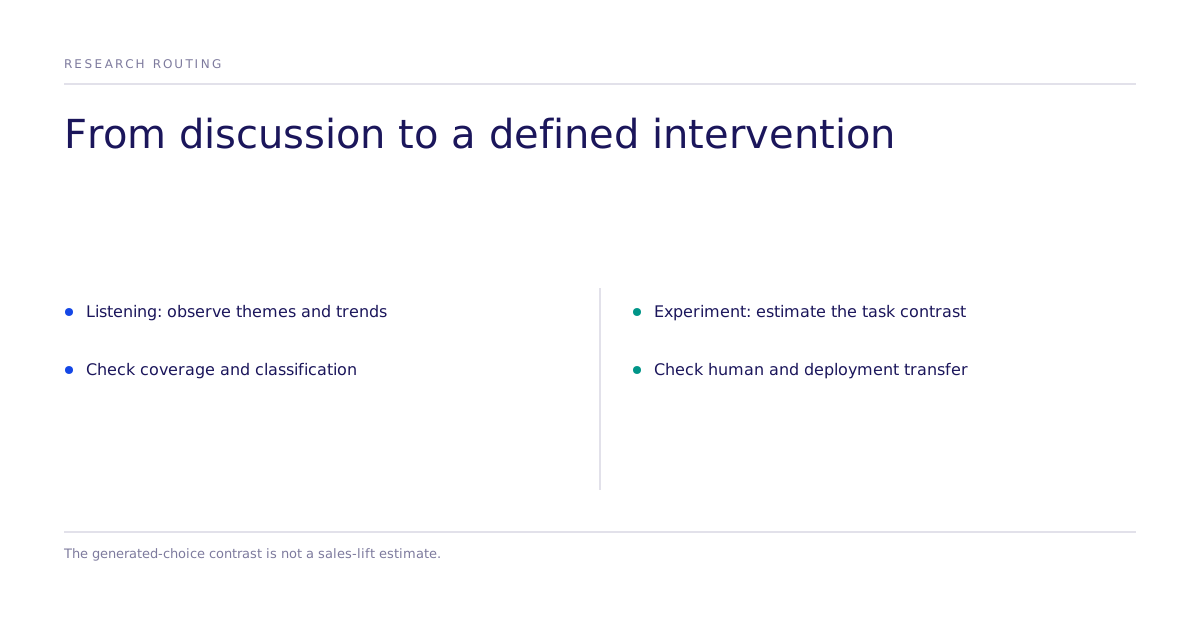
Use listening to identify concerns worth investigating. A controlled study can compare responses to those concerns. Human evidence checks task transfer; a live-market test adds evidence about actual deployment behavior.
For a team already running social listening, the practical move is not to replace it, but to add a testing step for any action specific enough that no one has reacted to it yet. See how Subconscious runs a study, or review published results and case evidence.
Limitations
A bounded choice study and an ongoing monitoring feed have separate requirements. Confirm the engagement scope for each. Generated respondents are not a standing consented human panel, and the quality of a human follow-up still depends on sampling and design.