Structured Study, Synthetic Conversation, or Causal Experiment: Which One Answers Your Decision
A pricing, packaging, positioning, or launch decision needs a study that measures the relevant comparison. Structured surveys can include randomized experiments; conversation can help generate alternatives. The risk is approving an action from an output that did not test the required contrast or endpoint.
Three research tasks can share a platform
Before picking a platform, name the question being asked. Three shapes come up repeatedly in consumer and B2B research:
- A structured, study-shaped question. "How does this segment rate five concepts on a fixed set of attributes?" This fits a survey-and-respondent model with a report at the end.
- An open-ended, conversation-shaped question. "What does this segment think about this idea, and why?" This fits a free-form dialogue where a researcher can follow up on a surprising answer.
- A controlled comparison. "How does a defined price, message, or feature change the measured outcome?" This requires appropriate assignment, alternatives, and analysis; it can be implemented within a structured survey.
Study format and experimental design are separate properties. Ratings, hypothetical choices, and actual behavior are different endpoints. Randomization can identify an effect on the elicited outcome; it does not automatically establish a change in purchases.
Where does stated preference break down?
Maier and colleagues' purchase-intent study evaluates synthetic Likert responses against human personal-care product surveys. Its results concern stated purchase intent, rather than observed sales. Performance on that task does not establish validity for an arbitrary free-form conversation or a new launch intervention.
A discrete choice experiment presents trade-offs and estimates preference parameters from the selected alternatives. Columbia's methods guide distinguishes hypothetical stated choices from recorded revealed choices. A controlled hypothetical choice still needs relevant human or behavioral validation before extrapolation to market action.
Comparison at a glance
| Method shape | What it produces | Fits best when | Where it runs out of road |
|---|---|---|---|
| Unrandomized ratings study | Ratings or rankings under a fixed protocol | Describing attitudes toward concepts | Ratings alone do not identify the effect of changing an attribute |
| Open-ended synthetic conversation | Free-form persona responses to a prompt | Early-stage discovery, hypothesis generation, exploring how a segment talks about a concept | Still stated preference; a fluent answer isn't evidence the choice would hold under real trade-offs |
| Controlled comparison, including a randomized survey or DCE | An estimate on a defined outcome under the chosen assignment and analysis | Comparing shortlisted alternatives | The claim remains limited by the sample, design, and whether the endpoint is hypothetical or observed |
How does Subconscious test the causal question?
Subconscious's synthetic choice method compares generated responses under controlled tasks. The public causal-fidelity paper evaluates agreement in estimated choice-parameter rankings with human replications. It does not establish effect-magnitude calibration or actual sales behavior for every new experiment.
Plan a human follow-up around aligned populations, alternatives, outcomes, and analysis. Document instrument differences and allow for an inconclusive or contradictory result.
What are Subconscious's limitations?
Open-ended exploration, descriptive surveys, and controlled comparisons serve different requirements. Intervals and segment analyses require suitable samples and estimators. Public parameter-rank validation does not replace a buyer-specific transfer check.
Matching the method to the decision
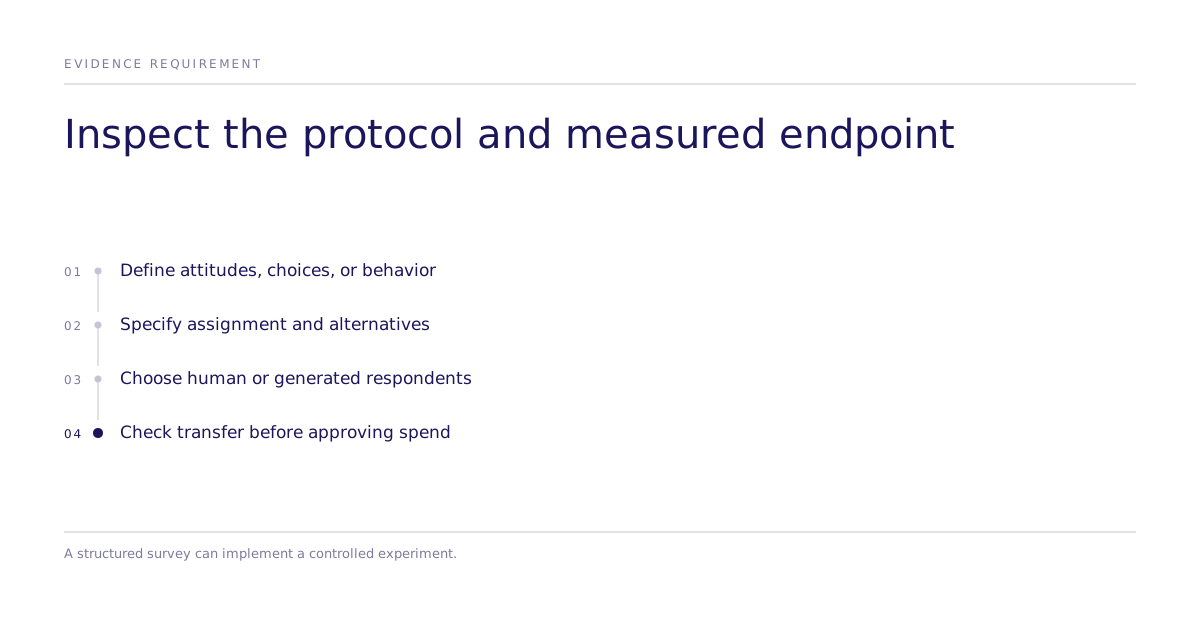
Three questions decide which tool fits:
- What is the endpoint? Distinguish attitudes, hypothetical choices, and observed behavior.
- What comparison does the decision need? Use appropriate assignment and alternatives when estimating an intervention.
- What would justify the spend? Set practical thresholds and require human or deployed-behavior evidence matched to the claim.
Where the decision is real and reversible mistakes are costly, run the causal comparison before the spend, not after the launch.
Explore how the method works, see it applied in the research library or the leaderboard, or book time to walk through a live experiment.