Synthetic Dialogue or Real Interviews: What Can Justify a Market Decision?
A synthetic panel can help a team explore how a simulated customer might respond. An automated interviewer can capture what a real respondent says. Neither transcript alone establishes which concept, price, or message will cause a better market outcome. A launch decision needs evidence matched to the action and the cost of choosing poorly.
Match the method to the decision
The useful distinction is not synthetic versus human. It is the question each method can answer.
| Research method | Evidence produced | Best buyer use | Decision boundary |
|---|---|---|---|
| Synthetic dialogue | Generated conversation, themes, and possible reactions | Exploring hypotheses and language before a decision is defined | No recruited customer made the statement, so the output cannot carry a launch approval |
| Automated interview | Real respondent testimony and stated reasoning | Discovery and verbatim customer voice | What someone says they would choose is not the measured effect of taking the action |
| Causal behavioral experiment | A controlled comparison between defined alternatives | Choosing a concept, price, message, or position before committing budget | The team must define the decision, alternatives, audience, and outcome |
Generated dialogue is not a record of what a recruited customer said, a limitation also made explicit in this first-party case for real customer research.
Discovery and launch approval need different evidence
An automated interview can collect real participants' testimony and follow-up answers. That supports customer language and discovery, provided eligibility, consent, sample selection, and transcript handling are appropriate. Delivery need not be a scheduled live session.
A transcript records stated reasoning. It does not automatically estimate the effect of changing a price, concept, or message while holding other conditions constant. Use interviews to sharpen the alternatives, then choose a comparison matched to the required endpoint.
The cost of confusing those jobs is material. Generated conversation can sound authentic even when no customer said it. Real testimony can sound decisive even when the study did not isolate the action. Either mistake can put launch budget and the go-to-market window behind the wrong choice.
What question does a controlled comparison change?
Subconscious's controlled synthetic choice method compares defined alternatives under a common task. It estimates a contrast on generated responses; the buyer's protocol determines which decision the result can inform.
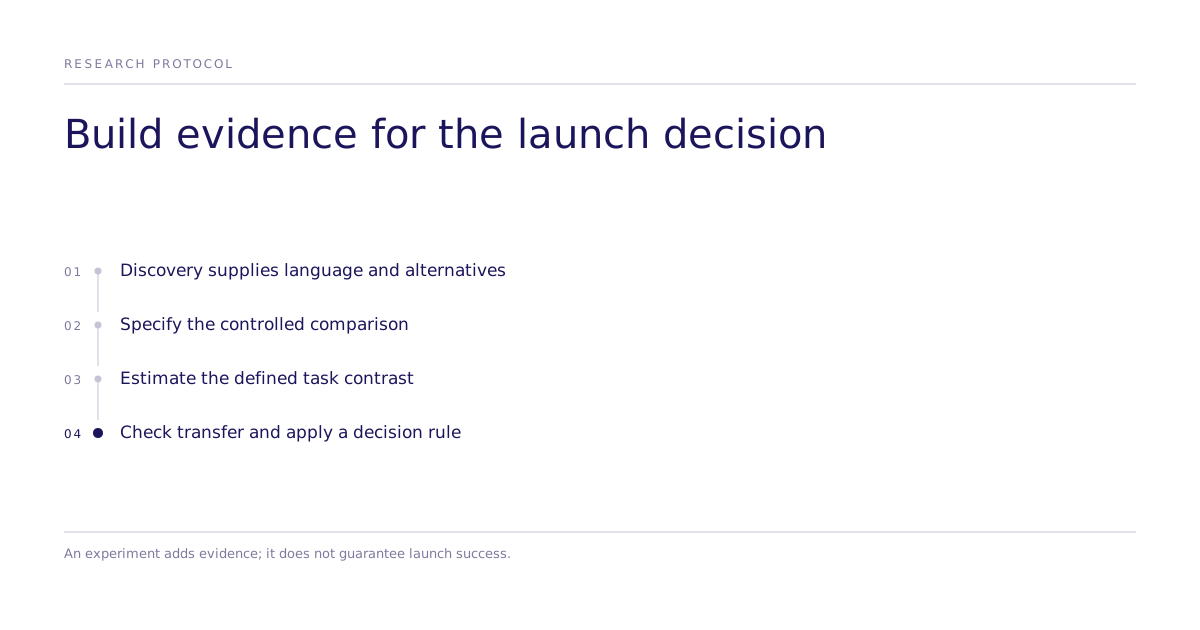
A bounded comparison needs concrete alternatives and a specified outcome. Hypothesis development and study design may be separate parts of the engagement; confirm the current scope.
What can the evidence carry and not carry?
The causal-fidelity working paper evaluates estimated choice-parameter rank agreement across human and synthetic replications. Inspect the design filters and study-level limitations in the validation record. That endpoint does not establish effect magnitudes or launch success for the buyer's study.
A human follow-up should align population, alternatives, outcome, and analysis where feasible. Record task and instrument changes to assess transfer, and retain contradictory or inconclusive findings.
Request audience definition, data provenance, and generator configuration for the proposed synthetic study. Modeled respondents are not a standing recruited panel.
Capturing verbatim customer voice requires actual participants. Intervals, segment estimates, and willingness-to-pay depend on study design and sample support; confirm the proposed outputs before procurement.
What is the right sequence for each method?
Use dialogue to develop hypotheses and real interviews to investigate lived experience and customer language. Add a controlled comparison when the decision requires an intervention estimate. Set the evidence threshold and relevant human or deployment check before consequential spend.
The practical next move is to write the decision as alternatives, audience, outcome, and cost of being wrong. The study workflow shows how that comparison is designed. When the choice is concrete enough to test, scope the decision.