Synthetic Panel Tools vs. Fielded Real-Respondent Research: How to Sequence Testing
A synthetic study uses generated responses; a fielded study uses recruited participants. Either can include controlled alternatives. Choose the sequence from the sample, design, and endpoint needed for the concept, price, or message decision.
Dig One's April 2026 introduction describes Upsiide as its study creation and execution tool for consumer research. The Share of Choice Simulator guide describes analysis of conjoint or MaxDiff study data. Inspect the actual fielded protocol and sample instead of treating the platform as inherently correlational.
Why this decision matters
An aggregate benchmark and a human sample answer different questions from a buyer-specific action comparison. Obtain scoped delivery and cost estimates, and examine whether the actual study randomizes relevant alternatives and measures the required endpoint.
A high aggregate score can conceal failures in a particular audience or task. Inspect study-level results, excluded cases, response distributions, and subgroup performance before using a benchmark to screen concepts.
What causes synthetic panels to diverge from real behavior?
Generated responses can depend on the model, supplied information, prompt, and sampling procedure. Inspect performance under the proposed configuration. A synthetic workflow can contain a randomized experiment, but its estimated contrast still concerns generated responses until transfer is evaluated.
A human study supplies actual participant responses. It still faces sampling error, nonresponse, inattentive answers, and a gap between hypothetical choices and purchases. Sound recruitment does not by itself identify an intervention or guarantee generalization.
Neither limitation is fatal, but both are reasons to be precise about what each method is evidence for.
What does an accuracy score actually measure?
An accuracy percentage needs a metric definition, denominator, study set, and uncertainty. Correlation measures association; exact agreement measures matches; calibration asks whether predicted levels or probabilities align with observed outcomes. None can be inferred from an unspecified percentage, and good average performance can coexist with a miss on the decision's specific comparison.
Subconscious's public causal-fidelity paper evaluates rank agreement between estimated choice parameters. Rank agreement does not establish calibrated effect magnitudes or sales lift. Request matched effect-scale evidence before making either claim.
Comparing the three approaches
| Dimension | Fast synthetic panel tools | Fielded real-respondent research | Subconscious causal experiments |
|---|---|---|---|
| Measured response | Generated answers or choices under the task | Answers or choices from participating people | Generated choices under a defined experimental comparison |
| Design to inspect | Can be descriptive or randomized; verify assignment and alternatives | Can be descriptive or randomized; verify assignment and alternatives | Verify assignment, alternatives, endpoint, and estimator |
| Relevant checks | Configuration, distributions, sample assumptions, and human transfer | Eligibility, sample quality, nonresponse, precision, and endpoint | The same design checks plus generator bias and human transfer |
| Generalization boundary | New audiences or tasks may diverge from a benchmark | Hypothetical choices may diverge from market behavior | A generated-choice effect is not a commercial effect magnitude |
| Sequence | May screen candidates before a human study | Can run directly or validate a synthetic screen | Use when the required comparison and study scope support it |
A recommended decision process
- Frame the decision, not the tool. Name the specific action being tested (a price, a claim, a concept), the population, and the outcome that matters.
- Use a synthetic screen when it helps narrow options. Pre-specify the screening rule and check some rejected options with people if false negatives would be costly.
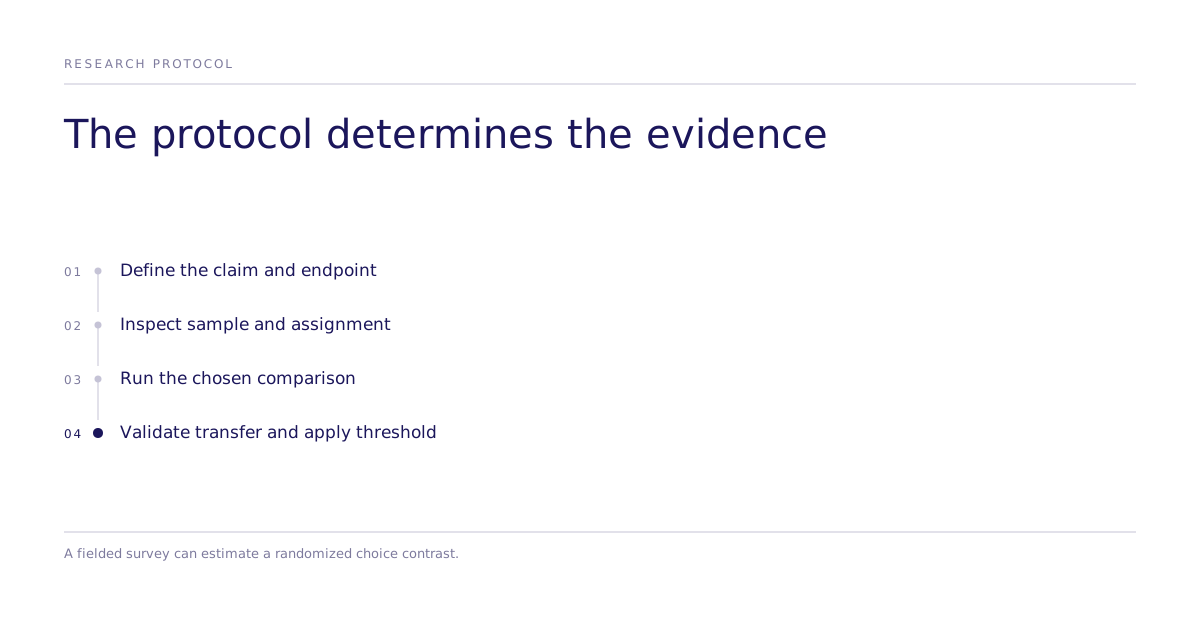
- Use a controlled comparison for an intervention claim. Inspect assignment, alternatives, endpoint, and analysis in either a human or synthetic study.
- Require validation matched to the consequence. Human evidence may be needed beyond regulated or board-level decisions. Sampling, consent, and documentation requirements depend on the claim and applicable standard.
The third option between "fast score" and "fielded sample"
Subconscious's synthetic choice method can support a bounded action comparison. Its result needs a clearly defined endpoint and relevant validation. Inspect research methodology, the study workflow, and decision examples, or scope the specific comparison.
What can't these three methods do alone?
Population definition, generated responses, and human fieldwork are separate requirements. A human sample can implement the same controlled choice question while introducing task or sampling differences that must be documented. Neither source alone establishes market performance.
Adjacent questions
Can synthetic and fielded methods be combined? Yes. A common pattern narrows a wide set of options with fast synthetic methods, then moves it to a fielded or causal test before committing budget. The mistake is skipping that second step for a confident-looking number.
Does a high accuracy percentage mean a synthetic tool is ready for this decision? Inspect the metric, denominator, study set, and uncertainty. The score does not by itself establish intervention identification, effect calibration, or transfer to this audience.
Is a synthetic choice experiment a clinical or usability study? The endpoint and study design determine that classification. A human follow-up on a choice task does not establish clinical safety, observed product use, or automatic market performance.