UXPressia vs. Subconscious: Journey Maps vs. Behavioral Experiments
UXPressia and Subconscious answer different parts of a product decision. Choose UXPressia when the team needs persona documents, journey maps, or impact maps. Choose Subconscious when the team needs to estimate which product, message, or journey action is likely to change a defined behavioral outcome. A map organizes what the team believes; an experiment tests whether that belief survives a choice.
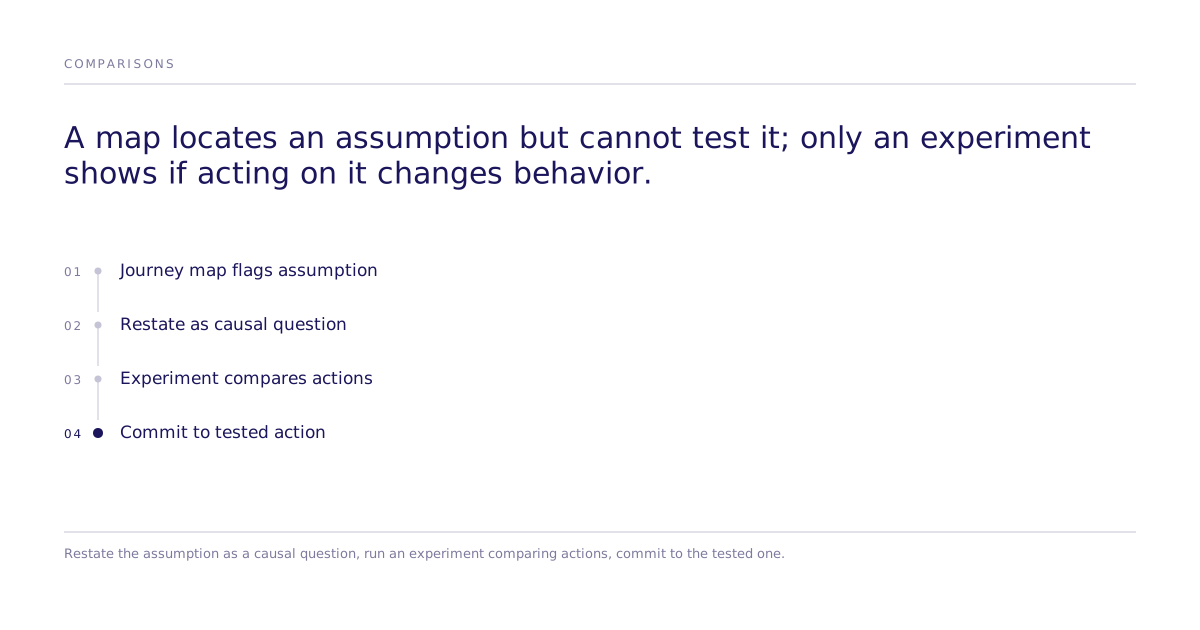
The distinction matters when a team must commit roadmap capacity, research budget, or brand equity. A journey map can locate an assumption but cannot establish causation.
Start with the deliverable
UXPressia presents itself as a customer experience management and journey mapping platform (UXPressia). Its value is the shared artifact: a persona, journey map, or impact map used in workshops or stakeholder reviews.
Subconscious is a causal behavioral platform that runs controlled experiments on simulated markets to estimate which action is likely to move a specific outcome, and reports uncertainty where the study design supports it.
| Decision need | UXPressia | Subconscious |
|---|---|---|
| Primary job | Document a persona and map a customer journey | Test a specific product, message, or journey action |
| Core output | Persona documents, journey maps, and impact maps | A causal estimate from a controlled behavioral experiment |
| Best fit | Workshops, design briefs, and stakeholder alignment | Roadmap, messaging, and journey choices that depend on behavior |
| Evidence boundary | Organizes a team's assumptions; does not test an intervention | Estimates an intervention's effect; does not guarantee a launch outcome |
| What it does not replace | A behavioral experiment | A visual mapping or design-collaboration workspace |
The expensive mistake is treating a map as evidence
A persona might say first-time buyers value simplicity, and a journey map might identify onboarding as where that belief matters. Neither artifact tells the team whether a shorter, guided, or current onboarding flow will change completion behavior.
If the team treats the map as the answer, it can ship a redesign built on the author's best judgment and discover after launch that behavior diverges from the documented profile. The team still has no experimental record showing which action was tested.
Turn the mapped assumption into a decision: which action should change, compared with what alternative, for which buyers, against which behavioral outcome?
How do you design a useful causal test?
For a journey decision, keep the audience, outcome, and context fixed, then compare alternative actions. The result should answer the commitment question directly, such as which onboarding flow is more likely to increase completion or which message is more likely to change product choice.
Subconscious does not build or export visual persona documents, customer journey maps, or impact maps, and is not a design-collaboration workspace. Confidence intervals, segment heterogeneity, and decision memos depend on the study; none are standard packaged outputs.
How accurate is Subconscious's causal fidelity?
Subconscious's causal fidelity paper shows its best configuration reaches 87% of the measured human ceiling on one study: 0.832 rank correlation against the published human result, where two independent samples of real humans reach 0.959. Across all 43 studies that pass design filters the mean is 0.73. This is evidence about Subconscious's validation, not a score assigned to UXPressia or a promise that any single launch will match the estimate.
When a decision needs further confirmation, a team can move from a simulated experiment to real-human testing without changing the causal question. That step validates the experiment against recruited participants; it does not become an observed usability session or automatically prove market performance.
Can you use UXPressia and Subconscious together?
Use UXPressia to make the persona and journey legible to the team; identify the assumption that carries the investment decision. Use Subconscious to compare the actions encoded in that assumption.
This division also clarifies procurement: buy a mapping workspace for artifacts and collaboration, and use a causal behavioral platform when the cost of choosing wrong justifies a controlled test. Review how Subconscious structures studies and its case studies before deciding whether the method fits.
If the open question is which product, message, or journey action to commit to, book a demo with the alternatives and behavioral outcome already defined.