What Comes After a Persona Document Like Make My Persona
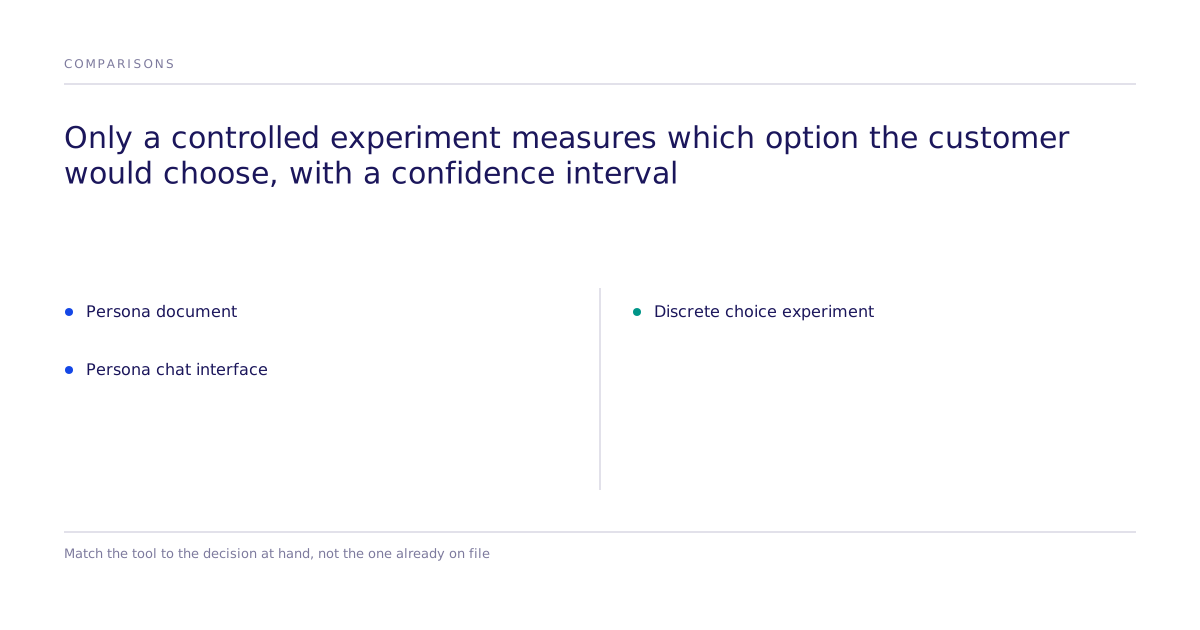
A team that has already built a persona document is not asking "what is our customer like." It is asking a sharper question: which message, price, or feature framing will that customer actually choose. A one-page document cannot answer that. Neither can a chat window that lets you type questions at a simulated customer.
What does a persona document do?
HubSpot's free persona generator walks a user through a guided form, then styles the answers into a single page carrying a name, demographics, goals, challenges, and a stock photo. It ships in about 15 minutes at no cost, and marketing teams have used it to produce a large volume of first-draft personas (HubSpot's Free AI Persona Generator).
It is a reference document for sprint planning, onboarding, or aligning a team on who they are building for. It was never built to test a decision, and it cannot say whether price A or price B wins, or why one message beats another.
Three answers to "who is our customer," and what each one leaves open
| Approach | What it produces | What it cannot tell you |
|---|---|---|
| Static persona document | A one-page reference: goals, demographics, a photo | Which specific message, price, or feature wins, or why |
| Conversational persona interface | A plausible-sounding answer to any question typed in | Whether that answer reflects how real buyers would choose, since there is no controlled comparison or confidence interval behind it |
| Controlled discrete choice experiment | A measured causal effect on an actual decision, with a confidence interval | Open-ended, exploratory ideation before a team knows what it wants to test |
The middle row is where most teams land once they outgrow a static document, and it is also where the risk hides. A transcript from a simulated persona can sound specific and confident with no way to check whether it reflects real buyer behavior. Building a launch, price, or pitch on that transcript carries the same risk as building it on a guess.
What does a controlled experiment add?
Subconscious runs controlled discrete choice experiments (McFadden DCE, Mixed Logit, ICLV) against a defined set of choices, then reports which option moves the outcome and by how much, with a confidence interval attached: a measured comparison, not one plausible response.
/research documents the experiment design, and the leaderboard is the running record of how simulated results compare against real human studies, including where they miss. A score with no boundary attached is marketing copy. The leaderboard publishes where simulated results miss right next to where they hit, so a buyer can check the method before trusting the number. Our best configuration reaches 87% of the measured human ceiling on one study: 0.832 rank correlation against the published human result, where two independent samples of real humans reach 0.959. Across all 43 studies that pass design filters the mean is 0.73. It is a validation result, not a guarantee for a new market. See the causal fidelity paper.
When a decision is big enough to justify it, a team can move from a simulated experiment to a real-human validation study without changing the underlying causal question: the same experiment design carries forward, so a team does not have to treat "fast and simulated" and "slow and real" as two unrelated projects.
Where this does not fit
Naming the case where a method does not apply is what lets a buyer check it before spending budget on it. A defined choice set and a decision worth testing are prerequisites. A team still doing open-ended, exploratory persona work, before anyone has settled on the message or price to test, has nothing yet to compare. That is still the job for early ideation and a lightweight, shareable persona document.
Stating the exact shape of the output keeps a buyer from judging it against the wrong yardstick. This is not an open-ended interview with a single simulated persona. The output is a measured effect across a defined set of options, not a conversation transcript.
Deciding which one to use
- Need a shareable reference document for internal alignment: a free persona generator is the right, fast tool.
- Need to explore a customer segment before knowing what to test: stay in open-ended research.
- Have a specific message, price, or feature decision and need to know which option wins, and why, before committing budget: that calls for a controlled discrete choice experiment.
Teams in the third case can see how the process runs or book a walkthrough.