What Hotjar Can't Tell You About Why Users Leave
Say your dashboard shows a 67% drop-off on the pricing page. Hotjar can show exactly where visitors stall and where they leave. It cannot tell you whether they left because the enterprise plan looked expensive, because the feature list confused them, or because a competitor's page made a clearer case. That gap is where a product or growth lead who already runs Hotjar has to decide: keep guessing and ship a redesign on faith, or test the candidate fix before spending engineering time on it.
What behavioral analytics actually observes
Hotjar captures real visitor behavior on a live site: heatmaps, session recordings, and funnel reports showing where a flow breaks down (What Is Hotjar? Key Features & Why You Should Use It). Recordings track clicks, scrolling, and mouse movement, showing what a visitor did rather than what they say they did (Watch Users Scrolling, Moving, And Clicking With Recordings).
A capability is only useful to a buyer once its edges are stated plainly. That data comes straight from live traffic, but it is strictly retrospective. It tells a team what happened after the fact, on the page as currently built. It cannot run a page that doesn't exist yet, and it cannot ask a visitor why they hesitated on the way out.
The guess that follows the drop-off
A 67% drop-off is a fact. The reason for it is a hypothesis. Was the price too high? Was the enterprise tier unclear? Was the visitor just comparison shopping? Behavioral analytics narrows down where to look; it does not settle which of several plausible causes is the real one.
Teams that only have behavioral data tend to pick the most plausible-looking cause, redesign around it, ship, and wait weeks to find out whether the guess was right. When it wasn't, the engineering cycle is gone, and the team is back to guessing.
How do you test the cause before committing engineering time?
This is the decision a causal experiment is built to shorten: test the candidate explanations and candidate fixes before shipping a guess. Subconscious runs controlled experiments on simulated audiences to test whether a specific change, a different price point, a rewritten claim, a reframed feature, actually changes the decision, with confidence intervals where the study design supports them.
This does not replace what Hotjar does. It sits upstream of it. Hotjar finds where the drop-off happens and confirms whether a shipped change moved the number. A causal experiment tests which of the candidate explanations actually holds, and which fix addresses it, before anything ships.
Where each approach stops
Listing what a method can't do next to what it can is what makes the claim checkable. A causal experiment run on a simulated audience does not replace continuous behavioral monitoring, and it does not observe real clicks or scroll behavior on a live page; only an instrumented site with real visitors can do that. It also isn't a usability study or a clinical trial: it stays a test of which action changes a decision.
A limit stated in plain terms is what turns a claim into something a buyer can verify. The reverse limit holds too. Behavioral analytics cannot test a page that hasn't been built, cannot ask a visitor to explain a choice, and cannot isolate one variable, price, wording, framing, from every other thing that changed between two live sessions.
| Behavioral analytics (Hotjar) | Causal experiment (Subconscious) | |
|---|---|---|
| What it measures | Real visitor behavior on a live page | Whether a specific change moves a decision |
| Requires | Live traffic on the actual page | A candidate change to test, before it ships |
| Answers | Where visitors dropped off, whether a shipped change worked | Which of several candidate causes or fixes actually matters |
| Cannot do | Explain why, or test a page that doesn't exist yet | Replace continuous monitoring of real clicks and scrolls |
When should you confirm a result with real people?
When a decision is significant enough to warrant it, a team can move from a simulated experiment to real-human validation, carrying the same causal question into a study with recruited participants. Reach for it when a wrong call would be expensive; for smaller fixes, the simulated result and the next round of live analytics are usually enough.
How do you put behavioral analytics and causal testing together?
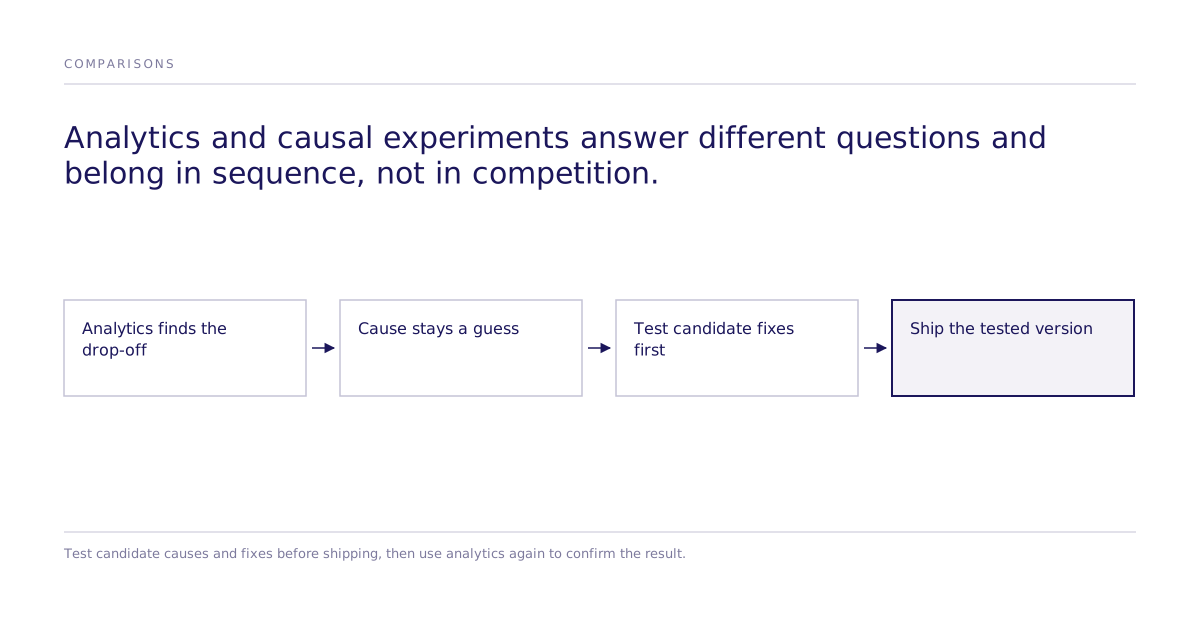
A workable loop looks like this: let behavioral analytics surface where the problem is, test the candidate causes and fixes before writing code, ship the version that held up under testing, then use behavioral analytics again to confirm it worked on real traffic.
Teams already running Hotjar don't need to replace it to close the observation gap; they need a way to test the fix before it ships. Subconscious's research method is built for that step, and how Subconscious works covers what a study looks like end to end. Examples of tested changes across industries are in the case studies, and a demo is the fastest way to see a study design against a real pricing or messaging question.