What to Use After HubSpot's Make My Persona
A marketing or product team that has already run HubSpot's Make My Persona template has a document, not a decision. HubSpot's template asks demographic, goal, and objection questions and produces a one-page profile at no cost. The real question for a team past that step is what the document is for next: better sourcing, a way to be questioned, or a test against a specific action the team is about to take.
What the free template gets right, and where it stops
HubSpot's template is a useful starting artifact for a first buyer profile. What it does not do is let a team check the profile against current customer records, question it, or find out how a messaging, pricing, or positioning choice lands with the buyer it describes. It is a static document that cannot be updated or verified without redoing the exercise by hand.
Three ways teams extend it
Teams outgrowing a static profile move one of three ways:
- Data-grounded profile generators. These rebuild the profile from CRM records, website analytics, or social signals, producing a document plus a behavior-data dashboard. The output is a document; it is better sourced.
- Conversational profile tools. These let a team pose questions to a modeled version of the profile and read back a plausible answer. They are fast to set up and useful for early-stage exploration, but a plausible answer is not a measured one, and most of these tools do not publish how the model's answers compare with what real customers say.
- Causal experiment platforms. These start from an existing profile or segment and run a randomized comparison of specific actions (a headline, a price point, a positioning statement) on a modeled population built from it, returning which action moved the outcome. Subconscious is in this third group.
| Approach | What it produces | What it answers |
|---|---|---|
| Static template (Make My Persona) | A one-page profile document | Who the buyer roughly is |
| Data-grounded generator | A profile plus a behavior-data dashboard | What the buyer's records show |
| Conversational profile tool | A plausible answer to a posed question | What the modeled buyer might say |
| Causal experiment platform | An estimated causal effect, compared across actions | Which action changes the buyer's decision |
A team choosing between them should start from the decision in front of them, not from which output looks most sophisticated.
Where does a causal test pick up after a profile is built?
A profile, however it was built, describes a buyer; it does not tell a team whether swapping one headline for another, or one price point for another, changes what that buyer does. That is what Subconscious tests for: once a team has a profile or segment defined, Subconscious runs a controlled experiment on a modeled population built from that segment to compare specific actions and estimate which one moves the outcome, with quantified uncertainty where supported.
Subconscious does not generate a persona document, and it does not offer a conversational interface for talking to a modeled buyer. It answers a narrower, later-stage question: which action wins, not what the buyer looks like on paper.
How do you move from a profile to a tested decision?
A causal question sometimes needs to move from a modeled population to real customers before it ships. Subconscious can test or validate a study with real human participants, carrying a question from a controlled experiment into human confirmation without redefining what is being measured. It follows the controlled comparison rather than replacing it, once the modeled result is worth confirming.
Choosing between the three
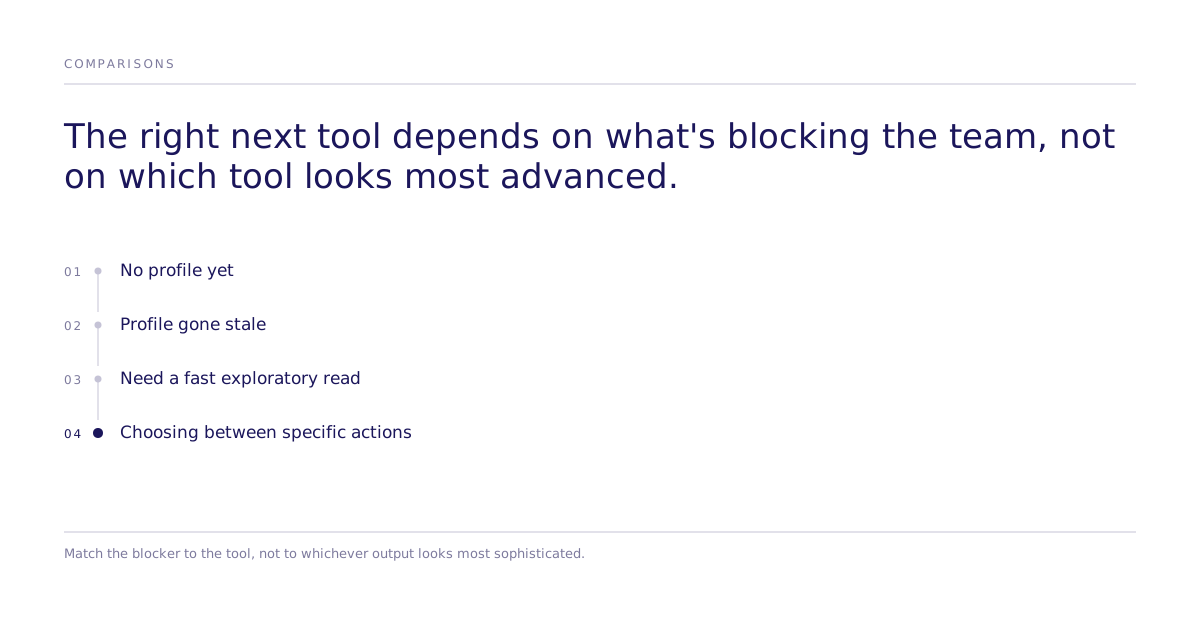
The decision comes down to what the team is stuck on:
- If the team has never built a buyer profile before, the free HubSpot template is the right first step; building a heavier tool on top of no profile is premature.
- If the profile exists but keeps going stale because it is disconnected from actual customer records, a data-grounded generator closes that gap.
- If the team wants a fast, exploratory read on how a modeled buyer might react to an idea, a conversational profile tool is the cheapest way to get one; its answer is a hypothesis, not a measurement.
- If the team already has a profile and is choosing between two or more specific actions, a headline, a price, a positioning line, and needs to know which one changes behavior, that is a causal test, not a profile exercise.
A profile that has never been checked against how buyers decide is a hypothesis about the market. A causal experiment turns that hypothesis into an estimate a team can act on before it commits budget to the wrong version.
See worked examples, or book time to walk through a specific decision.