9 Steps to Turn a Marketing Goal Into a Causal Experiment
Require a stated goal and a testable hypothesis before any team runs a comparison test. Skipping straight to a comparison produces a result nobody can interpret or act on, because there is no prior claim to confirm or reject against it.
Why this decision matters
A product, insights, or revenue-growth leader deciding whether to require this workflow is deciding who owns each stage of an experiment: what the team must define, and what a testing platform can carry out. Skipping the goal and hypothesis stage produces a pile of numbers with no stated cause attached, wasting the test cycle and the setup work behind it, whether that setup was a spreadsheet, a survey panel, or a causal-testing platform.
Naming the goal and hypothesis first makes a later result interpretable, in line with the broader argument for structuring strategic decisions around an explicit theory before testing it, rather than mining data for patterns after the fact (Design- and Theory-Based Approaches to Strategic Decisions, Organization Science).
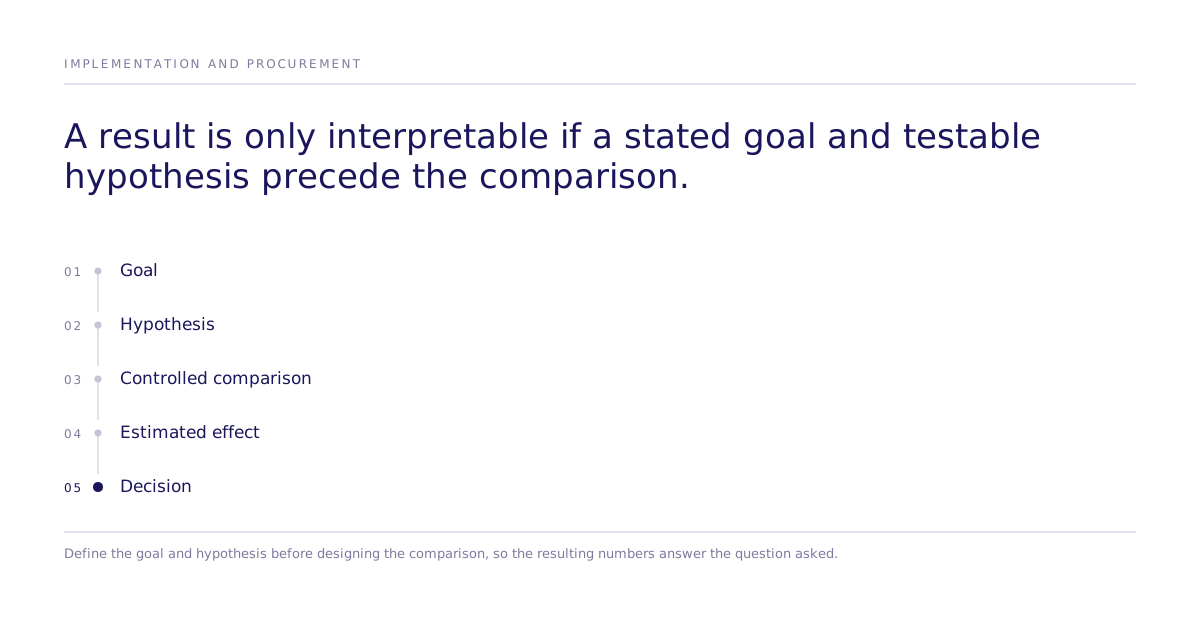
The 9 steps
1. Get clear on the goal
Start with the outcome that matters, not the tactic. Whether the question is which marketing message resonates with an audience, whether a new product feature moves the target behavior, or what shapes a segment's preferences, be specific.
Example: a team launching a product wants to know which message (affordability, innovation, or sustainability) gets millennials interested.
2. Turn the goal into a hypothesis
Convert the goal into a testable claim: what outcome is being measured, and what factor is being changed. For example, the claim might be that among millennials, leading with a sustainability message lifts product interest by 10%, naming both the outcome (interest) and the lever (message type), so the result can be judged as confirming, weakening, or reversing that claim.
3. Design a controlled comparison
A hypothesis needs a comparison built to test it, not a single message shown to one group. A controlled comparison, where audience members are assigned to different message versions and their responses are compared, separates what a message caused from what would have happened anyway. Subconscious supports building this kind of comparison directly: a team enters its hypothesis and the variables it wants to test, such as different message types, without hand-building the test design from scratch.
4. Choose the audience and the scenarios
Pick the audience the decision depends on, such as millennials, and set up the scenario variants the hypothesis calls for, such as a sustainability-led message against a price-led message. Subconscious runs these scenarios against a modeled audience built for causal experimentation, so the comparison reflects the segment the decision is about rather than a generic panel.
5. What happens when you run the comparison?
Once the hypothesis, audience, and scenarios are set, the comparison runs and produces a result set the team can analyze. The value of this step is not speed; it is that the comparison was built to test the stated hypothesis, so the resulting numbers answer the question the team asked in step 2.
6. Read the results by mechanism and segment
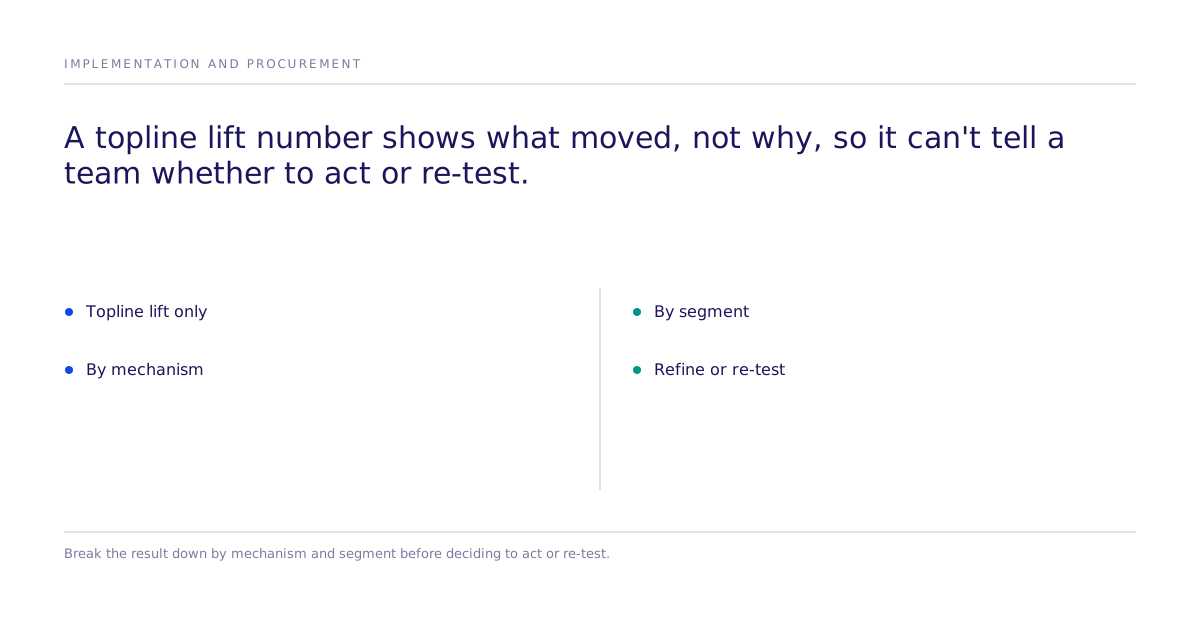
Look for which scenario moved the target outcome, and by how much, and whether different segments reacted differently. Subconscious's causal action testing and discrete-choice-style experiments estimate which action is more likely to move a stated outcome for the audience being tested, so a team can see whether a sustainability message worked because it aligned with a segment's values or because it stood out from what else was in market. Segment-level and uncertainty breakdowns beyond that estimate should be confirmed against current product documentation before a team relies on them, since coverage varies by experiment type.
7. Refine and re-test
A single comparison rarely closes the loop. Use what the first test showed to sharpen the hypothesis, test a narrower set of variables, or run a follow-up comparison on a segment that responded differently. Multi-stage, adaptive test designs, where an early round narrows the field before a more focused follow-up round, make a business experimentation program more efficient over repeated rounds (A case for conducting business-to-business experiments with multi-arm multi-stage adaptive designs, PMC).
"Our simulation results show that, compared to RCT, multi-arm multi-stage adaptive designs (MAMS) can reduce the sample size requirements and expected time to experiment completion whilst maintaining a similar level of statistical power."
Legare, Yao, and Lo, Journal of Marketing Analytics (source)
8. Turn the estimate into a decision
An estimate is only useful once it changes a decision: a marketing message, a product feature, or a pricing approach. Treat the causal estimate from step 6 as the basis for that choice, and be explicit about the confidence the estimate supports. Where a decision needs more certainty than a modeled comparison can offer, Subconscious can test or validate the same study with real human participants without changing the underlying causal question.
9. Why should the testing method stay privacy-conscious?
A modeled audience lets a team explore a sensitive or early-stage question, such as a controversial message or an unlaunched product, without exposing real customers to the test or collecting their personal data in the process. That is a practical advantage, not a substitute for the human validation in step 8 when a decision needs it.
What are the limitations of this method?
A stated goal and hypothesis do not guarantee a well-specified experiment; a poorly chosen comparison can still produce an unusable result. Not every scenario comparison qualifies as a randomized controlled trial, and treating one as if it does overstates the certainty of the result. Subconscious does not optimize price or promotions automatically, does not output substitution or cannibalization matrices by default, and does not replace real-human validation when the decision in front of the team requires it.
Next step
Read how the underlying method works in more depth on Research, see the workflow applied to a specific test on How We Work, or bring a live decision to a demo to see the comparison-design step firsthand.