Automating a Consumer Research Workflow Without Losing Rigor
Automating consumer research without losing rigor means matching each pipeline stage's automation level to its risk, letting back-end stages run automated while pricing and launch decisions still require a real human respondent. A research operations lead facing a growing backlog of ad-hoc requests has one real decision to make: which stage of the pipeline to automate first, and which decisions still require a real human respondent before the company commits budget to a price, a launch, or a message. Getting the sequence wrong costs more than time. Treating a directional, simulated result as final evidence for a high-stakes call can mean redoing a study after the decision is already public, with both the budget and the internal credibility of the research function spent.
Break the pipeline into stages before automating any of it
Consumer research is not one task. It runs through six distinct stages, and each has a different tolerance for automation:
- Request intake and briefing: translating a stakeholder's ask into a testable question.
- Hypothesis screening: narrowing many candidate claims, prices, or messages down to the few worth fielding.
- Questionnaire pretesting: catching confusing logic or biased phrasing before a live launch.
- Fielding and sample management: collecting responses and screening out low-quality ones.
- Open-ended response analysis: coding and clustering free-text answers.
- Reporting and synthesis: turning results into a decision memo.
The stages closest to the data collection back end, pretesting, coding, and draft reporting, tolerate automation well because an error there is caught internally before it reaches a stakeholder. The stages closest to strategic framing and final validation tolerate it far less, because the cost of a wrong or overconfident answer lands on the business decision itself.
How should you sequence automation across the pipeline?
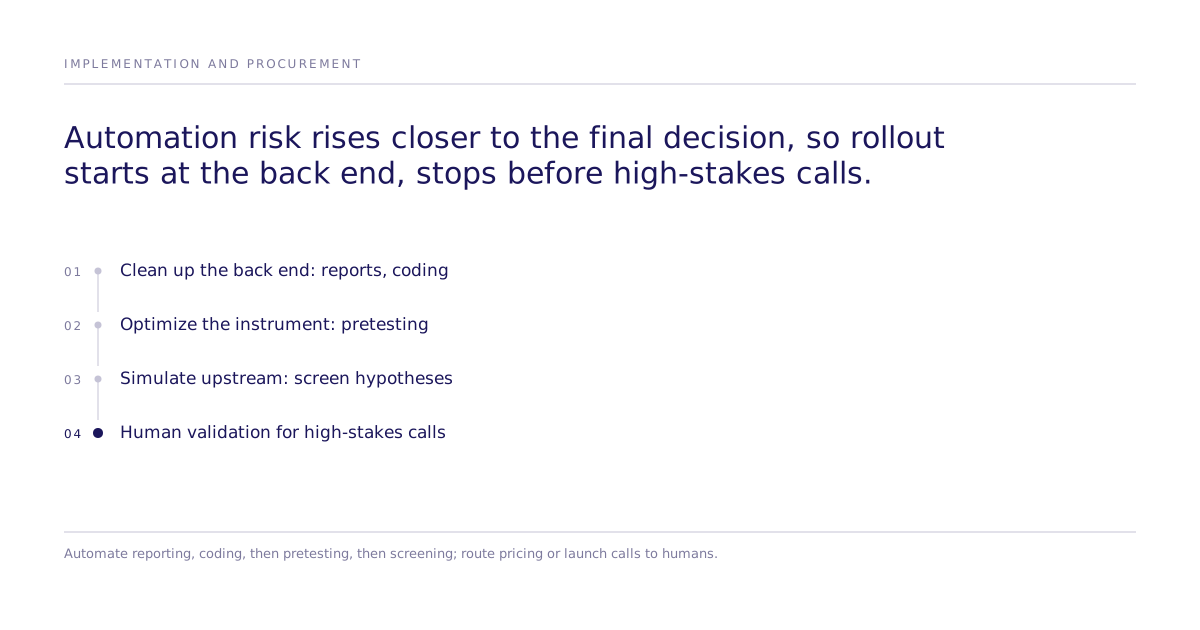
A phased rollout avoids the two most common failure modes: automating a stage stakeholders don't trust yet, and automating a stage where a hallucinated or biased result reaches a business decision unchecked.
| Phase | What to automate | Why it's lower-risk here |
|---|---|---|
| 1. Clean up the back end | Draft report generation, open-end coding | Internal-only output; errors are caught before a stakeholder sees them |
| 2. Optimize the instrument | Questionnaire pretesting against simulated respondents | Acts as an extra quality check on a study that still fields to real people |
| 3. Simulate upstream | Hypothesis and message screening across many candidates | Narrows the field before spending recruitment budget, not after |
Fielding itself sits in between: the physical act of a human answering a survey does not automate, but sample-quality checks and a synthetic first pass to cut the volume of paid human sample do.
Where a causal experiment fits, and where it doesn't
Generic AI persona chat can produce a fluent-sounding read on a message or a concept, but fluency is not evidence. A research operations lead comparing candidate hypotheses needs to know which specific claim, price, or message changes a target buyer's stated choice under controlled conditions, not which one an LLM found more persuasive to summarize.
Subconscious runs controlled discrete-choice experiments that compare defined alternatives, a claim against a claim, a price point against a price point, and reports which one produced a stronger response, rather than generating open-ended persona commentary. Used at the hypothesis-screening stage, this narrows a long list of candidates to the few worth fielding to a live panel.
A method's misses belong on the record next to its hits. Independent review of experiments with [synthetic respondents](https://measuringu.com/review-of-experiments-with-synthetic-users/) has found that digital-persona methods vary in how closely they track real survey results depending on the population and the question asked, a caution against treating any simulated output as a stand-in for validation on its own. A study on when digital personas reliably approximate human survey findings reaches a similar conclusion: approximation quality is condition-dependent, not a fixed guarantee.
Do not skip human validation for the decisions that matter
Automation is well-suited to directional research: narrowing candidates, catching a broken survey skip pattern, clustering open-ended text. It is not a substitute for a real human respondent when a pricing decision, a regulatory submission, or a major launch is on the line.
Subconscious can test or validate a study with real human participants when the decision warrants it, moving from a simulated experiment to real-human testing without changing the causal question being asked. That progression matters most at the exact point this pipeline creates the temptation to skip it: right after a synthetic screening round has already produced a clean-looking directional answer.
What does automation in this pipeline not cover?
A scope note works only when it states what is excluded. Subconscious is not a backend automation suite for this workflow. It does not perform open-ended response coding, generate draft reports, or triage intake requests. Those stages call for the natural-language-processing and workflow tools built for them, and pairing them with a causal-experimentation layer upstream is a sequencing choice, not a product substitute.
Putting the sequence to work
The Subconscious research program covers how controlled experiments and human-baseline comparisons are run. The how we work page walks through the steps from a defined decision to a completed study, and the current case studies show teams that used repeated screening rounds before a live fielding commitment. A demo is the fastest way to test one real hypothesis against the sequence described here.