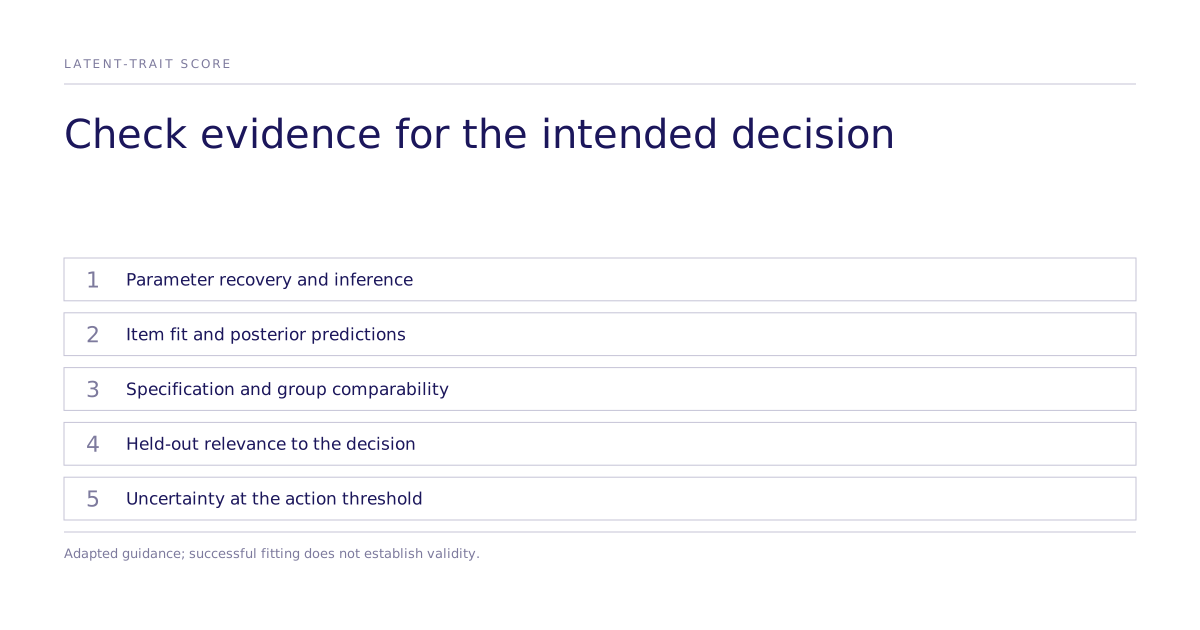
Five checkpoints before you trust a latent-trait score
A personality or preference score from a psychometric model is never observed directly. It is inferred from a person's answers, then compressed into a single number that a hiring, pricing, or segmentation decision leans on. The question is not whether the model runs. It is whether the number is trustworthy enough to act on.
What a trait score actually claims
Item response theory models relationships between latent traits and observed answers. A graded response model handles ordered categories such as a five-point agreement scale. The PyMC Labs/Alva Labs panel introduces IRT at 12:14 and the graded response model at 19:36.
The trait itself is never measured. Only the responses are. Everything past that point is inference, and inference carries assumptions that can be checked or left unchecked.
Five adapted checkpoints
The PyMC Labs discussion with Alva Labs covers workflow at 23:19, simulation at 35:32, parameterizations at 40:25, inference engines at 43:40, and real data at 46:05. The following checkpoints are adapted guidance for assessing a decision score; they are not a fixed sequence claimed by that presentation.
| Checkpoint | What it catches |
|---|---|
| Simulate known parameters and check inference | Parameter recovery, computation, and dependence on inference settings |
| Check fit to the observed items | Posterior predictive checks and item-fit problems, alongside convergence diagnostics |
| Compare specifications and relevant groups | Sensitivity to parameterization and measurement invariance needed for group comparisons |
| Evaluate held-out predictions and decision relevance | Performance beyond the fitted responses and evidence for the intended use |
| Report uncertainty and assess the decision threshold | Whether errors and uncertainty make the proposed action acceptable |
Gelman and colleagues' Bayesian Workflow describes iterative model building, checking, validation, troubleshooting, and comparison. These activities support review; completion of a checklist does not establish measurement validity.
What breaks when a checkpoint gets skipped?
Successful fitting does not show that the latent scale measures the intended construct, works comparably across groups, or predicts a relevant outcome. A precise posterior can still depend on an unsuitable model or item set.
For a hiring-related score, examine whether the intended interpretation and threshold are supported for the relevant population, including group comparability and the consequences of false positives or negatives. A preference-segmentation score needs comparable checks for its distinct use.
Where does the same discipline apply to a causal question?
Apply the same questions to a proposed Subconscious choice study: request the design, estimator, sensitivity checks, uncertainty calculation, and evidence relevant to the endpoint. Confirm which checks are actually included. For a generated study, plan aligned human evidence where needed and keep the response sources distinct. How the study process works can frame the proposal.
What this kind of discussion doesn't prove
The PyMC Labs panel describes one personality-modeling project. Its workflow does not establish the accuracy of an unrelated score or a Subconscious deliverable. Inspect the actual item-level, predictive, and decision evidence for the model under review.
What is a practical gate before you trust a score?
Before using the score, inspect item fit, posterior prediction, held-out performance, group invariance where relevant, and sensitivity of the decision threshold to uncertainty. State the intended use and who approves it. Review aggregate study validation, or discuss the proposed research decision.