How to Build a Customer Persona Worth Testing Against
A persona worth testing records evidence about the buyer's role, context, history, decision process, and constraints. A detailed story can suggest hypotheses; it does not by itself predict which price or message the buyer will choose.
The following five inputs organize a candidate profile. Their relevance depends on the decision and supporting evidence. Separate observed records, reported beliefs, and assumptions, and identify the people the available records omit.
What separates a usable persona from a narrative one
A low-fidelity persona lists traits:
- Five years into a marketing manager role
- Employer is a mid-sized business
- ROI is the main concern
- Leans on data before deciding anything
A more specific hypothetical profile adds context:
- Runs demand gen for a 150-employee B2B SaaS company, with three people reporting to her
- Inherited a marketing stack where the ABM tool was never set up correctly
- A prior vendor promised "AI-driven insights," then shipped dashboards nobody bothered to open
- Evaluated on pipeline contribution, not MQL volume, since a change six months ago she is still adapting to
- Gets tool recommendations from a peer community, then runs a two-week trial before purchasing gets involved
The second version supplies more testable hypotheses, such as whether onboarding effort matters to the buyer. A more distinctive generated answer is not evidence that the profile predicts real customers. Check grounding and held-out agreement for the intended question.
Five inputs to investigate
| Input | Question it answers | What to include |
|---|---|---|
| Role and context | What situation constrains this person day to day? | Title, hierarchy, company size and stage, team size, real KPIs |
| Behavioral history | What past experience shapes their filter on new claims? | Prior tools, what worked and failed, how they were disappointed before |
| Core beliefs | What assumptions won't move with new information? | Beliefs about the market, about vendors, about how decisions should be made |
| Decision patterns | How do they actually reach a yes or no? | Discovery channel, evaluation process, who else is involved, deal-breakers |
| Constraints | What boundary makes an otherwise-good answer impossible? | Budget ceiling, approval thresholds, compliance requirements, team bandwidth |
Beliefs, context, prior behavior, demographics, and constraints are candidate features; no one feature is universally the strongest predictor. For the hypothetical manager, inspect whether prior vendor experience and procurement limits appear in relevant customer evidence, including counterexamples.
Where do the inputs for a persona come from?
Start with relevant records and document their provenance, dates, consent or permitted use, and missing coverage:
- Sales calls. Sample won and lost deals, nonbuyers, and less engaged customers where relevant. Tag role, outcome, date, and selection. A fixed five-to-ten count does not establish segment coverage.
- Support tickets. The problems customers hit, in their own words. This feeds behavioral history and constraints.
- CRM notes. Decision-making dynamics, stakeholder involvement, and the objections that killed past deals. This feeds decision patterns.
- Customer interviews. Preserve exact quotations and context as evidence of what participants reported. A reported belief does not establish its effect on a purchase.
- Product analytics. Inspect actual usage and churn patterns, while distinguishing observed customers from prospective buyers the data do not cover.
The mistakes that flatten a persona back into a stereotype
- Treating demographic or psychological detail as proof. Select features from relevant evidence and validate their contribution to the intended prediction or comparison.
- Making the profile uniformly agreeable. Retain evidence of skepticism, budget limits, and conflicting accounts instead of instructing the model to accept the offer.
- Declaring segments from different answers alone. Check independent stability, size, membership and reachability before using the grouping.
- Letting the persona go stale. Markets and roles change; revisit definitions on a regular cadence rather than writing them once.
- Assuming every buyer was burned before. Record prior vendor experience when the evidence supports it, including buyers with different histories.
Where does a well-built persona still fall short?
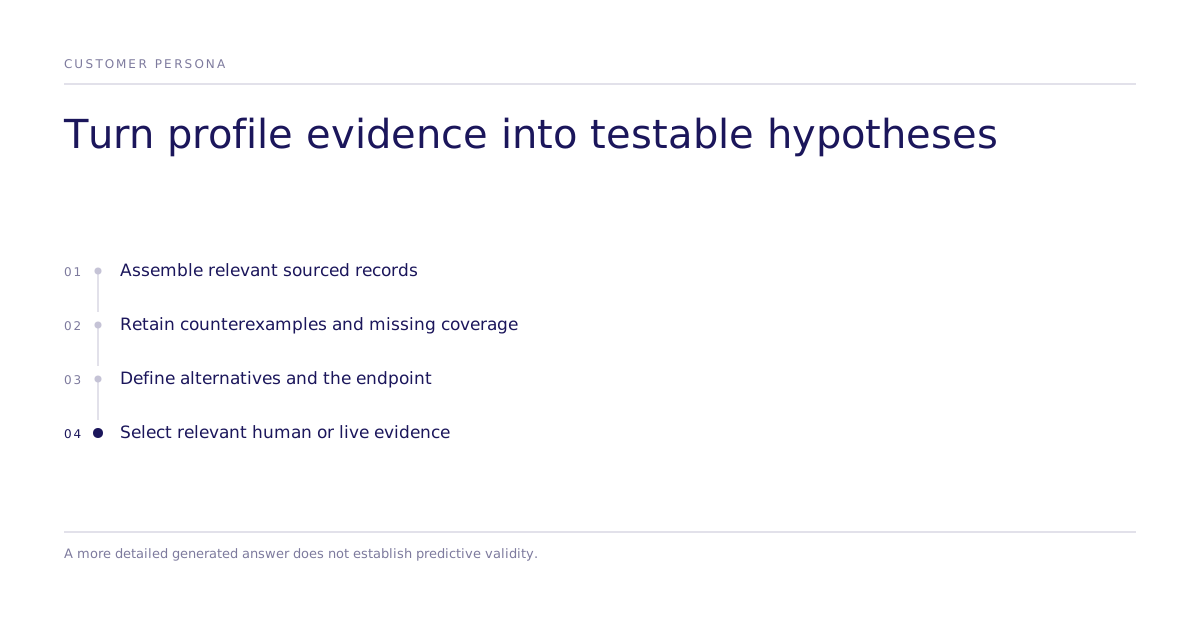
A profile can organize hypotheses about needs and the decision process. It does not measure how changing an offer affects choices or purchases. The procurement-manager example might motivate a comparison of lower price with assisted onboarding, but the profile cannot resolve that comparison.
A choice study can compare defined alternatives; a live test can measure actual purchases or completion. Vass and colleagues' 2017 review describes qualitative research used to select and refine DCE attributes, terminology, and tasks. Subconscious uses generated responses for controlled choice comparisons. Specify its task endpoint, estimator, and uncertainty, then assess transfer with relevant human evidence.
The cost of skipping that step shows up late: weeks spent mining calls and notes can produce a persona that reads convincingly and still turns out wrong once the decision ships and behavior contradicts it.
Method boundaries worth keeping straight
A modeled profile and recruited participants are distinct evidence sources. For validation, align alternatives, eligibility, and outcomes and record fielding changes. Select human choice, usability, or live behavioral evidence according to what the decision requires.
A practical next step
Build a profile from relevant records and contrary evidence. Define the action and endpoint next. Review aggregate validation evidence, read how a study works, or discuss the proposed comparison before committing to a result.