How Research Leaders Govern Self-Serve Research
Before stakeholders use AI to produce research output on their own, define what that output can support. Exploration can frame a question. Descriptive claims need verified sources or observations; feasibility questions need operational evidence; causal intervention claims need a design that identifies the effect. Set independent validation requirements according to the endpoint, existing evidence coverage, and cost of error.
Put the Decision Before the Tool
Self-serve access changes who can produce an answer. A stakeholder may summarize interviews, draft a customer narrative, or generate objections. A summary can report what a source contains if it is checked against that source; it cannot establish an intervention effect without an appropriate study design.
The cost of a weak boundary appears when a plausible answer enters a decision memo as evidence. The business may commit budget, make a public claim, or change a roadmap against a hypothesis that was never tested. The research function then owns the consequences without having owned the method.
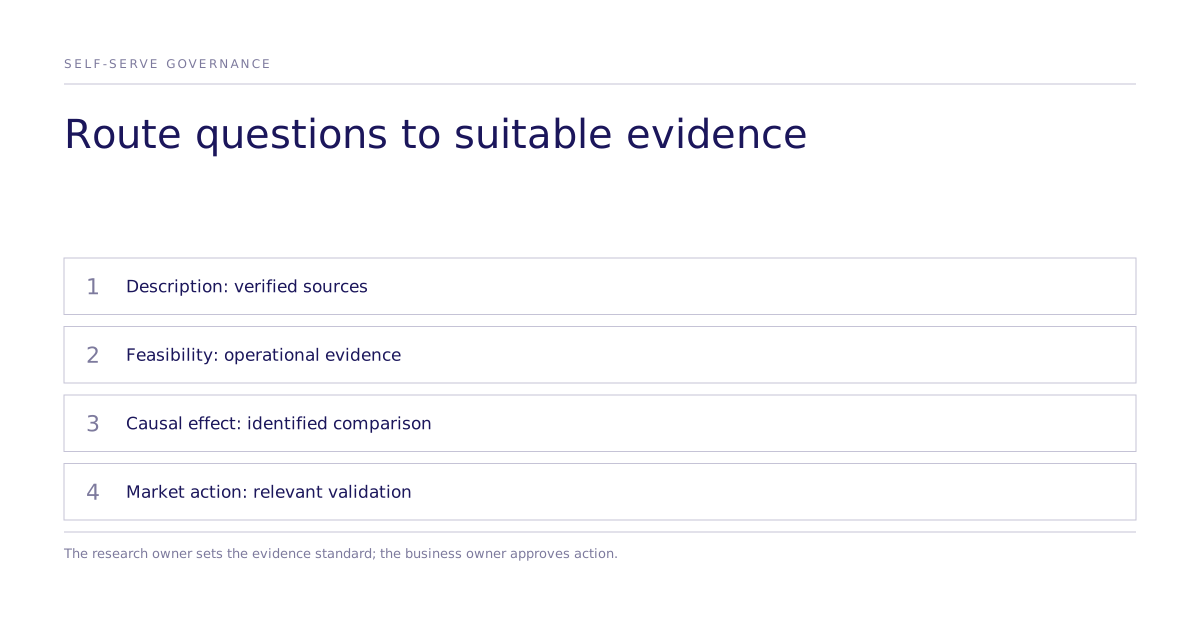
Write a governance rule that routes each question to suitable evidence and a named reviewer. The research leader owns the evidence standard; the business owner owns the commitment and its cost.
The U.S. Bureau of Labor Statistics projects 7% growth for market research analysts and marketing specialists from 2025 to 2035, in the outlook checked in October 2026. This occupation forecast does not measure demand for research judgment within a particular organization or prove that AI has replaced a task.
Four Activities for Reviewing AI-Assisted Evidence
Use these activities when appropriate to the question. Human or live experiments can run directly; a simulated study is not a prerequisite.
| Layer | Method | Allowed use | Required owner | Failure condition |
|---|---|---|---|---|
| Exploration | Generate hypotheses, objections, and alternative explanations | Reversible internal question framing | Stakeholder | A generated answer is presented as observed behavior |
| Research review | Define the action, population, alternatives, outcome, and risk | Approve or reject the study design | Research team | The method cannot answer the decision as written |
| Controlled comparison | Randomize alternatives using a specified response source | Estimate the contrast on the measured endpoint | Research team | Generated or hypothetical selection is described as actual purchase |
| Independent validation | Compare with relevant human responses or observed behavior | Check the intended use against predeclared criteria | Research team with business owner | Validation is asserted without a matched comparison |
Name the completed activities in the decision record. Review can detect problems but does not transform generated text into observed evidence. A common question does not make modeled and human responses equivalent.
Match the Evidence Bar to the Cost of Error
The right governance tier depends on what happens if the answer is wrong.
| Question and decision | Example | Appropriate evidence |
|---|---|---|
| Reversible internal exploration | "What objections should we investigate?" | Labeled exploration |
| Description or feasibility | "How many eligible accounts exist, and can we serve them?" | Verified records, coverage checks, and operational capacity evidence |
| Intervention effect | "Will a lower price change renewal selection?" | Identified comparison with explicit assignment, endpoint, uncertainty, and population limits |
| Consequential market action or public causal claim | "Will this change actual paid renewals?" | Relevant behavioral evidence and validation criteria matched to the endpoint and cost of error |
What Decision Rights Should Researchers Have?
The research team should design the self-serve system, not operate as a request queue. Its governance document should define:
- which questions stakeholders may explore on their own;
- which decisions require a named research reviewer;
- what must be specified before an experiment begins;
- when a simulated result is sufficient for a reversible internal choice;
- when a separate real-human test is required;
- how every output must state its method and limitation.
Ask whether the source and method support the claim as written. Descriptive questions may be answered by verified records. A causal question requires an identified comparison. A claim about actual buying requires relevant behavioral evidence rather than a fluent prediction.
Roll Out One Decision Workflow
Start with one live decision that crosses teams. Use the same sequence each time:
- Write the business decision in one sentence.
- Name the question type, target population, response source, and outcome; specify alternatives and assignment for an intervention test.
- Assess the cost of error, available validation coverage, reversibility, and deadline.
- Label generated exploration and preserve source records for any descriptive summary.
- Have the research owner approve the evidence path.
- Record the action, result, method, limitations, decision owner, and remaining validation need.
As a planning example, repeat this review weekly for a month. The cadence is not a delivery promise. Its purpose is to expose unclear decision rights and turn the rule into normal operating practice.
Where Does Subconscious Fit In?
Subconscious uses controlled comparisons of generated choices to study candidate actions. Randomized alternatives can estimate a contrast on the tested response; they do not establish every motive behind an individual's choice. General replication evidence does not validate a new population, intervention, or sales forecast.
Agree on any recruited-human or live validation separately, including population, instrument, endpoint, fielding owner, and acceptance criteria. Align the comparison with the modeled study where possible and document differences rather than assume the only change is the response source.
Specify the population's eligibility, provenance, coverage gaps, and weighting assumptions in the study brief. Audience coverage, generated sample size, recruited participants, and method validation are different facts; each needs its own evidence.
The public research record reports aggregate replication evidence and method limitations. Bring the decision and required response measure to a study review to determine an appropriate evidence path.
Limits of This Governance Model
This framework is an organizational practice. Subconscious does not automatically enforce it inside a stakeholder's workflow. The research leader must write the rules, assign decision rights, and stop unsupported output from crossing the evidence boundary.
Naming where simulation ends and human confirmation begins is what lets a buyer check the claim. Real-human validation is separate from simulated experimentation. A simulated result is not human-validated unless that step was explicitly run.
The public method record provides aggregate results; per-study replication data is not public. Neither a generated study nor a human hypothetical-choice study automatically establishes sales performance. Match validation to the intended action and use the relevant business or domain expertise.
Buyer Questions
Does self-serve access replace the research team? Self-serve tools can change task allocation; staffing depends on the organization. The proposed governance assigns responsibility for questions, sources, methods, and decision rights.
Can exploratory output support a consequential decision? It can identify hypotheses. It cannot establish which action caused a behavioral outcome.
Who owns the governance document? The research leader accountable for the evidence the organization acts on. Business owners remain accountable for the final decision.
What is the next step? Choose one pending decision, assign its evidence tier, and document the boundary before the study begins. Discuss a validation workflow.