How to Scope a Simulated-Market Study Before You Procure One
A vague research brief produces a vague result. Before an insights, product, or pricing leader commits budget to a simulated-market study, the team needs one decision-specific question: the action being considered, the audience it affects, the alternatives on the table, and the outcome that changes what happens next.
Why does a thematic question waste the study budget?
"What do customers think of our product?" is a valid exploratory question. Interviews or open-ended responses can uncover issues and help form hypotheses. To procure a controlled action comparison, refine that question into alternatives, a population, and a measured response. The research design should follow the objective: exploratory, descriptive, or causal.[^1]
Compare a weak brief to a strong one:
| Weak brief | Strong brief |
|---|---|
| "What do customers think of our product?" | "How do mid-market marketing managers evaluate our positioning against a named competitor?" |
| "Is our pricing correct?" | "Randomly compare three defined plan offers with the current offer among eligible startup purchasing leads; measure stated selection, including no purchase" |
| "Will people like this message?" | "Randomly compare the current and proposed message among eligible decision makers; measure stated intent to switch, then separately validate actual switching where required" |
Write a concise decision summary, then document the design details needed to answer it. A summary alone does not specify assignment, coverage, measurement, or analysis.
The four inputs a decision-specific brief needs
1. The action under consideration
Name the concrete thing being compared: a price point, a message variant, a product concept, a positioning statement. "Improve our messaging" is not an action. "Lead with the outcome claim instead of the category claim" is.
2. The audience the decision affects
Name the buyer segments whose response actually changes the decision, not every segment the company could theoretically reach. A pricing decision for enterprise buyers does not need a self-serve consumer's reaction.
3. The alternatives being compared
A study needs at least two things to compare. Testing one message in isolation tells the team whether people reacted, not whether it works better than the current one or a competing option.
4. The outcome that changes what the team does next
Decide in advance what result would change the plan. If the team would ship the same roadmap regardless of what the study shows, the study is not tied to a decision and should not be funded.
Sizing the study once the question is scoped
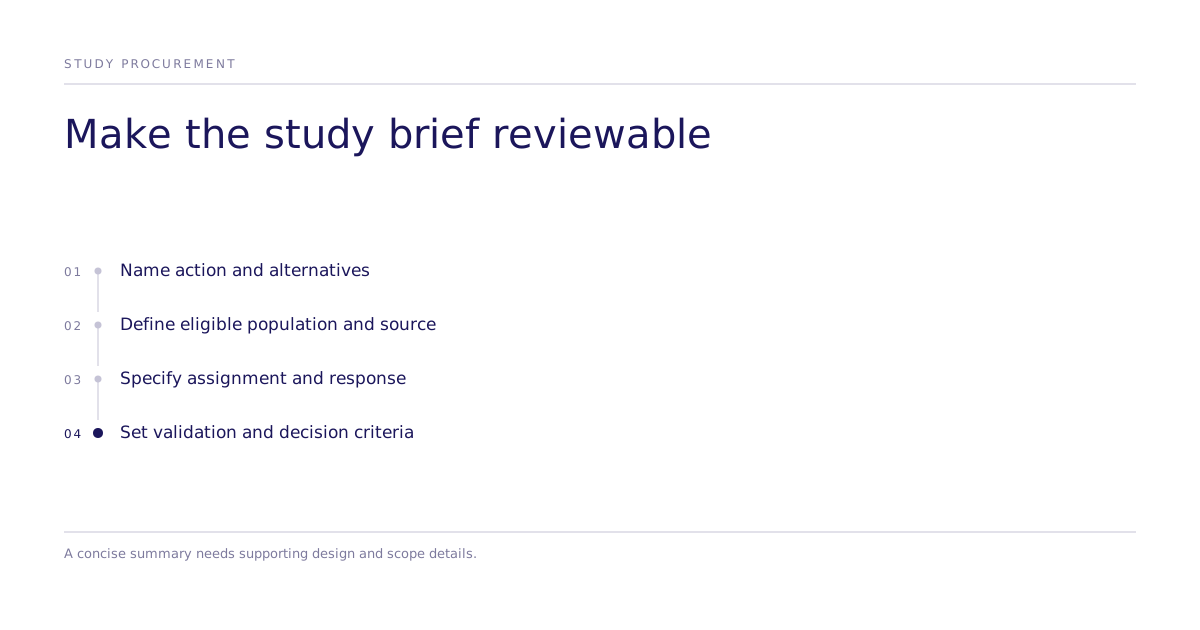
Size the proposal around the design and decision criteria:
- Population and segments. Identify eligible buyers, the source used to define them, coverage gaps, and subgroup contrasts worth estimating.
- Assignment and tasks. Specify the unit randomized, comparison cells, feasible alternatives, status quo or no-purchase option, and respondent burden.
- Precision and validation. Plan sample or draw counts around the estimator and decision threshold. Repeated model draws are not independent recruited respondents.
- Timing and cost. Request a dated scope for design, pretesting, recruitment or generation, analysis, review, and any revision. Separate agreed turnaround from hypothetical planning assumptions.
Require deliverables that expose the response source, design, analysis assumptions, validation result, and remaining decision risk. Do not infer study quality from a segment count or session length.
What this scoping work rules out
This scoping work also rules out engagements the method cannot support:
- Deep relationship building. A single study estimates a directional response; it does not replace ongoing customer relationships.
- Population and behavioral validity. Generated sample size cannot repair model bias, missing population coverage, or a mismatch with the required sales endpoint.
- Topics requiring human experience. Use direct human evidence when understanding lived experience or observed emotion is part of the question; generated explanations alone do not establish it.
- Regulatory mandates for real participant data. When a rule requires human data, a simulated study cannot satisfy that requirement.
Use these boundaries to decide which evidence belongs in the proposal. A human pilot may be the appropriate first study when grounding or comprehension is unresolved.
How does the scoped question run as a causal comparison?
For a Subconscious comparison, agree on the randomized alternatives, population, generated-choice endpoint, estimator, and uncertainty method. The comparison estimates a response contrast within that configured task. It does not automatically explain an individual's motives or establish the effect on actual purchases.
The July 2026 causal-fidelity working paper reports mean Spearman correlation on estimated choice-parameter ranks of .73 across 43 design-filtered studies and .55 across roughly 300 replications. Those are aggregate parameter-rank comparisons, not sales accuracy or validation of this proposed study.
When the scoped question still needs a human study
The same four boundaries apply after a simulated study comes back. A simulated result is directional evidence: it does not turn a causal action test into an observed usability session, a clinical trial, or a guarantee of results.
Define a recruited-human or live validation plan when the intended endpoint, evidence coverage, or decision cost requires it. Validation may confirm, contradict, or leave the simulated estimate unresolved. Set acceptable disagreement and precision in advance, and state whether failure means revising the design, collecting more evidence, or withholding the action.
Write the one-sentence decision question before requesting a proposal. If a vendor cannot state back the action, audience, alternatives, and outcome the study is meant to test, the engagement is not scoped yet. Review current research and methodology, or book a walkthrough.
[^1]: The Market Research Process, Lumen Learning, Introduction to Business.