How to Sequence Target-Group Research Before You Field a Study
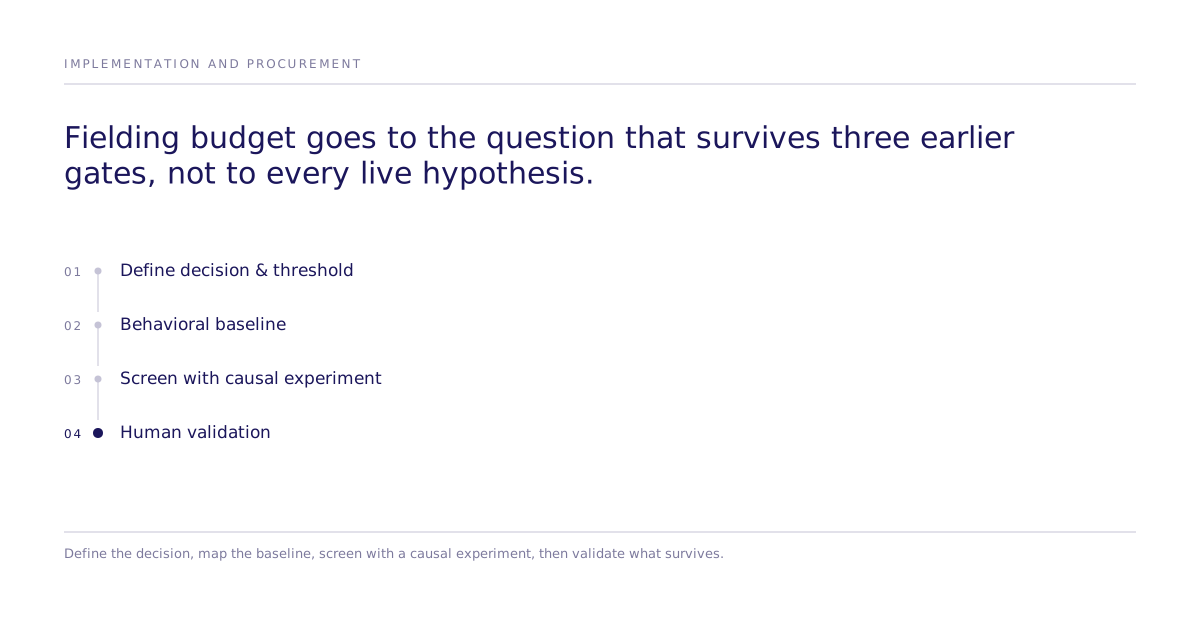
Target-group research for a launch should follow four gates: define the decision, establish the behavioral baseline, screen the live hypotheses with a controlled causal experiment, then validate the surviving question with recruited human participants when the evidence standard requires it. This sequence protects fielding budget from an unrefined concept without treating a simulated experiment as a substitute for human evidence.
Put the launch decision before the audience profile
"Understand the customer" is not a research decision. It can produce a broad profile without resolving what the launch team should do.
Start with the action that will change if the evidence changes. The decision might be choosing between two product concepts, selecting a message for a defined buyer segment, or deciding whether a pricing hypothesis is ready for a higher-stakes study. Name the alternatives, the target segment, the behavior that matters, and the evidence threshold for proceeding.
Sending an unrefined concept directly into a full recruited study can burn weeks of recruitment work and the study budget. The result may look like launch evidence while answering a question that should have been screened first.
Use four gates before full fielding
1. Define the action and evidence threshold
Write the decision in a form that can be tested: "Which of these two concepts should advance for this segment?" is stronger than "What does this audience want?"
Set the evidence threshold at the same time. A directional screening decision, a representative population estimate, a regulatory claim, and a final pricing decision with real financial exposure do not require the same proof. The study plan should state which one it must support.
2. How do you establish the behavioral baseline?
Use existing market, customer, product, and behavioral data to define the starting conditions. This step can reveal who is already engaging, which segments matter to the decision, and where behavior differs.
Baseline analysis cannot establish why one intervention will change the outcome. It helps define the population and alternatives for the experiment, not replace it.
For planning, a team might reserve one day for baseline mapping or budget an initial fielded pass around one or two variants. Those are historical planning examples, not current Subconscious delivery commitments or universal method limits. Use the actual decision, recruitment conditions, and evidence standard to set the plan.
3. Screen the hypotheses with controlled choices
Turn the remaining concepts, messages, or positioning options into structured alternatives. Discrete-choice modeling studies preferences by asking people to choose among alternatives described by different attributes (Displayr, "Discrete Choice Modeling: A Market Researcher's Guide").
Subconscious runs controlled causal experiments against defined target segments to compare those alternatives before a team commits to a full recruited fielding pass. The experiment can screen concepts, messages, and positioning. It can report uncertainty when the study design supports it. The result is evidence for deciding what deserves the next research investment, not an automatic recommendation or a final population estimate.
4. How do you carry the surviving question into human validation?
Keep the alternatives, target segment, and causal question stable as the evidence moves into a recruited-human study. Subconscious can test or validate studies with real human participants. That continuity lets the team validate a screened question instead of rebuilding the study around a new premise.
Human validation does not turn a causal action test into a usability session, clinical trial, or automatic forecast of market performance. It adds the evidence required for the decision at hand.
Budget fielding around evidence, not activity
The useful procurement comparison is not software against recruiters. It is an unrefined fielding commitment against a gated evidence plan.
| Decision gate | Fielding-first plan | Screen-then-validate plan |
|---|---|---|
| Question definition | Recruitment can begin while the launch question is still broad | Alternatives, segment, behavior, and evidence threshold are fixed first |
| Hypothesis screening | The recruited study carries every live assumption | A controlled experiment identifies which assumptions deserve fielding |
| Budget commitment | Fielding budget is committed before the question is screened | Fielding budget is reserved for the question that survives screening |
| Final evidence | One study may be asked to provide both direction and final proof | Human validation is used when representative, regulatory, or financial-risk evidence is required |
This plan does not make recruitment optional. It gives each research stage a distinct job and makes the handoff criteria inspectable.
How do you match the method to the claim you need to make?
A controlled experiment is appropriate for comparing defined actions and screening which alternative should advance. It should not be presented as regulatory-grade evidence, representative population sizing, or final proof for a pricing decision with real financial risk.
A scoping review has examined how discrete choice experiments are used to derive preferences for health-screening programs (NCBI/PMC, "Methodology to derive preference for health screening programmes using discrete choice experiments: a scoping review"). That is evidence that the method is used to study structured preferences. It is not proof that every target-group study has external validity or predicts real-world uptake.
"A total of 27 studies that used a DCE to elicit preferences for cancer ( n = 26) and cardiovascular disease screening ( n = 1) programmes were included in the final analysis."
Brain, Jadambaa, and Kularatna, BMC Health Services Research (source)
Do not turn uncertainty into a universal confidence-interval promise. Do not treat an audience-reach figure as a recruitable panel. Do not treat a ranked result as an automated decision. The research owner remains responsible for matching the evidence to the launch decision.
Bring one fieldable question to the research plan
Choose one upcoming launch decision. Write down the alternatives, the target segment, the behavior that matters, and the proof required to act. Then separate the work into baseline mapping, causal screening, and any recruited-human validation the decision requires.
Research explains the experimental method. How We Work shows how the screening-to-validation sequence runs end to end. Bring the decision and evidence threshold to a demo to scope the first experiment.