How to Structure a Message Test Before You Spend Media Budget
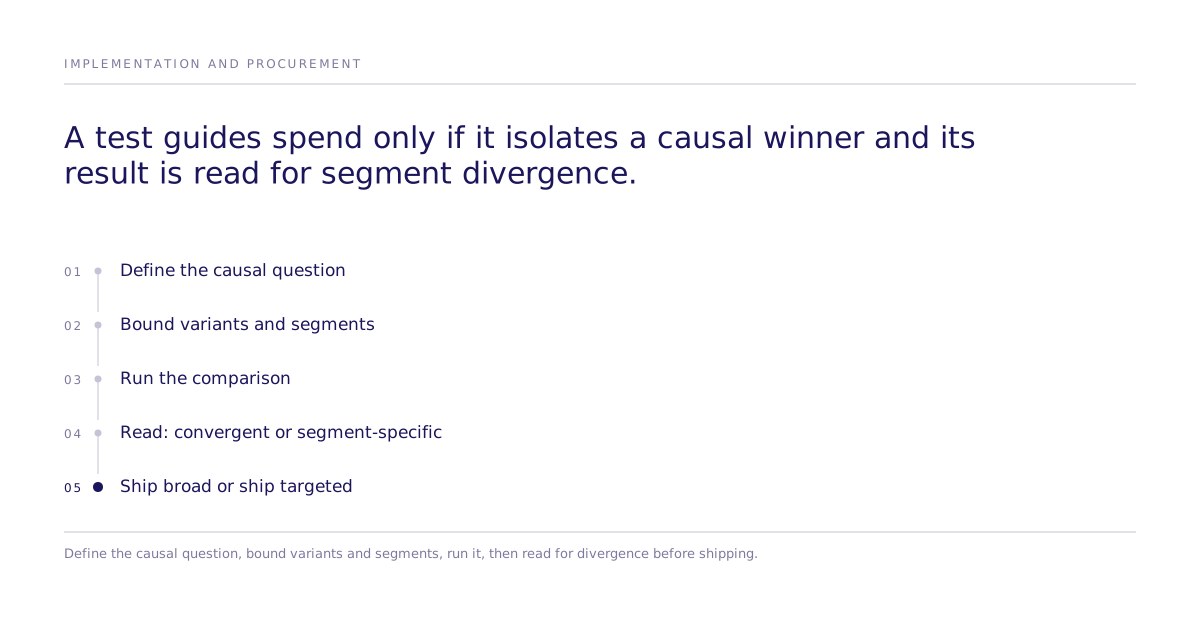
The question a marketing leader has to answer before media spend commits is not "which message do we like best." It is "how many variants, segmented which way, do we need to test so the winner is a causal read rather than a guess." Get the structure wrong and a test produces noise that looks like signal.
The decision behind the test
A campaign launch usually has more candidate messages than time to test them properly. Workshop consensus fills the gap: a room agrees on a favorite, the copy ships, and the team finds out what worked only after the budget is spent. That path skips the one question a test is supposed to answer: not "do people like this," but "which message moves the outcome, for which audience."
Media budget goes toward a message that was never compared against alternatives. A test structured too loosely, with too many variants, no segmentation, or opinion-only questions, produces a result that looks decisive but is not. The team ships the wrong message with false confidence.
What's the difference between a workshop vote and a randomized comparison?
A workshop vote and a randomized comparison answer different questions: a controlled comparison assigns variants to defined conditions and measures the difference; a vote just measures preference in the room (Discrete choice experiments: a primer for the communication researcher).
"DCEs are powerful for disentangling the influence of many message attributes with modest sample sizes and participant burden."
Reynolds and colleagues, Frontiers in Communication (source)
| Workshop vote | Randomized comparison | |
|---|---|---|
| Decision basis | Group opinion on which message "feels right" | Each variant assigned to defined segments and compared against the others |
| Typical variant count | However many made it into the deck | A bounded set: three to six is a common planning range, enough to differentiate without diluting the comparison |
| Segmentation | Usually none | Two to four audience segments is a common structuring pattern, so a cross-segment winner can be told apart from a segment-specific one |
| Output | A favorite | A ranked result tied to a stated causal question, with segment-level divergence visible |
Two structural choices carry most of the weight. First, keep variants comparable: same length, same voice, same call to action, so the test isolates the message angle rather than copy length or tone. Second, give each segment enough respondents to produce a usable read. This planning floor is published so a buyer can check a study's sample against it before trusting the result. A handful of respondents per segment across two to four segments is a reasonable planning floor cited in general message-testing practice, not a target to exceed, and not a current Subconscious configuration.
How should you read the result of a message test?
The output of a well-structured test is not "one message won." It is a set of segment-level results that has to be read for at least two different patterns.
A convergent winner shows up when most segments independently rank the same variant first. That is the message to ship broadly. A segment-specific winner shows up when one segment prefers a variant that another segment ranks lower. That is a personalization opportunity, not a tie to break by averaging. Treating a segment split as noise and shipping whichever variant has the highest raw count discards the more useful finding: two audiences that respond to two different messages.
A team testing five subject-line variants across three segments might find one variant wins with most segments while a second variant wins only with one segment. The first ships broadly; the second becomes a targeted follow-up rather than a discarded runner-up. The example is labeled this way because a reader needs to know it didn't come from a completed study. The specific counts here are illustrative, not a benchmark from a live study.
A structured comparison should also surface the failure mode, not just the winner. Asking why a respondent would skip a message, not just whether they'd act on it, tends to reveal specific friction, such as a message that reads as a sales pitch or a claim that sounds implausible, that a straight ranking hides. That friction pattern is worth carrying into the next round of variants, whether or not the message it was attached to wins.
What can a simulated message comparison do before media spend?
A randomized experiment run on a simulation of the target market can compare message variants against a defined causal question, with segment-level results and confidence intervals where the study design supports them, before a dollar of media spend commits. For a routine campaign decision, that comparison is often the last step before shipping.
For a high-stakes launch, meaning a large budget commitment or a category-defining campaign, the simulated result should not be the only evidence. Subconscious can test or validate a study with real human participants, moving from a simulated comparison to real-human validation without changing the underlying causal question: the same variants, the same segments, run again before the launch goes wide.
Where this breaks down
This boundary is stated directly so a team relying on the result knows where it stops. A synthetic-population experiment tests a defined hypothesis under controlled conditions. It does not replace a live market read at real spend. An audience graph used to design and scope a study differs from a group of people recruited to participate in it, and collapsing that distinction is a common way teams overstate what a simulated result proves.
Naming this scope limit lets a buyer see exactly what the result covers before acting on it. The method also does not resolve a workshop disagreement about brand voice or a compliance question about a specific claim. It answers one question: given these variants and these segments, which one moves the outcome, and where. Everything upstream of that, including writing the variants, deciding what's on-brand, and clearing legal, still has to happen first.
The research page describes how this comparison is structured end to end, and the case studies page has worked examples of a message decision carried from a simulated result to a validated one. Teams scoping a specific launch can book time to walk through the design before committing budget.