How to Test Positioning Angles Before You Commit Campaign Budget
Before committing campaign budget, use a structured preference screen to compare positioning angles, then run an identified intervention test when the decision needs an effect estimate. Forced ranking can reveal relative preference among the shown statements; ranking alone does not create a causal experiment. Define whether the campaign decision depends on comprehension, stated selection, or live response.
Match the research route to the deadline and evidence requirement. A human pilot can check comprehension; a generated screen can explore defined options when grounding is adequate; a live randomized comparison can measure campaign behavior. Confirm actual timing in the study scope.
The decision this changes
Before writing a campaign brief, a sales deck, or the site copy that follows from it, a brand or marketing leader is choosing one positioning statement over several plausible alternatives. That choice is usually made once, on instinct, in a room. If the angle is wrong, the cost isn't the workshop time, it's every dollar spent on campaigns, enablement, and copy built around a position the target buyers don't find clear, differentiated, or relevant.
For a Subconscious comparison, agree on the population, alternatives, assignment, response measure and validation. Generated explanations may suggest wording hypotheses; they do not establish the causal mechanism behind an individual's choice. Bring the decision to a study review.
What does a structured preference screen establish?
| Workshop vote | Structured preference screen | |
|---|---|---|
| Signal | Preferences among workshop participants | Choices or rankings among the shown statements, with eligibility and response source recorded |
| What's measured | Internal brand judgments | Separate comprehension checks, relevance measures, and preference among alternatives |
| Output | A candidate chosen for development | Candidate options and uncertain segment hypotheses for further evaluation |
| Repeatable? | Can repeat discussion with a new group | Can version stimuli and evaluate revisions on fresh or held-out evidence |
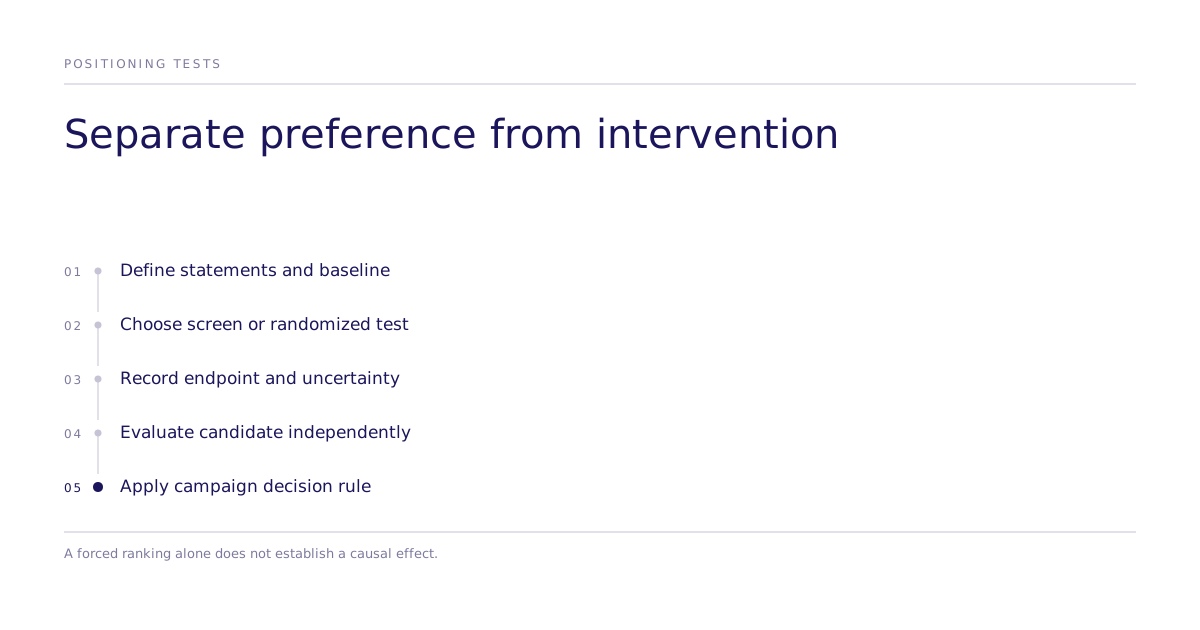
1. Define the positioning statements to test
Write distinct positioning statements in comparable form. Category, job-to-be-done, pain-point, competitor, and outcome framing can supply candidate hypotheses. There is no universal four-to-six requirement; choose the number around meaningful contrasts, participant burden, design and precision. Keep the current positioning as a baseline where relevant.
2. What buyer population should the comparison cover?
Positioning rarely lands the same way with every buyer. Before running the comparison, define the distinct buyer segments it needs to cover: the roles and contexts that will actually read the campaign, the pitch deck, or the site copy that follows from the winning angle.
3. Separate preference screening from causal testing
A comprehension prompt can check what respondents believe the company offers; ratings can record clarity or relevance; a ranking can compare relative preference. None alone establishes the effect on market behavior. For an intervention test, randomly assign eligible people or generated units to defined statements against a baseline and record the named response. A live click or purchase endpoint requires a live measurement plan.
Reynolds and colleagues' 2025 DCE primer discusses designed stimulus comparisons, blocked or factorial structures, and analysis choices. Those design elements, rather than forced ranking alone, support estimation of message-attribute effects.
4. Read for convergence and segment splits
Predefine the weighted objective, minimum worthwhile change, and relevant population shares. Examine effect magnitude and uncertainty before treating a broadly preferred option as the campaign default. Test planned message-by-segment interactions before personalization. Keep useful unprompted wording as traceable exploratory material; check factual support and comprehension in the revision.
5. Carry a supported candidate into the brief
Give copy owners the candidate statement, exact supporting response evidence, response source, uncertainty and validation status. Preserve the baseline and borderline options if the comparison is inconclusive. Consistent wording helps execution, but it does not substitute for evidence that the chosen angle meets the intended objective.
Iterate before you lock, not after you ship
Iterative refinement is an option when a screen reveals ambiguity. Keep versioned statements and results, predefine the metric and stopping rule, and evaluate the selected candidate on fresh human or held-out evidence. Repeatedly selecting and retesting on the same contexts can overfit the screen; several short rounds are not inherently faster or more valid than a single planned study.
When does a simulated comparison stop being enough?
Plan additional evidence when the intended endpoint, target population, or cost of error exceeds the available validation coverage. Agree on human eligibility, instrument, assignment and acceptance criteria; record differences from the generated comparison. A small human pilot can check comprehension, while effect precision or actual campaign performance may require a different sample and live design.
What to ask for before you bring this in-house
Before procurement, ask what the comparison measures, how alternatives are assigned, what response source is used, how uncertainty and coverage are assessed, and what independent validation supports the intended action. Agree on exports and the handoff to the campaign, deck and copy owners.
Bring the current statement, candidate angles, eligible buyer population, intended endpoint, and campaign deadline to Subconscious to scope a comparison. Use the aggregate research record to assess general method evidence separately from validation of the new positioning decision.