How to Use Synthetic Consumers for Early Concept Testing
Use synthetic consumers to explore reactions and nominate early concepts for further study when their grounding fits the question. Decide beforehand which outputs are hypotheses, which are measured contrasts, and which require independent human or behavioral validation. A generated reaction can suggest a revision; it does not establish market demand.
Why the fork matters more than the tool
The U.S. Bureau of Labor Statistics projects 7% employment growth for market research analysts and marketing specialists from 2025 to 2035, in the outlook checked in October 2026. This occupation forecast does not measure the benefit of synthetic concept testing or prove how AI changes individual roles.
The practical question is what uncertainty the proposed screen can resolve, and whether a direct human pretest would provide better evidence under the team's budget, grounding and deadline constraints.
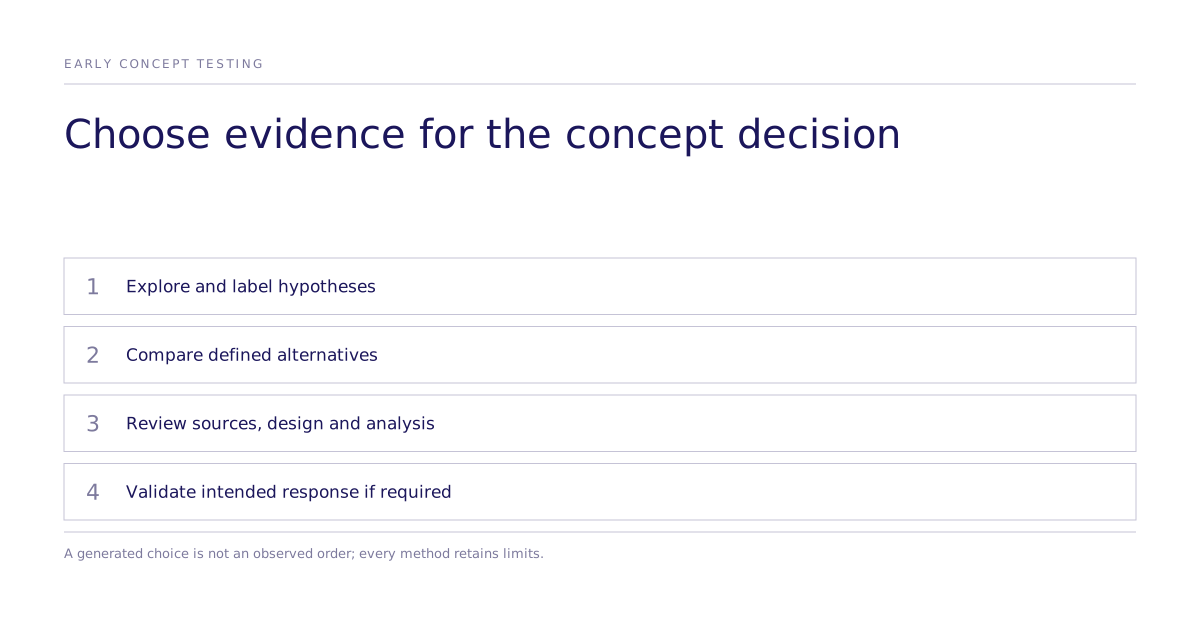
Four activities in an early-concept study
Choose the activities needed for the question; they need not form a mandatory sequence:
- Exploration: use AI to generate hypotheses, objections, and alternative framings for a concept.
- Structured screening: compare defined alternatives on a named generated or human hypothetical response, with design-specific uncertainty and coverage limits.
- Source and design review: trace responses, verify population grounding and assignment, inspect contradictory findings, and check the analysis.
- Independent validation: test the response required for the decision against relevant held-out human or live behavioral evidence, with predeclared criteria.
Where does a causal experiment fit?
A controlled generated-choice study and a conversational synthetic panel can share a generated response source. Their design differs: an identified comparison can estimate a contrast on the specified choice task. For a Subconscious study, agree on assignment, baseline, endpoint, estimator, uncertainty and relevant validation. A platform-wide benchmark does not validate this concept's actual purchase response.
| Stage | Purpose | What it tells you | Risk if treated as proof |
|---|---|---|---|
| Synthetic panel exploration | Surface objections and confusion fast | Where a concept is unclear or weak | Mistaking a fluent answer for evidence |
| Controlled generated-choice comparison | Estimate a contrast between defined alternatives | Response difference within the tested generated setup | Population/model bias, task limits and transfer to actual behavior remain |
| Independent human or live comparison | Check the intended human response or market action | Evidence on the specified validation endpoint | Coverage, precision, measurement and setting limits still apply |
Match evidence to the claim. A verified description can be reported with its source and population limits; it need not be causal. An intervention claim needs identification, and a sales forecast needs evidence about actual buying.
What does the workflow look like from start to finish?
In a hypothetical meal-kit concept study, explore confusion about preparation time and delivery format. Then compare feasible offers with the current option, define eligibility, randomly assign alternatives, and measure selection within the named generated or human task. Review raw feedback and uncertainty. If the launch depends on actual paid orders, plan an independent behavioral comparison rather than infer demand from the screen.
State whether responses were generated, recruited or observed, and record model/prompt versions where applicable. Name the endpoint, coverage, analysis assumptions, validation actually completed, and the proposed next action.
What are the limitations of this approach?
No stage removes all risk. Choose a cognitive pretest, generated screen, human choice task, or live comparison according to what remains unresolved and the cost of error. Review both promising and rejected options when model mismatch could eliminate a real winner.
Next step
Review aggregate method evidence, then scope a concept study with the current offer, candidate alternatives, eligible population, response measure and criteria for acting.