Market Research Brief - Free Template + Examples
Use the copyable brief and hypothetical example below to state the business decision, population, method, deliverables, timing, budget, and evidence needed for acceptance. Existing guides can also help: FlexMR discusses context and objectives, while Conjointly's guide includes action standards, decision rules, contacts and responsibilities. Their fields can accommodate design and quality requirements; inspect the actual brief rather than assume every template omits validation.
- Start with the business decision and knowledge gap, then ask the agency to propose a suitable evidence path.
- Define whether the result is descriptive, a hypothetical preference, or an intervention effect on observed behavior. A well-written brief cannot establish behavioral validity by itself.
- Specify eligibility verification, duplicate and response-quality checks, exclusion rules, and replacement costs for a recruited study; a universal fraud-discard rate is not established here.
- Add assignment and baseline when the question is causal, and agree on decision-specific validation and acceptance criteria.
- General method benchmarks can inform procurement, but they do not validate the new population or endpoint.
What does a standard market research brief template include?
The seven fields below are a practical starting format, not a universal industry standard. FlexMR separates business and research objectives; Conjointly explicitly asks for action standards and decision rules as well as methodology and responsibilities. Expand the brief to expose the specific design, quality, and evidence risks.
Why isn't a well-scoped brief enough to trust the answer?
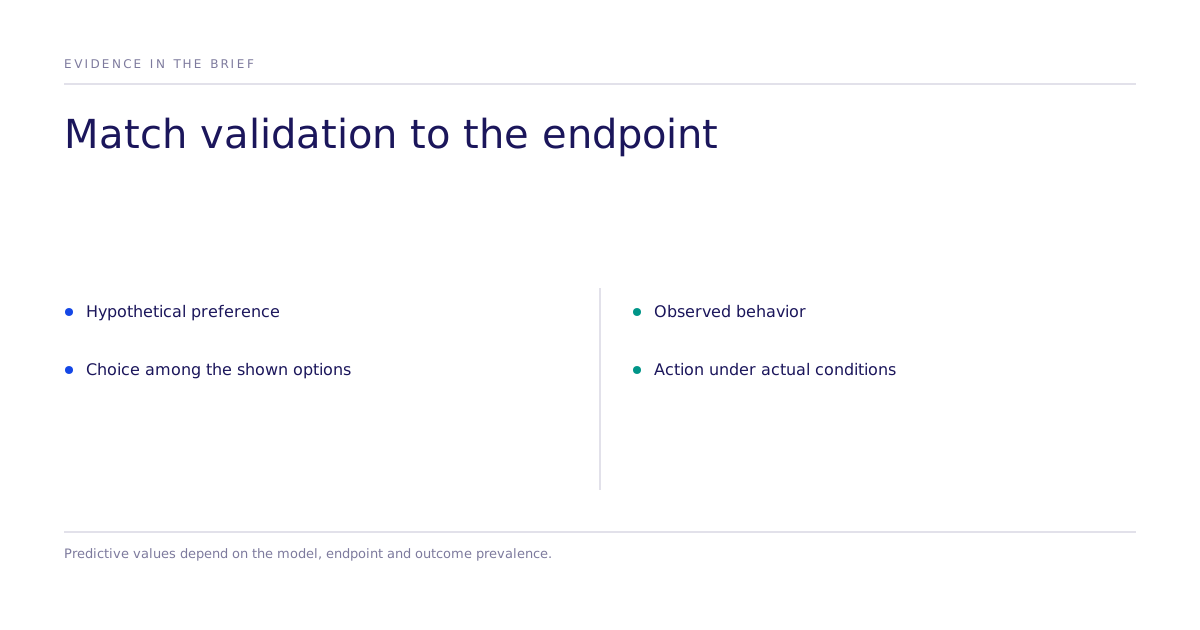
Lambooij and colleagues' 2015 Dutch hepatitis-B vaccination study compared DCE-derived uptake predictions with parents' actual decisions about vaccinating newborns. Correspondence was 80%, positive predictive value 85%, and negative predictive value 26%. The negative group was a model-derived classification, not simply respondents saying "no." Predictive values depend on uptake prevalence; the authors caution about the high-uptake setting. These rates do not establish a general pricing or survey error rate.
Use a matched behavioral comparison when actual behavior is the endpoint. A hypothetical preference can still answer a preference question, provided its source and limits are clear.
Why does data quality also belong in the brief?
Require the fielding vendor to describe its recruitment source, identity and eligibility checks, duplicate detection, task-specific quality criteria, exclusions, denominator, and replacement policy. Record when checks occur and who reviews disputed exclusions. A small pilot can expose comprehension and quality problems; a vendor-wide discard percentage cannot predict this study's losses without a comparable source and method.
What should an intervention brief add?
For a causal question, specify the intervention, baseline, eligible population, assignment unit, randomization or other identification assumptions, and endpoint. For example, compare complete billing offers on the stated selection task rather than infer an effect on paid renewal. Discrete choice models, Mixed Logit and ICLV are estimators; identification depends on the design and assumptions, not the estimator's name.
What validation standard should a vendor have to clear before you trust the number?
Set acceptance criteria for the intended use: source fidelity for a description, design and precision for a response contrast, and relevant independent human or behavioral evidence for market transfer. Separate data used to tune the system from held-out validation. The July 2026 working paper reports mean Spearman correlation of .73 on estimated choice-parameter ranks across 43 design-filtered studies. This is not a ceiling-normalized ratio or validation of a new study. The public research record reports aggregate evidence; per-study replication data is not public.
Match the brief to the question
| Requirement | Every brief | Additional detail when applicable |
|---|---|---|
| Objective | Decision, knowledge gap and owner | Intervention, baseline and intended causal effect |
| Method | Response source, population and measurement | Assignment unit, randomization and analysis assumptions |
| Acceptance | Deliverables, source checks and decision criteria | Precision, independent validation and failure action |
| Quality | Provenance, coverage, review responsibilities | Recruitment checks, exclusions, model/prompt records |
| Behavioral claim | Distinguish reported preference from observation | Validate the actual endpoint required for the commitment |
| Commercial scope | Timeline, budget, exports and responsibilities | Recruitment or integration costs and revision contingencies |
A brief makes requirements reviewable; it does not itself verify that the study meets them. Inspect the data trace, design, analysis and validation before accepting the result.
Copyable seven-field brief
1. Background: current situation, prior evidence, alternatives and constraints.
2. Decision and objective: action, decision owner, knowledge gap and acceptance rule.
3. Population: eligibility, geography, period, source, coverage and subgroup needs.
4. Method and response: source, instrument, assignment/baseline when causal, analysis and validation.
5. Deliverables and review: records, exclusions, estimates, limits, reviewer and failure action.
6. Timeline: decision deadline, design/pretest/fielding/analysis/review milestones and dependencies.
7. Budget: ceiling, scope assumptions, recruitment/generation, review, revisions and optional work.
Hypothetical completed brief
A scheduling-software team is choosing between a $100 monthly offer and a $1,000 annual offer. These amounts, dates and budget are planning assumptions, not a completed study.
| Field | Example entry |
|---|---|
| Background | Current monthly offer; annual offer under consideration. Confirm billing feasibility and margins before testing. |
| Decision and objective | Pricing lead chooses an offer before Q1 2027 approval. Advance only if the predeclared weighted selection and margin criteria are met; keep the current offer if inconclusive. |
| Population | US small-business administrators who can approve scheduling software in the coming quarter. Check eligibility and coverage using a dated account frame; record missing noncustomers. |
| Method and response | Randomly assign eligible units to the two otherwise matched complete offers. Primary endpoint is stated offer selection including no purchase. This compares billing packages, not price alone. Quote a precision-based human sample or clearly labeled generated screen. |
| Deliverables and review | Assignment and stimulus records, response source, exclusions, estimates/uncertainty, subgroup checks and limits. Research owner reviews; a separate live purchasing comparison is required before claiming a sales effect. |
| Timeline | Design and pretest precede fielding; analysis and human review precede the Q1 approval meeting. Request a feasible dated schedule and contingency for recruitment or validation failure. |
| Budget | Illustrative $8,000 ceiling for the scoped first study; proposal must separate fielding, analysis, review and revisions. Live validation is separately quoted and approved. |
Bring the brief, population evidence and intended endpoint to a study review.