Prove Research Impact When AI Makes Everyone Faster
When AI-assisted tools let anyone produce a research draft in minutes, the
question a research leader has to answer is not "how do we go faster." It is
"where does a finding stop being a draft and start being safe to act on,"
answered before a fast, plausible output reaches a business decision.
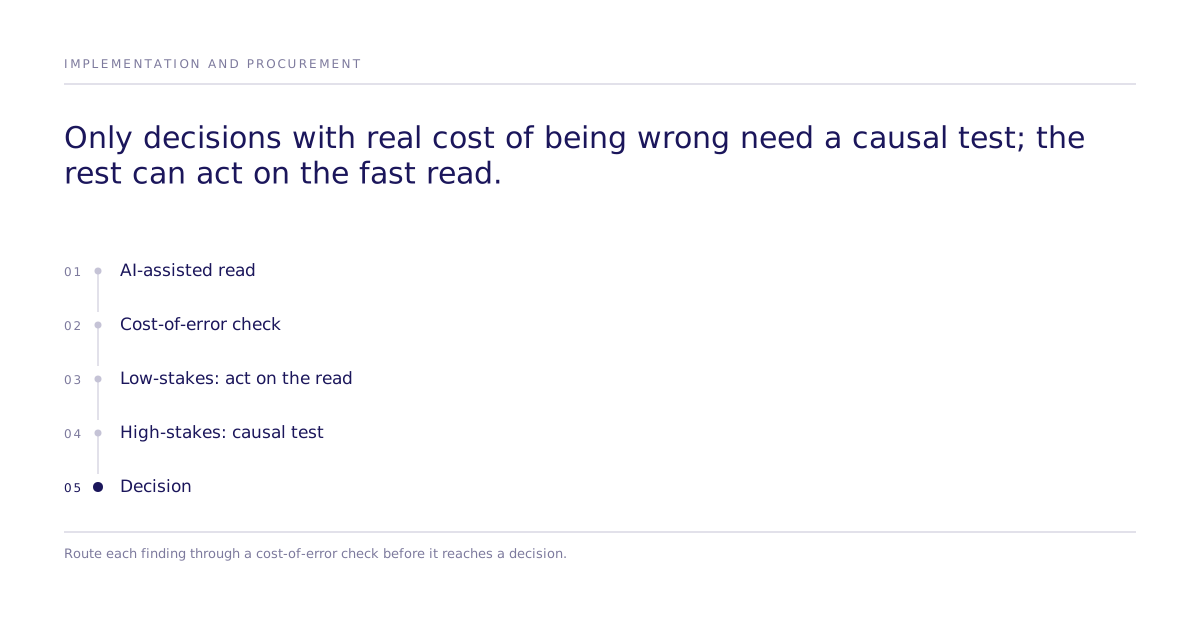
The risk AI exposes first
Research teams now reach for AI daily. It drafts surveys, summarizes
transcripts, and produces a first-pass read on a concept or message in
minutes. That speed is not the problem. The problem is what happens when
speed gets measured instead of decision quality: a team ships a conclusion
built on a fast, unvalidated read because the deck needed one, not because
the underlying claim was tested.
That risk is narrower than "AI replaces research." A research function does
not disappear because output gets cheaper to produce: the U.S. Bureau of
Labor Statistics projects continued growth for market research analysts and
marketing specialists through 2034 (BLS Occupational Outlook
Handbook).
What does disappear is the safety margin between a fluent answer and a
proven one, unless a team draws a deliberate line between the two.
What two jobs get compressed into one deliverable?
An AI-assisted read and a validated finding answer different questions.
Treating them as interchangeable is the mistake that makes fast research
dangerous. One is built for speed and breadth: it surfaces hypotheses,
objections, and directional reactions before a team commits budget to a
slower method. The other is built for weight: what a team should be willing
to defend in front of a stakeholder who will act on it.
| Stage | What it answers | What it should never be asked to do |
|---|---|---|
| AI-assisted exploration | Which hypotheses, objections, or angles are worth testing further | Stand in as proof for an expensive or public decision |
| Controlled causal validation | Whether a specific action actually changes the outcome, with a measured effect and stated uncertainty | Replace the exploration stage it was built to test |
Collapsing these into one undifferentiated "the AI said" output is what
turns a productivity gain into a credibility risk.
Where does the validation gate belong?
The decision a research or research-operations leader has to make before
this reaches procurement is not whether to adopt AI-assisted tools. It is
whether to build or buy a defined validation step that sits between
AI-assisted exploration and any decision with real cost of being wrong.
Skipping that gate has two failure modes, and both are expensive. A team
ships a decision on an unvalidated AI-assisted read that turns out to be
wrong. Or a team overcorrects and validates everything uniformly, spending
budget testing low-stakes calls that never needed it. Neither failure is
solved by using AI less or more. Both are solved by defining, in advance,
which findings need a test and what that test has to prove.
A controlled causal experiment is that test. The mechanism, described at
/research, isolates one action and measures its effect with
stated uncertainty, which is what turns "this seemed to resonate" into a
claim a team can stand behind.
What the validation step is not
A controlled causal experiment does not automate the exploratory stage
itself. It does not generate the hypotheses, draft the stimulus, or decide
which findings are safe to act on and which are not; that judgment stays
with the research team. It is not a dashboard for tracking how many
projects went through a validation step, and it does not report on
research-team productivity. It supplies one specific thing: a test of a
specific action, run as a randomized intervention, with a result a team can
cite.
That boundary matters for procurement: expect it to gate findings before
they reach a consequential decision, not to replace the exploratory
workflow.
How do you move from a simulated test to real-human validation?
For decisions where a simulated test is not enough on its own, the same
causal question can move to real-human validation without being redesigned:
Subconscious can test or validate studies with real human participants,
raising the evidentiary weight without rebuilding the test. That matters
most for decisions above a stated risk threshold.
Method boundaries hold in both directions. Moving to real-human validation
does not turn a causal action test into a usability session, a clinical
trial, or automatic proof of market performance. It answers the same
question the simulated test asked, with a stronger evidentiary basis behind
it.
Setting up the gate
A team does not need to rebuild its whole workflow to start. The smallest
useful version is to take one live project, write the decision it is meant
to inform in one sentence, and decide in advance what risk level makes that
decision worth a controlled test. Everything below that threshold can stay
in AI-assisted exploration. Everything above it goes through validation
before anyone acts on it. /how-we-work walks through how
that test gets designed and run, and /case-studies shows
the kind of decision this threshold is built for. A team ready to define
its own threshold can start with /demo.
The point is not to slow research down. It is to make sure that when
research moves faster, the decisions built on it are still ones the team
can defend.