Routing Time-Sensitive Decisions Around the Standard Research Pipeline
Research turnaround varies by method, audience and deliverable. Drive Research's guide, checked in October 2026, describes online projects from two days to two–four weeks, interviews and focus groups at three–five weeks, and mail projects at six–eight weeks. These are that provider's estimates, not a universal research clock. Compare the evidence required for a decision with its actual deadline.
Why this decision matters
When a study cannot meet the deadline, the team must decide what can be answered with existing evidence, a narrower task, a human pilot or a generated screen, and what action should wait. Urgency does not make an inadequately grounded model valid. Delaying or retaining the current action can be appropriate when required evidence is unavailable.
Where does the standard research cycle spend its time?
Break the proposed schedule into dependencies rather than assume every study follows the same duration:
| Phase | Scope to establish | Potential constraint |
|---|---|---|
| Brief and design | Decision, population, instrument and approval owner | Unclear alternatives or slow stakeholder review |
| Recruitment or generation | Eligibility, coverage, incidence and quality plan | Hard-to-reach buyers or missing grounding sources |
| Fieldwork or computation | Assignment, tasks, sample/draw plan and response | Quota completion, respondent availability or model/runtime needs |
| Analysis and review | Estimator, source trace, validation and deliverables | Coding, unresolved errors or required independent checks |
For a hypothetical recruitment scenario, assume 10% of screened candidates qualify and 80% of confirmed participants attend. To expect 20 completions, plan 25 confirmations and about 250 screens before any additional quality loss. These assumptions need a pilot or past comparable record; they are not universal rates. If each completed interview lasts 45 minutes, 20 interviews produce 15 recording hours. Moderator capacity, scheduling and analysis time must be quoted for the actual task.
What changes when recruitment leaves the critical path?
A generated-choice study avoids recruiting people for the generated stage. It still needs population grounding, design, generation, analysis and review. Agree on those milestones, runtime and deliverables for the configured Subconscious study; no universal setup or five-minute reviewed delivery is established. Any recruited-human or live validation adds its own fielding plan.
Generated screening and direct human work can each be an appropriate first study. Choose the route from unresolved risk, grounding quality, recruitment feasibility, cost and deadline.
A routing framework for time-sensitive decisions
Use direct human discovery or task observation when understanding experience or comprehension is the unresolved question. Verified descriptive records can establish a baseline or population estimate. Choose the relevant method rather than treat every broad question as a long project.
A narrow intervention question needs explicit alternatives, assignment, response source and endpoint. A generated comparison can screen defined offers if relevant grounding and validation exist. Comprehension, live engagement and actual purchases may require human or behavioral measurement rather than a model reaction alone.
A narrower brief, parallel preparation or a short human pilot can reduce some dependencies. Confirm the actual schedule and quality checks; fewer steps do not guarantee a valid answer or the advertised delivery time.
What does this article not cover?
Confirm the configured estimator, interval assumptions, subgroup outputs and decision deliverables. Support tickets or in-app responses can describe recorded behavior or feedback; a randomized comparison estimates the effect of a specified change on its measured endpoint. Neither automatically identifies every psychological mechanism behind a customer's action.
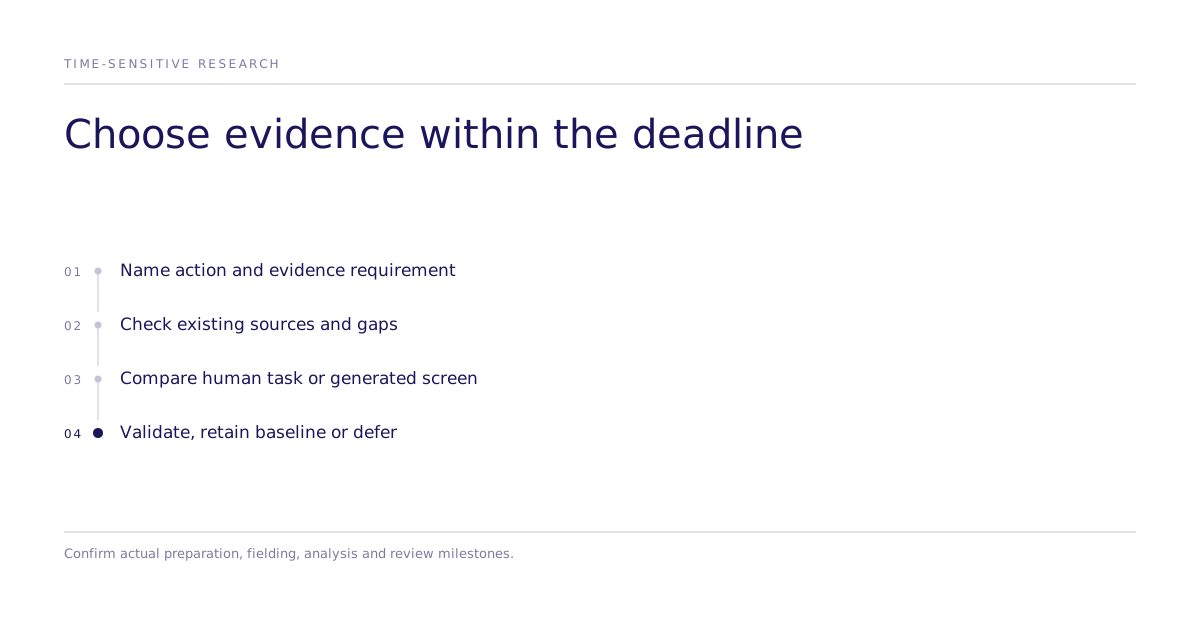
Bring the pending action, decision deadline, data sources, recruitment constraints and acceptance criteria to a study review. Assess aggregate method evidence separately from what the new study must establish.
Sources
- How Long Does Market Research Take? -- Drive Research
- Considering Custom #3: Custom Market Research Project Structure & Timeline -- MarketResearch.com