Consumer Insights Triage: When to Screen and When to Collect Human Evidence
When a stakeholder wants a positioning decision by the end of day, triage what evidence already exists and what remains unresolved. A generated screen may help nominate options when the audience is grounded, but it can also reject a real winner. Compare that route with a direct human pretest or deferring the commitment. The deadline does not establish same-day reviewed delivery.
Why does the fieldwork clock keep colliding with the decision clock?
Research timing depends on the method and audience. Drive Research's guide describes online projects that can take days as well as longer interview and mail projects. Request the actual schedule for design, data access, generation or recruitment, analysis, review and any validation.
The failure mode that follows is predictable: the team routes around research entirely, using internal assumptions or a single unstructured AI query with no defined audience or controlled comparison behind it. Neither replaces a study. Neither tells anyone which action is more likely to change behavior.
Is a triage layer a replacement for fieldwork?
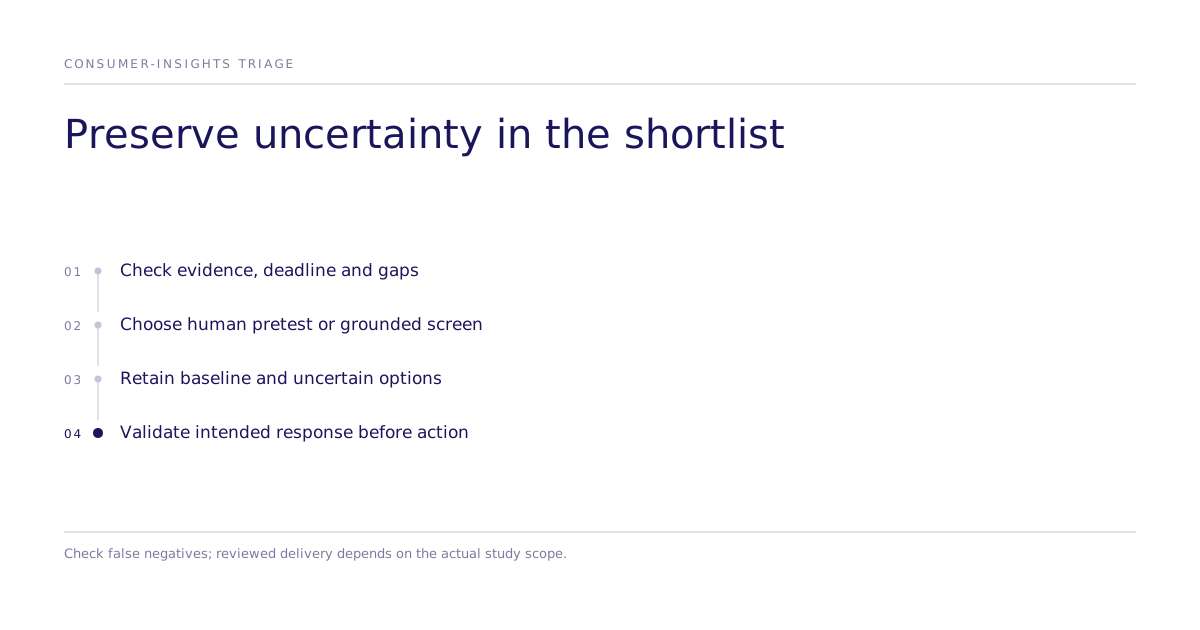
The fix is neither forcing every research question through the slow path nor abandoning recruited human research. It is splitting the work into two tiers with different jobs.
| Unresolved question | Evidence to consider |
|---|---|
| Which concepts merit further study? | A grounded screen or direct human pretest; retain borderline options and check false negatives |
| Is the concept understood or feasible? | Human comprehension or task observation and operational evidence |
| What effect does a defined offer have? | An identified comparison with explicit assignment, baseline and response source |
| Will the action work in the intended market? | Relevant independent human or live behavioral evidence and predeclared criteria |
A false-negative screen can eliminate the strongest concept before validation. Set conservative advancement criteria, retain poorly covered or uncertain concepts and the status quo, and independently check a sample of rejected alternatives when the decision loss warrants it.
Structuring the fast pass so it survives scrutiny
A triage pass needs a bounded decision and traceable evidence:
- Turn the stakeholder ask into a testable brief. Name the target audience, the competing hypotheses (for example, does the audience respond more to a functional-benefit claim or a transparency claim), and the exact stimuli to compare. Vague requests produce vague experiments.
- Choose the appropriate comparison. A survey can support randomized stimuli. Specify baseline, assignment unit, randomization, response source, estimator and uncertainty for an intervention test; keep open-ended exploration separately labeled.
- Inspect the estimate and raw responses. Use magnitude, uncertainty and planned segment checks. Objections and explanations can guide revisions as hypotheses, not proof of the causal mechanism.
- Test revisions independently. A revised or hybrid concept is a new hypothesis. Version it, use a fresh eligible sample or held-out generated contexts, compare against the baseline, and predefine the stopping rule.
- Record the action and limits. Name the endpoint, evidence, owner and validation still needed; keep unresolved or rejected options visible.
What evidence does a triage layer need before anyone trusts it?
The July 2026 causal-fidelity working paper reports mean Spearman correlation on estimated choice-parameter ranks of .73 across 43 design-filtered studies. This aggregate metric does not validate a new screening population or forecast sales. Confirm actual turnaround for the configured study rather than infer delivery from a historical runtime claim.
If generated and human results will be compared, align population, alternatives, assignment, instrument and endpoint where appropriate. Scope fielding, review and acceptance criteria separately, and record differences. Hypothetical human choices and observed purchases need distinct interpretation. Review aggregate method evidence, then scope the triage decision.
What this changes for the budget
Compare the total cost and decision value of a direct human pilot with a generated screen plus independent validation. Include grounding, design, screening, rejected-option checks, revisions, fielding and review. Do not assume the added stage always saves budget or improves the shortlist.