A Staged Evidence Model for High-Stakes Research
High-stakes research needs separate gates for exploration, causal comparison, human review, and real-human validation. A number without its limits is marketing, so the limit gets stated up front. Exploratory output can narrow what deserves testing. It should not become the basis for an executive, pricing, launch, or public claim until the evidence matches the cost of being wrong.
What is the operating-model decision?
A Head of Research or VP of Consumer and Market Research has to decide whether those gates are formal policy or an informal judgment made under pressure. A plausible but untested recommendation reaches an executive or goes public, then fails. The research function loses the credibility it needs to shape future decisions.
The U.S. Bureau of Labor Statistics projects employment growth for market research analysts from 2024 to 2034 (Occupational Outlook Handbook). The durable value in that role is judgment about questions, evidence, and claims. A staged operating model protects that judgment.
Four layers, four different jobs
Each layer answers a different question.
| Layer | Question it answers | Appropriate method | Failure if treated as final |
|---|---|---|---|
| Exploration | What hypotheses and alternatives deserve attention? | Drafting, source review, and open-ended option generation | A plausible framing is mistaken for evidence |
| Directional comparison | Which defined actions should advance to the next gate? | [Causal experimentation](/leaderboard) and discrete-choice-style comparison | A weak shortlist misdirects later validation |
| Human review | Are the audience, framing, sources, and business context fit for the decision? | Researcher review against explicit acceptance criteria | Hidden assumptions pass into a high-stakes claim |
| Real-human validation | Does the decision-critical effect hold with human participants? | [A study tested or validated with real human participants](/#why-it-works) | An expensive or public claim rests only on a simulated result |
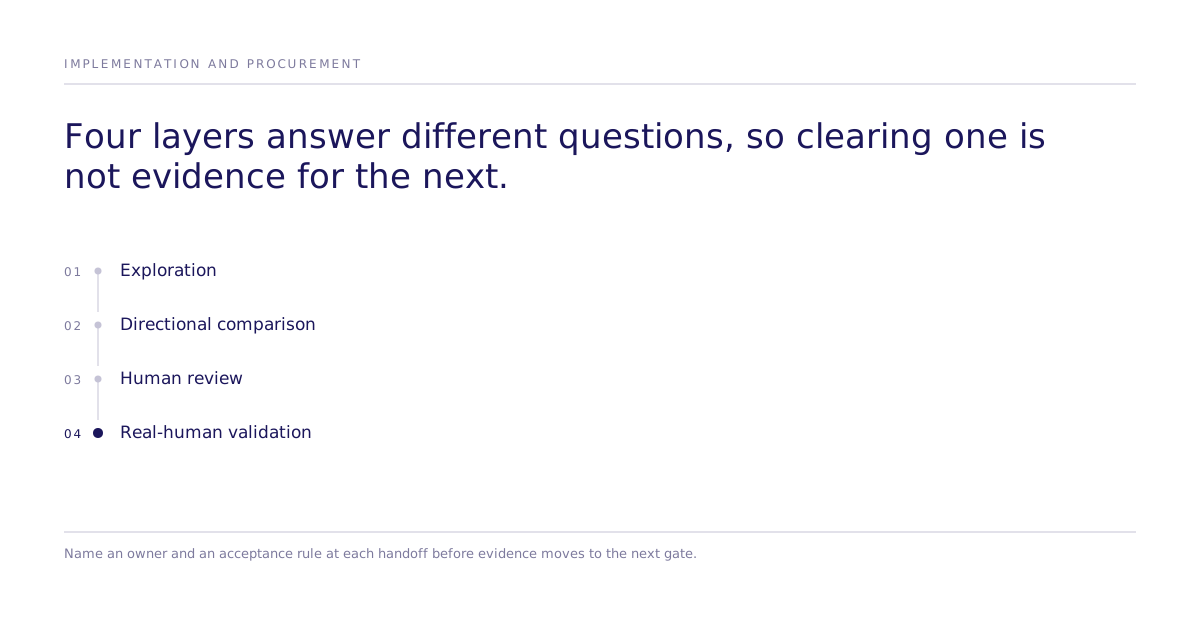
The handoff between layers needs an owner and an acceptance rule. Without both, exploratory material can become decision evidence simply because it is already in the deck.
Keep the causal question intact
Subconscious is a causal behavioral platform for testing product, pricing, messaging, and go-to-market actions before a team commits capital. Its method uses causal experimentation and discrete-choice-style comparison rather than open-ended roleplay.
That method fits the directional comparison layer. A team defines the action, audience, alternatives, and outcome. Subconscious compares the actions under a controlled study design. When the claim justifies another gate, the team can move from a simulated study to real-human validation.
The practical advantage is continuity: the team preserves the intervention, comparison, population, and outcome, so the evidence stays tied to the original decision through validation.
Set the validation trigger before the study
Before work begins, write down four questions:
- Which business decision will this evidence support, and what is the cost of choosing poorly?
- Which audience, action, alternative, and outcome define the causal question?
- Which result may remain exploratory, and which result requires human review?
- What evidence must exist before the claim reaches an executive or goes public?
The fourth answer is the validation trigger. Set it before anyone sees a preferred result, so the standard cannot shift once an appealing answer appears.
Why should boundaries be part of procurement?
Subconscious is one stage in this evidence system. A published boundary lets a buyer check the method before relying on it. It is not an automated decision engine, a packaged catalog or pricing optimizer, or a substitute for human review. It does not automatically produce confidence intervals, decision memos, or recommendations for every study.
A researcher still has to define the audience, check neutral framing, examine source grounding, and decide whether the stakes require real-human confirmation. Real-human validation also has a clear boundary. Naming that boundary is what lets a buyer check the claim against the method. It does not turn a causal action test into an observed usability session, a clinical trial, or automatic proof of market performance.
These limits should appear in vendor evaluation and study acceptance criteria. A buyer should be able to identify what the method compares, who reviews the design, what evidence advances the claim, and which decision remains with the accountable human.
Run a one-month operating exercise
Treat this as a 2026 planning example, not a delivery commitment:
- Pick one live decision.
- Write the decision and cost of choosing poorly in one sentence.
- Define the audience, alternatives, outcome, and risk level.
- Use causal comparison only for the directional layer.
- Review the design and result against the four validation questions.
- Present the result with its current evidence label and next gate.
Apply the sequence once a week for a month. At each review, record the current layer, the evidence available, the accountable reviewer, and the condition for advancing.
At the end of the month, inspect every handoff. The useful result is not a larger volume of output. It is a repeatable boundary between a hypothesis, a directional comparison, and evidence ready for a high-stakes decision.
Put one consequential claim through the gates
Bring one product, pricing, messaging, or launch decision to a working session. Define the action, audience, alternative, outcome, and validation trigger. The goal is a defensible path from a question to a decision, with human accountability at every gate.