A Triage Rule for the Solo Consumer Insights Manager
A solo insights manager has to route requests before committing a fixed budget and calendar. Product may need to compare onboarding flows, marketing may need an ad-copy check, and sales may need a positioning decision before Friday. An explicit intake rule helps the researcher choose among existing evidence, a modeled screen, recruited research, and an observed-use or live-market test.
Why can't every request get the same treatment?
A one-person research function has a fixed budget and a fixed calendar, and every request competes for both. Treating a minor packaging tweak the same as a final pricing decision means either the pricing decision gets shortchanged or the packaging tweak eats weeks it does not need. The U.S. Bureau of Labor Statistics tracks market research analyst work broadly; the tension of turning limited capacity into decisions the business can trust holds whether the analyst sits on a team of twenty or a team of one (U.S. Bureau of Labor Statistics).
The rule that resolves this is a triage decision, not a research methodology: sort every incoming request along two axes before choosing a validation path.
- Financial risk. How much money moves if the decision is wrong, comparing an ad headline against a final price point.
- Strategic stakes. How hard the decision is to reverse once shipped, comparing a copy edit against a product pivot.
Risk and reversibility set the burden of proof. Audience coverage and the required endpoint set the method. A low-budget request may still need real users to handle packaging or complete an onboarding task; a high-stakes descriptive question may need verified records rather than a randomized experiment.
A four-step workflow for running the rule
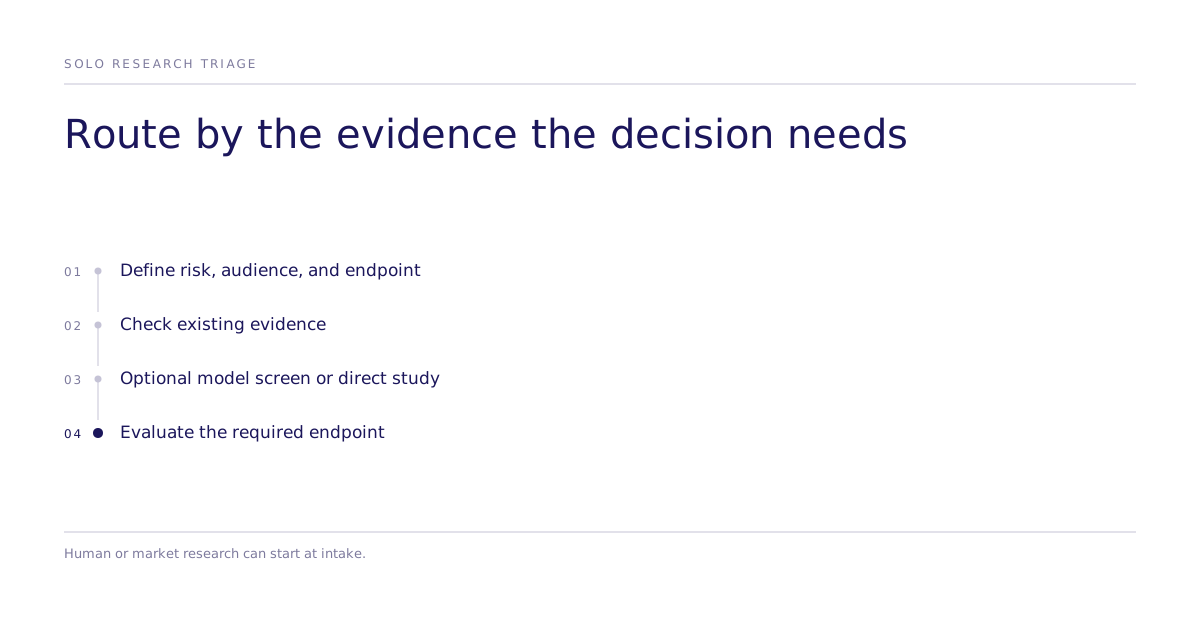
Step 1: Assess the decision risk at intake
Ask what breaks if the answer is wrong, who must be represented, and what would count as success. Request a concrete concept, claim, landing page, or question. Route sensory tasks, novel populations, regulatory claims, and actual-purchase questions to appropriate human, operational, or market evidence from intake. A small reversible copy decision may need only an existing record or a limited live comparison.
Step 2: Use a modeled screen when it fits the request
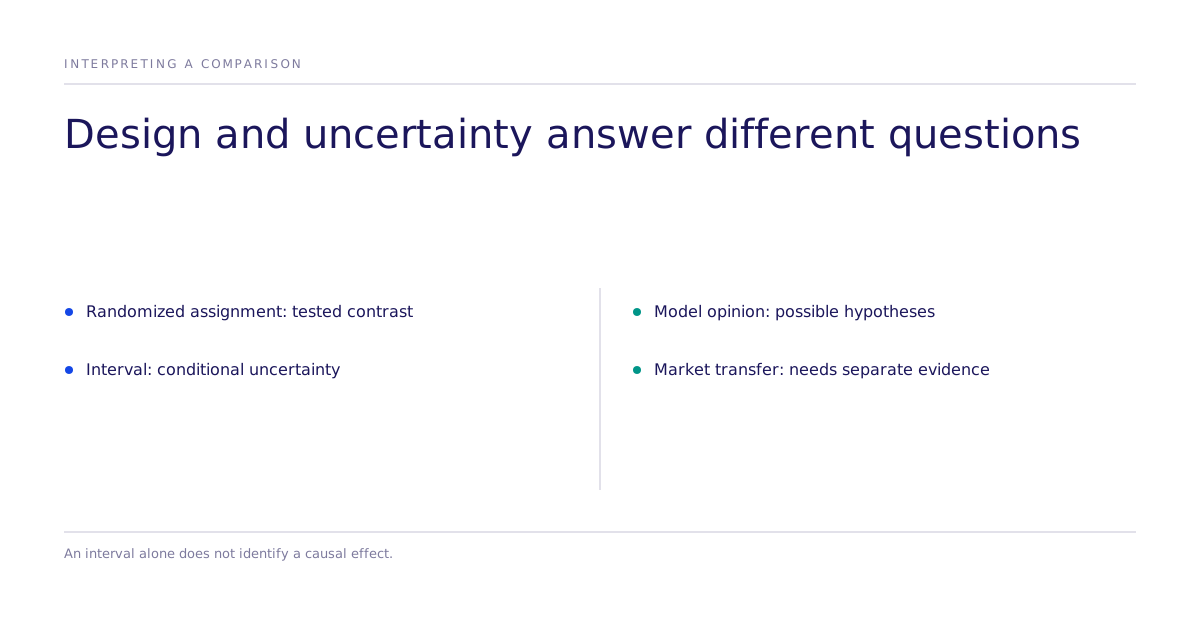
A structured comparison against a simulated population can expose assumptions and compare candidate concepts before recruitment. For a causal contrast within the model, specify the intervention, random assignment, comparator, and generated-choice endpoint. An interval describes uncertainty conditional on that design and model; it does not establish that real buyers will respond the same way. Discuss the required study setup with Subconscious and inspect the public evidence summary.
Step 3: Refine before you spend recruitment budget
Use the modeled results to revise unclear wording or identify hypotheses. Keep a baseline, borderline options, and options from poorly covered segments. A simulated loser may be a human winner. Set a stopping rule and reserve untouched human data or a fresh live comparison for evaluating the selected version; repeated tuning on the same answers is not independent validation.
Step 4: Reserve recruited human fieldwork for the requests that earned it
Where the decision requires recruited research, it can start directly or follow a suitable screen. Match the target population, interventions, comparator, and endpoint where possible, and document any differences. A stated-choice study measures stated choices; a usage test or live purchase test measures a different endpoint. Confirm recruitment, consent, timing, and analysis responsibilities in the project scope.
What is the simulation actually testing?
Random assignment can identify the effect of a tested intervention on the measured response under the study's assumptions. Changing a complete offer may change several attributes at once; its effect is the offer contrast, not an isolated price effect. The interval quantifies uncertainty for that estimate. It does not by itself identify causality, cover generator bias, or validate transport to a market. Unstructured model opinions can suggest hypotheses but do not supply a controlled comparison.
Where simulation stops being enough
Validation depends on the model version, audience, intervention, and endpoint. A pooled vendor percentage without a named study and metric cannot establish fit for the incoming request. Ask for independent evidence on the relevant population and a plan to test the decision against the human or behavioral endpoint it requires.
- A historical fit does not establish performance for a new category or changed economic conditions. Novelty increases the need for direct evidence.
- A generated-response interval does not quantify sampling uncertainty for a real population. Population estimates need an appropriate sampling and measurement design; recruitment alone does not make a sample representative.
- A simulated population does not experience physical reality: shipping delays, real financial transactions, the physical feel of packaging. Longitudinal tracking of real customer cohorts still needs real-world behavioral data.
Putting the rule to work on the next request
Apply the rule to the next request: record the decision, error cost, target audience, required endpoint, available evidence, and owner. Agree on what would change the action before collecting new answers. Book a walkthrough with that request to discuss which evidence path fits.