When a Simulated Panel Can Replace a Focus Group, and When It Can't
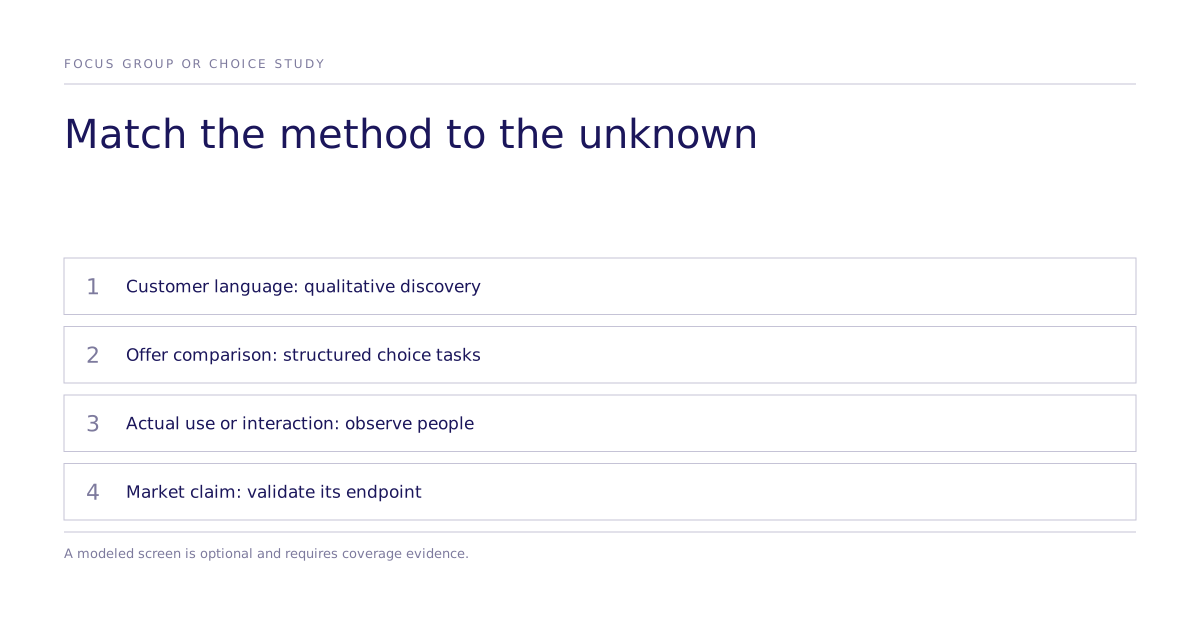
A simulated panel may support an early positioning or message screen when its audience and response model fit the question. It does not automatically replace customer language discovery, observed group discussion, or a human choice study. Choose the method by the unknown, target population, endpoint, and cost of an error; an individual-attitude question can also require direct human evidence.
What a Traditional Focus Group Is Built to Do
A moderated group session, a handful of unfamiliar participants gathered in one room, guided by a moderator working to keep the loudest voice from dominating, is a specific instrument. It is built for three jobs:
- Generating hypotheses. Pulling in a spread of first reactions to a new idea from people with different backgrounds, all in one room.
- Language discovery. Picking up the actual words and phrases real customers reach for when they describe a problem or a product.
- Exploring reactions in a group. Hearing participants respond to a concept and to each other's comments. This supplies qualitative observations; it does not by itself estimate population prevalence or identify peer influence.
Simulation can model social interaction: Artificial Societies, checked October 2026, documents networked personas, interactive focus groups, and scenario cascades. Those are vendor-described capabilities. Whether a particular simulation reproduces real human group dynamics requires separate validation.
A focus group can help discover language and hypotheses about individual attitudes. It is poorly suited to estimating how common an attitude is from a small selected group. Dominant voices, recruitment, moderator prompts, and setting all affect what the discussion reveals. Choose a survey or experiment when the decision requires a measured distribution or intervention contrast.
Where Does a Discrete Choice Simulation Fit?
A structured discrete choice study defines alternatives and attributes, presents controlled tasks, records choices, and specifies an analysis plan. It can use human or generated respondents. Randomized assignment supports the tested contrast under design assumptions; a generated-choice interval remains conditional on the response model and does not establish actual adoption.
The July 2026 causal fidelity working paper reports mean Spearman correlation of estimated choice-parameter ranks of 0.73 across 43 design-filtered studies and 0.55 across roughly 300 replications. These aggregate rank results do not establish replacement validity for a new focus group or product decision.
The Decision Checklist
| Signal | Points toward |
|---|---|
| Need customer vocabulary, context, or unresolved hypotheses | Human interviews or qualitative group discussion; model output can suggest probes |
| Compare several clearly specified alternatives | A structured human or modeled choice study, with an identified design and analysis plan |
| Compare defined segments | A design with adequate segment coverage; a model label alone does not establish representation |
| Need actual group reactions or peer interaction | Observed human discussion or a separately validated social simulation |
| Stakeholders need video footage or non-verbal cues for internal buy-in | Recruited human panel |
| A compliance or regulatory context requires documented human respondents | Recruited human panel |
| Need observed use, purchase, or evidence for a consequential claim | Direct behavioral or appropriate human research, with an optional preliminary screen |
Drive Research's November 2025 guide titled for 2026 estimates $7,000–$20,000+ per focus group, with audience, incentives, facilities, and reporting affecting price (provider guide, checked October 2026). This is a provider's ballpark estimate, not a market-wide tariff or a Subconscious comparison.
Designing the Study
1. Define the unknown and endpoint. If the unknown is how buyers describe a problem, start with qualitative discovery. If it is which complete offer they select, specify a choice task. If it is actual purchase, plan a behavioral test. Asking which positioning angle increases stated purchase intent does not measure purchases.
2. Specify the target audience. Include current solutions, category usage, buying role, constraints, and relevant context. A detailed generated persona is still a specification rather than a verified representative person. Define coverage requirements before selecting respondents; there is no universal three-to-five-persona rule.
3. Pilot the instrument. For an exploratory discussion, a short example guide might cover current workflow, unmet need, concept comprehension, concerns, and comparison with alternatives. Use a pilot to check clarity and burden. Question count and duration should follow topic complexity and participant needs.
4. Define structured choices separately. For a DCE, set attributes and levels, alternatives, opt-out where appropriate, task assignment, sample or model coverage, and the estimator. Independent interviews do not supply this design merely because respondents answer separately. Check identification before efficiency (ISPOR experimental-design report).
5. Analyze the measured response. Treat generated explanations as hypotheses, not verified buyer motives. For structured tasks, report the specified choice contrast and uncertainty. For human discussion, retain disagreements and context instead of presenting agreement as a prevalence estimate.
Can You Iterate Without Re-Fielding a Panel?
A modeled screen can be repeated with revised stimuli, subject to project scope. Repeated tuning does not create independent validation. Human studies can also include planned revisions or later sessions; recruitment needs depend on the design and consent. Reserve fresh data for the selected version and keep borderline or poorly covered options for testing.
When Does the Answer Still Need a Human Room?
Use human work where the decision requires actual customer language, physical interaction, observed social reactions, or documented respondent evidence. An appropriately sampled human stated-choice study still differs from actual market behavior. A final price decision may need operational and purchase evidence as well as stated choices.
Next Step
Write the decision, audience, unknown, and endpoint before selecting a format. A modeled choice screen may help refine alternatives; it can also be skipped when direct human or behavioral research fits better. Inspect the aggregate research evidence, then discuss a specific study scope and the independent validation it needs.