When to Test a Social Listening Signal Before You Act on It
A spike in negative sentiment, a competitor campaign, or an emerging complaint theme tells a brand lead to investigate what changed. Before acting, establish whether the signal reflects a real product or service problem and what evidence the proposed response needs. Monitoring existing posts is observational; estimating the effect of a new response needs a separate design. That design can recruit consenting respondents or use an authorized live experiment.
The cost of guessing after detection
The buyer who owns this decision, usually a brand or insights lead or a CMO, has to choose between two paths once a listening tool flags a signal: act directly on the finding, or test the proposed response before committing resources. Acting directly is faster but carries a specific risk: the people who post publicly about a brand are self-selected and vocal, not a validated sample of the broader customer base. A response built on their reaction alone can miss how the actual target audience responds. The cost of being wrong is the budget spent shipping a response that was never checked against the people it needs to convince.
Why isn't a public comment a validated response?
A public post, a human stated-choice task, a generated choice, and an observed purchase measure different things. None automatically establishes the others. A sentiment spike can suggest a hypothesis about a complaint or response, but does not identify the effect of shipping a proposed fix.
What monitoring tools and controlled experiments each do
| Job to be done | Social listening and monitoring | Controlled testing of a proposed response |
|---|---|---|
| Track organic brand or category conversation | Monitors available mentions, volume, and sentiment with platform and classification limits | Separately collects responses to defined stimuli |
| Flag a complaint theme | Detects changes in observed conversation | Can test a hypothesis raised by monitoring |
| Compare proposed responses | Monitoring alone does not assign interventions; a vendor may offer separate survey or testing tools | A valid randomized design estimates a contrast on its measured endpoint |
| Support a high-stakes public claim | Needs corroboration and claim-specific review | Needs appropriate population, endpoint, design, and legal or regulatory evidence; human recruitment alone is insufficient |
The 2025 ICC/Esomar Code calls for fit-for-purpose methods and disclosure of sources and limits. A monitoring record describes observed conversation. A controlled test compares assigned responses. A simulated test compares generated responses under its model; its estimated contrast does not establish market transfer.
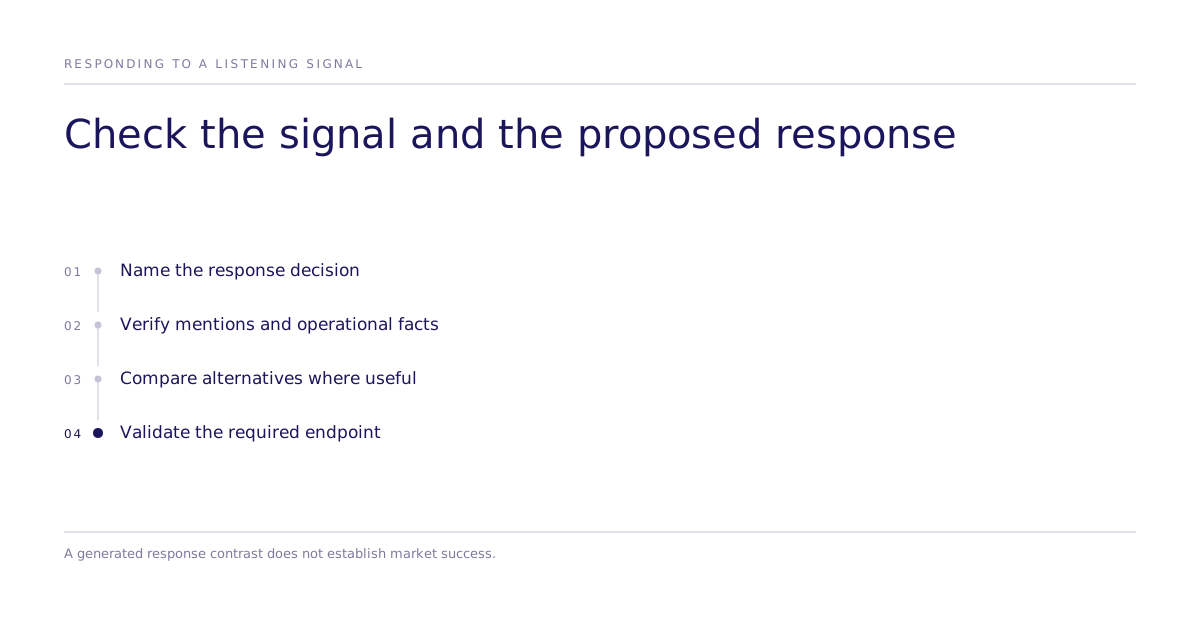
A four-step process for testing before you act
- Define the decision. State whether the signal calls for investigation, a product correction, a messaging change, or a public response. Urgent operational fixes need verified facts and an accountable owner; they need not wait for a preference study.
- Set up detection queries. Configure monitoring across three areas: brand and competitor mentions, category and industry conversation, and specific customer-experience complaints.
- Check and prioritize themes. Deduplicate mentions, inspect examples and bot or campaign effects, and compare complaints with support and operational records. Assess severity, segment coverage, and actionability rather than assuming a frequent theme is representative.
- Match evidence to the response. For a message comparison, define the audience, comparator, assignment, endpoint, and decision rule. For an actual service defect, verify the defect and fix. Use direct human or market testing when required; an optional modeled screen should retain borderline and poorly covered alternatives.
How does Subconscious test a proposed response?
A Subconscious study may provide a structured comparison of proposed messages or concepts for a specified audience. Confirm the study's design and deliverables in scope. Treat generated-choice results as conditional modeled evidence and compare them with independent human or behavioral data when the decision requires it.
For example, a hypothetical delivery-delay complaint could prompt comparison of an explanation-only message with an explanation plus a tracking link. A randomized human test could measure comprehension and trust; operational records would separately establish whether tracking reduces support contacts. A simulated trust response does not prove either service performance or actual retention.
What does this not replace?
Ongoing monitoring, verified operational records, and appropriate human or behavioral research remain useful. Historical model fit does not establish performance for an unprecedented event. Avoid promising that a preferred simulated response will work in the market; record what would disconfirm it and who owns the next check.
Next step
Bring a proposed response, its comparator, and the action you would take to a study discussion. Review the public research evidence, then specify whether the decision needs comprehension, stated preference, operational improvement, or actual customer behavior.