AI Panels for Luxury Brands: Testing Positioning Before It Ships
A luxury brand leader choosing positioning, price framing, a category extension, or a retail concept needs evidence about a narrowly defined audience. Recruitment feasibility, respondent qualification, confidentiality, and physical experience can constrain the design. Assess those constraints for the actual market rather than assume affluent customers are unavailable or will never reconsider a brand.
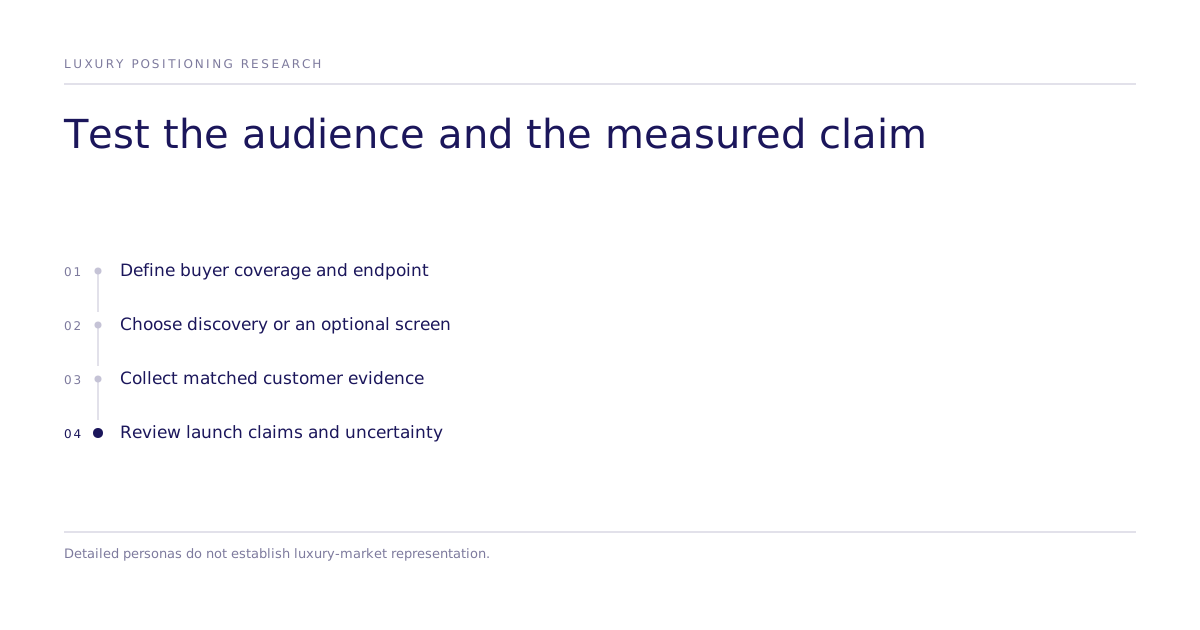
A structured modeled comparison may help screen narratives or complete offers when its audience coverage is supported. Direct customer discovery or a boutique pilot can also begin first. Specify the measured endpoint and independent evidence required before treating generated preferences as a real-customer response.
Why Luxury Research Breaks the Standard Playbook
Three issues to investigate when scoping luxury research:
Qualification. Define the category, purchase history, geography, and decision role, then ask a fieldwork provider how those criteria can be verified. Wealth alone may not identify the buyer of the relevant product. Blind recruitment and NDAs are design options, not universal luxury-research practice.
Participation. Martin Ravallion's June 2021 discussion of rich non-responders concerns income-selective nonresponse in household surveys. It does not establish participation rates for your luxury segment. Request evidence on recruitment incidence, refusal, and coverage for the intended study.
Measurement. Discussion about taste, stated choice, touching a product, and buying it are different endpoints. Select interviews, a structured choice study, observation, or a sales pilot according to the unknown. Generated explanations cannot establish what actual customers mean by craftsmanship or exclusivity.
A modeled study can avoid recruiting respondents for that stage. It still incurs design and analysis work, and confidentiality depends on contracts, retention, provider access, and security controls. Confirm permitted inputs and data handling before sharing unreleased designs; simulation does not guarantee that nothing leaks.
What Does a Well-Specified Luxury Audience Require?
Define luxury audiences as testable specifications rather than verified model coverage. Variables may include category purchase history, geography, buying role, current brand use, and relevant price range. The following segments are illustrative hypotheses; none is a documented Subconscious audience or a recommended sample size.
| Segment (planning example) | Definition |
|---|---|
| HNW, Tier-1 European cities | Ages 40–60, primary plus secondary residence, brand-loyal to one luxury category |
| First-generation affluent, Asia | Hong Kong, Shanghai, or Tokyo, ages 30–45, early-career luxury buyers |
| Multi-generational wealth, US | Ages 50+, decades of brand-curated taste |
| Quiet-luxury, mid-career | $250K–$1M household income, brand-skeptical, prefers understated craftsmanship over logos |
Ask the provider which proposed traits and geographies are supported, how coverage is assessed, and what independent matched validation exists. A detailed persona description does not establish representative person-level coverage or make the audience recruitable. Unsupported traits should remain explicit assumptions.
For example, a luxury fittings manufacturer might define premium-residence renovation buyers and compare alternative brand stories. The audience criteria and alternatives are hypothetical. Size any modeled or human study from the design, decision-relevant effect, precision, dependence, and subgroup requirements rather than use 100 respondents as a validity threshold.
Six Decisions Where This Method Applies
1. Brand story validation
Compare draft collection stories on a defined response such as comprehension or stated fit with the brand. A modeled result can suggest which claim to investigate; it does not establish authentic customer interpretation without appropriate customer evidence.
2. Price-point strategy
Compare complete offers and identify whether the contrast isolates price or changes the framing too. Stated willingness to pay is not realized demand. Use actual purchasing and operational evidence when the decision concerns sales or margin.
3. New category entry
Compare extension concepts among intended and current customers, with the existing offer as a baseline. Keep poorly covered segments and borderline concepts for direct testing rather than discard them solely on generated choices.
4. Retail experience concepts
Use description-based screening to identify hypotheses about greetings, appointments, or follow-up. Actual service flow and physical experience require observation or a pilot; a simulated description cannot establish how a boutique feels.
5. Communications and editorial voice
Compare draft communications for defined comprehension or preference outcomes. Review claims and tone with accountable brand owners and relevant customers; generated explanations do not establish all buyers detect intent in the same way.
6. Demographic expansion
Assess coverage of the new audience and existing base separately. Compare responses where appropriate, then test actual experience or behavior required by the expansion decision.
A Worked Example, as a Planning Reference
The following is a hypothetical eight-week planning example. The audience, sequence, and calendar are assumptions, not a previous engagement or a standard Subconscious delivery promise.
A hypothetical bathroom-fittings house wants to compare launch stories for a flagship product. Its planning calendar could look like this, subject to recruitment, creative development, review, and fielding feasibility:
| Stage (planning example) | What was tested |
|---|---|
| Week 1 | Review customer and advisor records, define renovation-buyer coverage and baseline |
| Weeks 2–3 | Pilot and compare material, heritage, and architectural concepts; optional modeled screen |
| Weeks 4–5 | Revise story drafts; retain baseline and borderline alternatives for independent customer comparison |
| Week 6 | Test complete price-framed offers; review purchasing and margin assumptions separately |
| Week 7 | Check launch-material comprehension and observe relevant service tasks |
| Week 8 | Review supported claims, evidence gaps, readiness, and decision ownership |
The comparison can identify differences on the measured responses under the study's assumptions. It cannot guarantee the intended customer will buy or infer physical quality from a story alone. Decide what evidence would change the launch plan before inspecting results.
What Does This Method Not Replace?
Record weak or contradictory results alongside favorable ones in the project evidence. Model outputs can suggest story alternatives and compare generated choices, but actual customer relationships, product experience, and buying behavior need their own evidence.
Where human comparison is needed, confirm recruitment and study scope. Preserve the intended contrast where feasible and document instrument or population adaptations. A new evidence source does not automatically preserve the question or provide certainty.
Use each result for the endpoint it measured. Assign a launch owner to weigh customer, creative, operational, and commercial evidence with the remaining uncertainty.
Getting Started
Bring one positioning, price-framing, or retail-concept decision to a scope discussion. Specify audience coverage, alternatives, comparator, endpoint, and the independent customer evidence needed. Read the public research evidence as aggregate context, then confirm feasibility and data-handling terms for your project.