Automotive Research: Test EV Buyer Decisions Before Launch
Automotive teams can use controlled behavioral experiments to compare EV propositions, pricing, launch messages, and dealership interventions before committing a model or campaign. The method works best when the team names one action, one alternative, a defined buyer group, and the response that would change the decision.
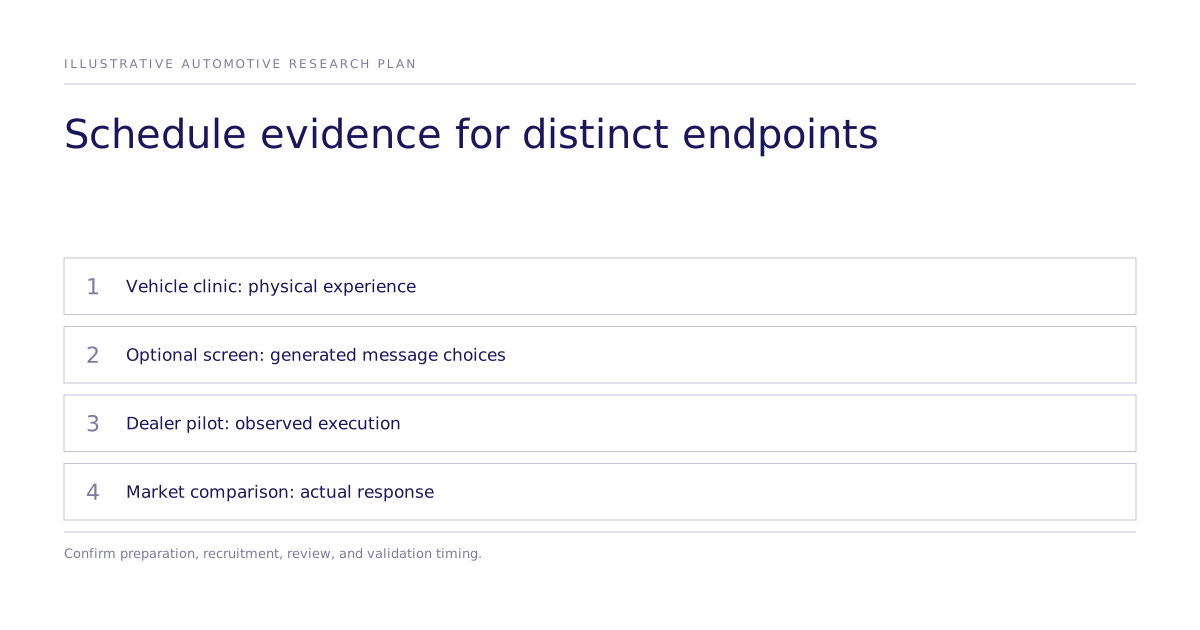
A modeled screen does not reproduce vehicle clinics, observed driving, engineering and safety evidence, dealer execution, or actual purchases. It can help refine alternatives under its assumptions. Keep baseline, borderline, and poorly covered options for independent testing so an early rejection does not discard a valuable proposition.
Which automotive decisions are suitable for an experiment?
The strongest candidates are decisions where the team can vary a commercial action while holding the rest of the choice context stable. Subconscious research centers on that intervention, not a persona conversation.
| Decision | Alternatives to compare | Response to examine | Evidence still needed |
|---|---|---|---|
| EV proposition | Range, driving experience, or premium ownership | Choice or consideration under the controlled alternatives | Vehicle clinic and in-market response |
| Price or package | Defined price points, trims, finance framing, or feature bundles | Directional change in choice across buyer groups | Commercial, margin, and market validation |
| Launch message | Claims, headlines, campaign narratives, or proof order | Which message produces the stronger decision-specific response | Creative testing and live campaign evidence |
| Dealership intervention | Sales scripts, charging explanations, or test-drive prompts | Which intervention reduces rejection or increases stated next-step choice | Dealer pilot and observed conversion |
| Fleet offer | Pricing structure, residual-value message, or transition support | Choice across defined fleet-buyer profiles | Direct fleet-customer and dealer evidence |
Why does the research cadence break?
Major studies and smaller comparisons can run in parallel where the design allows. The following durations are hypothetical scheduling inputs, rather than market averages or Subconscious delivery times. A sum applies only if the stages are fully sequential.
| Activity | Illustrative duration |
|---|---|
| Clinic recruitment | 4 weeks |
| Survey deployment | 2 weeks |
| Field interviews | 3 weeks |
| Synthesis | 2 to 4 weeks |
| Total from brief to decision material | 11 to 13 weeks |
Arm's July 10, 2025 article describes pressure from competitors delivering in 18 months and virtual development. It does not establish an industry-wide 18-month vehicle cycle or a standard research deadline.
An optional screening lane needs time for stimulus preparation, design review, execution, interpretation, revision, and independent checks. Scope those dependencies and capacity directly. No fixed number of fast passes follows from the clinic calendar.
How should an EV buyer experiment be designed?
Start with the action, not the persona. Define the buyer group tightly, then expose each group to the same choice context with only the intervention changed.
Planning examples, not universal segments: pragmatic switchers, premium loyalists, reluctant switchers, and conquest buyers for a proposition study; first-time EV buyers weighing a 35,000 to 50,000 euro purchase for pricing; drivers of premium German combustion vehicles for a dealership scenario; a 200 to 1000 vehicle corporate fleet mid-transition for a fleet study. Substitute your own market data and decision threshold.
The experiment then needs five explicit parts:
- The action under consideration.
- The alternative or control.
- The buyer population and relevant segments.
- The choice or behavioral response that matters.
- The evidence that would confirm or overturn the result.
Pricing comparisons should specify complete offers and whether changes isolate price or also alter finance terms and features. Choice estimates can inform a pricing decision, but commercial modeling and actual purchase evidence determine whether the proposed price is supported.
What can teams test across the automotive journey?
EV propositions and model-year communication
Compare defined response to range, driving experience, ownership, charging support, or a model-year update. Use the result for a specific next study or decision, with uncertainty. Keep novel or poorly covered concepts available for direct testing.
Dealership interventions
Text scenarios can compare generated responses to sales scripts about charging, financing, service, or a test-drive invitation. The public evidence record is aggregate; per-study replication data are not public. Text output does not reproduce cabin materials, acceleration, haptics, salesperson behavior, or showroom pressure. A dealer pilot is needed for observed execution or conversion.
Fleet and B2B offers
An early experiment can compare residual-value communication, transition support, pricing structures, or B2B sales messages across defined fleet profiles. Naming the failure mode here lets a buyer check the claim against what the method can actually do. The result is a pressure test, not a replacement for direct fleet-customer or dealer-network relationships.
Competitive positioning
A controlled comparison can place the proposed vehicle beside a named Chinese competitor and an established European competitor, testing which proposition earns consideration and how that changes by buyer group. Current product facts and live market evidence still need separate verification.
What does a 9-week launch plan look like?
The scenario below is illustrative: not a delivery estimate, customer result, or current Subconscious package.
A premium European OEM brings a mid-size EV to market, priced between 45,000 and 55,000 euros, with 9 weeks from brief to first asset live and controlled comparisons at four points in the cycle.
| Timing | Planning activity |
|---|---|
| Week 1 | Define buyer coverage, comparator, endpoint, and decision rule from relevant market evidence; confirm sample and model requirements |
| Weeks 2-3 | Compare three positioning concepts. Concept A leads with range. Concept B leads with driving experience. Concept C leads with premium ownership. |
| Week 4 | Refine concepts under a stopping rule; retain baseline and borderline options for a fresh comparison |
| Weeks 5-6 | Run comparisons across the copy: five versions of the hero line, three headlines, and a pair of campaign manifestos. |
| Week 7 | Test dealership scenarios and decide whether three concrete script changes merit a dealer pilot. |
| Week 8 | Compare final pricing communication, including financing framed as monthly cost or value over the vehicle lifetime. |
| Week 9 | Review launch readiness using the required clinic, dealer, market, and claim evidence; do not equate repeated model runs with validation |
Each test should answer a decision question; a fast result that changes nothing is not useful.
Where does this fit in the research stack?
Controlled experiments fill the gap between major studies; they do not replace them.
| Research layer | Illustrative cadence | Best use | Main limit |
|---|---|---|---|
| Brand tracker | Scope from decision and data availability | Market and brand movement | Observational trends alone do not identify an intervention |
| Segmentation | Scope from audience change and use | Audience structure | Needs verified coverage and stable definitions |
| Vehicle clinic | Scope from product and recruitment needs | Physical experience and observed tasks | Does not alone establish market demand |
| Optional modeled comparison | When coverage and decision fit | Compare generated responses to alternatives | Conditional on model; independent transfer evidence needed |
If human comparison is needed, confirm recruitment and fielding scope. Preserve the intended contrast where feasible and document differences in population, stimuli, and measurement. Direct human or live testing can begin before a modeled screen.
Review the case-study evidence for its specific source and endpoint; it does not establish this EV launch result.
What will the experiment not tell you?
Publishing the limit alongside the result lets a buyer see exactly what the method cannot yet answer. It cannot reproduce a ride-and-drive, cabin feel, acceleration, engineering performance, safety, dealer execution, or actual market demand. It is weaker when a category is truly novel and buyers have no stable reference, and results are sensitive to elicitation, calibration, and study design.
The right stop point is a prioritized action with explicit limits. High-stakes vehicle, pricing, and dealer decisions still belong in clinics, real-human research, field pilots, or in-market tests.
What is the useful first step?
Choose one upcoming decision with real cost: an EV proposition, a defined pricing scenario, a model-year message, or a dealership intervention. Write down the alternative, buyer group, target response, and evidence that would change the decision. Then scope the experiment and its validation path before building the full launch plan.