How to Test Patient Messaging in a Regulated Environment
On this page
A pharma brand team testing patient messages needs review before collection and again before final use. Early medical, legal, and regulatory input defines supportable claims, required risk information, and acceptable stimuli. A randomized comparison can then evaluate a specified response among eligible participants or a modeled audience with documented coverage. Final execution review remains necessary.
- Review claims, labeling, risk presentation, audience, and design before testing the supportable candidate set.
- Test risk information in the intended format rather than omit it and add it after selecting a message.
- Ratings, comprehension tasks, stated choices, and clinical-encounter behaviors are different endpoints. A randomized rating test can identify a tested rating contrast.
- A limited authorized in-market pilot can inform remaining media allocation; clicks or site visits need not pass through a prescriber.
- Aggregate model replication ranks do not validate this patient's message response or clinical behavior.
What should happen before the comparison?
Ask the reviewers which candidate claims and presentations are supportable under the applicable labeling and evidence. Keep the rationale for excluded versions, then pilot comprehension and burden. This prevents testing an unsupported claim while leaving room to compare valid alternatives. After results, assess the selected execution again in its final context.
Which patient response does the test measure?
Appeal, believability, comprehension, and stated intent describe responses in the study. A randomized assignment can estimate differences in those responses under design assumptions. It cannot establish actual questions asked in a consultation, prescriptions, adherence, or clinical outcomes without a design observing those endpoints.
What can an in-market pilot add?
Clicks, site visits, and recall can occur before any clinical conversation. They are proximal campaign outcomes rather than necessarily prescriber-mediated outcomes. An authorized limited pilot can compare valid executions and guide remaining allocation. Prescription or clinical outcomes require appropriate measurement, timing, review, and a separate identification argument.
How should the randomized message comparison be designed?
Specify audience, comparator, measured endpoint, assignment, exposure format, analysis, and action threshold. For an element effect, vary that element while preserving required context; if multiple elements change together, estimate the combined execution contrast. For generated respondents, identify the endpoint as modeled comprehension or stated choice, with coverage and independent human validation requirements. An interval is conditional on design and model, not a guarantee of clinical or market transfer.
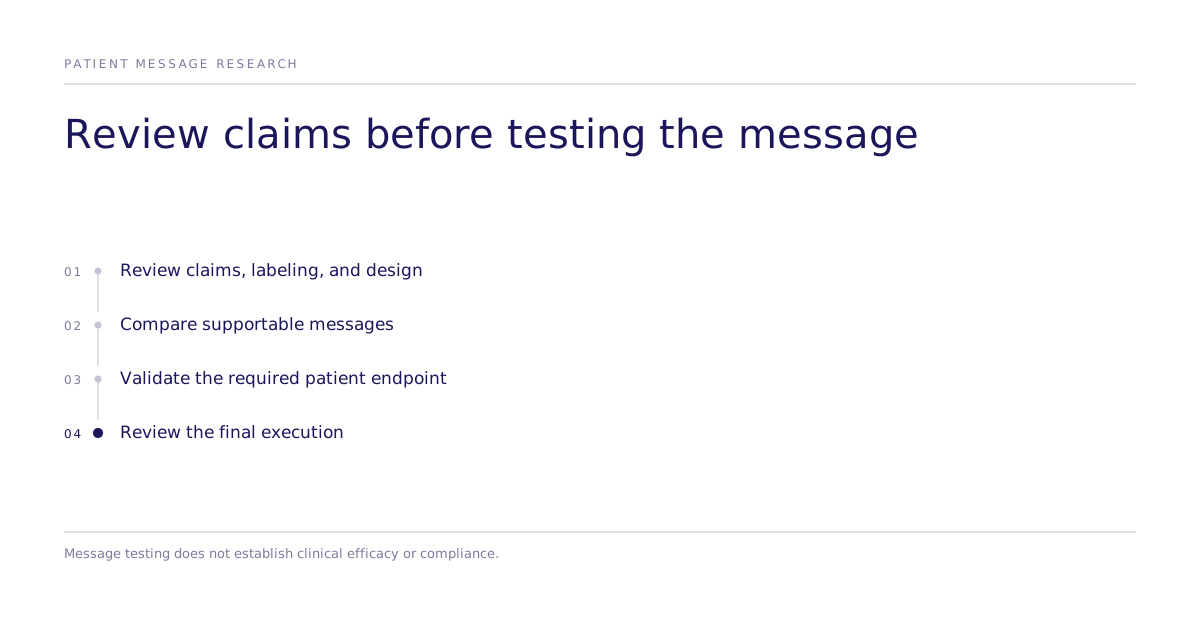
Retain a baseline and borderline messages for independent checks where early rejection would be costly. Report weak or contradictory results with favorable ones. Reviewers should inspect sources, diagnostics, deviations, and the claim supported by each endpoint rather than treat the selected message as automatically ready.
Which broadcast risk-statement rule applies?
For U.S. human prescription-drug ads directed to consumers in TV or radio format that name the drug and conditions of use, FDA's CCN rule requires the major statement about side effects and contraindications to be clear, conspicuous, and neutral (FDA final-rule guidance). The rule took effect May 20, 2024, with compliance required November 20, 2024 (FDA FAQ). The rule is format-specific; appropriate reviewers determine the requirements for the actual execution and channel. Testing text alone does not assess competing audio, pacing, or visual presentation.
How reliable is a simulated randomized comparison?
The July 2026 causal fidelity working paper reports mean Spearman correlation of estimated choice-parameter ranks of 0.73 across 43 design-filtered studies and 0.55 across roughly 300 replications. These are aggregate ranks, not patient-message accuracy, comprehension calibration, or clinical-encounter validity. Published benchmark exposure remains a concern requiring independent new-task evidence.
Randomization and design assumptions support identification of the tested contrast. Multinomial logit, mixed logit, or ICLV are analysis choices, not causal guarantees. Choose an estimator for the actual data and outcome; ratings do not become choice data merely because a choice estimator is available. The public evidence record is aggregate; per-study replication data are not public.
Three ways to test a patient message
| Ratings or comprehension study | Authorized in-market pilot | Modeled comparison | |
|---|---|---|---|
| Endpoint | Human stated ratings, comprehension, or choice | Observed proximal or behavioral response actually collected | Generated response conditional on model and task |
| Timing | After initial claim/design review; can precede final execution review | After required approval for the pilot; can guide remaining allocation | After design and input review where model coverage fits |
| Candidate set | Supportable stimuli defined with reviewers | Approved executions and exposure limits | Supportable stimuli with documented stimulus/model fidelity |
| Evidence limit | Does not automatically measure clinical behavior | Effect applies to identified pilot conditions and endpoint | Does not establish actual patient or clinical response |
| Next check | Final execution and any required behavioral validation | Monitor safety, operational outcomes, and transfer | Independent matched human or behavioral comparison |
What to do next
Bring the candidate messages, approved-labeling basis, required risk information, intended formats, target patients, and endpoint to a study discussion. Confirm initial claims/design review, recruitment or model coverage, independent evidence, and final execution responsibilities. Human message testing does not replace clinical substantiation or authorize promotional use.