Payer Perception Research When You Cannot A/B Test
On this page
Payer perception research can test responses to alternative value stories when a live formulary experiment is impractical. It estimates stated or generated responses to the dossier elements shown; actual coverage, contract terms, and committee deliberation remain separate outcomes.
A market access lead preparing a payer meeting can compare feasible value stories before committing to a dossier. Whether a field experiment is possible depends on the units, sample, decision process, permissions, and interference between plans. A choice experiment offers a different endpoint: responses to hypothetical dossiers. Use that endpoint to improve preparation without calling it an observed coverage decision.
- A live payer experiment may be impractical when committees are few, negotiations differ, and treatment can spill across decision makers; assess the actual setting.
- Test evidence-grounded presentation choices, economic framing, feasible contract structures, and restriction criteria.
- Randomized choice tasks can estimate contrasts on stated or generated responses. Intervals depend on sample, model, and design assumptions.
- General replication benchmarks do not validate payer coverage, reimbursement acceptance, or negotiating terms for a new product.
- Payer interviews can inform attributes before a study and interpret unresolved questions after it.
Why can a live payer experiment be difficult?
A team usually cannot observe both counterfactual outcomes for the same committee at the same time. That is a general causal-inference problem, not proof that all payer experiments are impossible. A design across suitable units might be feasible in some settings; a small set of different committees with negotiated outcomes can make comparable assignment and precision difficult.
Before rejecting a field design, document the eligible units, decision timing, treatment permissions, expected sample size, and likely spillovers. Small samples can limit precision, while negotiation can change exposure. If these constraints make the live endpoint impractical, state the limitation and choose a research method that answers a narrower question.
Randomizing dossier presentations to recruited payer professionals can estimate effects on their stated evaluations or choices under the study design. Using a modeled population estimates generated responses instead. Neither endpoint establishes what a particular P&T committee will approve, and a confidence interval does not bridge that gap by itself.
What advisory boards get right, and where they stop
Advisory interviews can reveal unfamiliar objections, language, clinical questions, and negotiation context. They help define attributes before an experiment and interpret findings afterward. A thematic interview study is not designed to estimate a randomized attribute contrast, but the absence of an interval does not erase the value of qualitative evidence. Record participant roles, recruitment, conflicts, and how the findings inform the dossier.
The decision in front of you: value story, price, contracting posture
A market access lead may need to choose a value story, price, and contracting posture before formulary and pathway discussions. The meeting can also be part of an ongoing process. Define the immediate decisions:
- Which clinical endpoint leads the narrative, and which becomes supporting evidence.
- Whether the dossier argues budget impact or cost offset as the primary economic frame.
- Which restriction criteria get conceded before the meeting and which get defended.
- How the rebate and contracting structure gets positioned relative to list price.
Research can compare possible presentation or concession sequences, but a hypothetical response is not an actual negotiation. Track what the committee requested and how the final terms changed to evaluate the preparation afterward.
What should a dossier experiment vary?
Vary realistic presentation choices and feasible terms. Clinical benefit and comparator claims must remain tied to supporting evidence; a team cannot change them simply to improve a preferred response. If hypothetical future evidence is included for planning, label it clearly. Specify the payer roles, tasks, baseline dossier, and response endpoint. Check precision and model fit, and state that the estimate concerns the study's stated or generated evaluations.
Price and rebate tasks do not involve a signed contract or a real budget allocation. The resulting sensitivity may differ from negotiated behavior, and there is no verified basis here for assuming that it always overstates concessions. Use it as a scenario input with uncertainty; set negotiating boundaries using economics, policy, and actual commercial evidence.
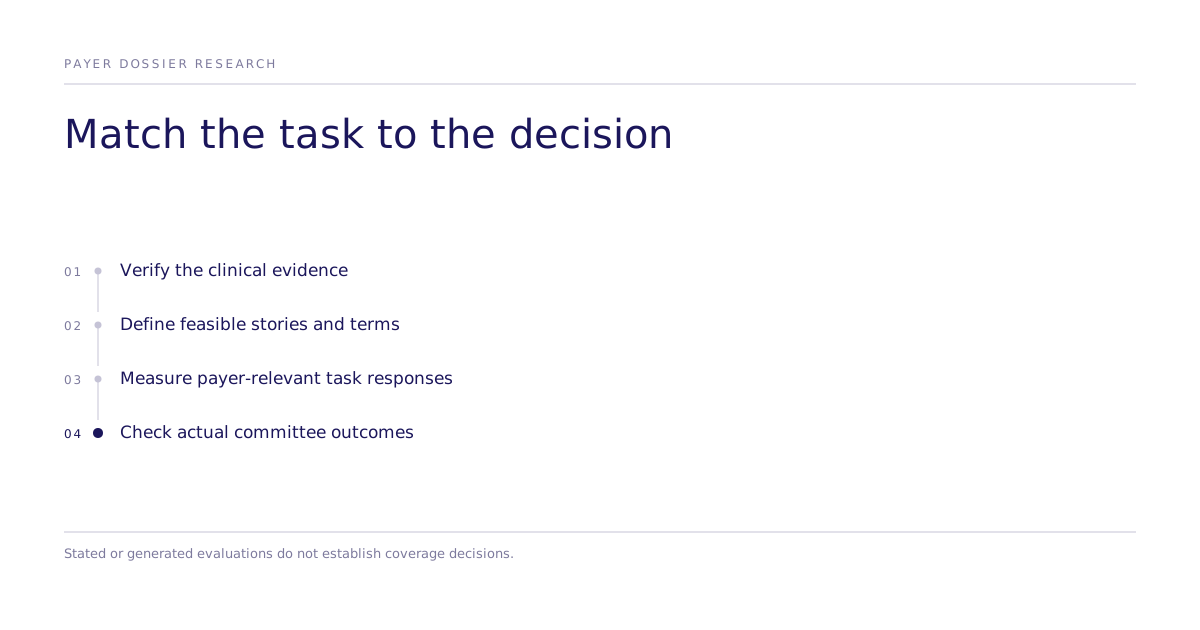
Which estimator: McFadden discrete choice, mixed logit, or ICLV?
McFadden choice models, mixed logit, and ICLV analyze the task responses. Identification comes from the design and assumptions, rather than the estimator's name. Standard multinomial logit imposes substitution restrictions; mixed logit allows preference heterogeneity, with fit and identification still to check. An ICLV latent construct needs a measurement model and supporting indicators; it is not direct observation of a hidden motive. Choose the estimator and precision criteria before collecting responses.
What validation is relevant to a simulated payer study?
A general choice-replication benchmark is useful context, but it does not establish payer-specific coverage accuracy. Ask for independent evidence matched to payer roles, clinical and economic attributes, and the intended task endpoint. Also ask how the design checks population coverage, training-data overlap, and sensitivity to model choices.
| Evidence | What it supports | What needs a separate check |
|---|---|---|
| Human payer choice study | Stated evaluations of the tested dossiers | Actual committee decisions and negotiated terms |
| Simulated dossier study | Generated responses under its model and design | Agreement with matched human tasks and actual outcomes |
| General replication benchmark | Aggregate estimated choice-parameter rank agreement | Performance for this product, payer population, and endpoint |
The July 2026 Causal Fidelity paper reports mean Spearman choice-parameter rank correlations of .73 across 43 design-filtered studies and .55 across roughly 300 replications. These are not a planning accuracy for a new therapeutic area. Per-study replication data is not public; the leaderboard provides an aggregate summary. Regulatory submissions and health technology assessments require evidence suited to the applicable authority and claim, which this aggregate benchmark does not establish.
A useful example of outcome validation comes from Kossmeier and colleagues' 2021 Austrian reimbursement study. They compared company sales forecasts with actual reimbursed sales for 102 products submitted during 2005–2014 and accepted for out-of-hospital reimbursement, with at least three years of sales data. That study concerns sales forecasts, not the accuracy of payer perception methods. It illustrates why a task response and a later commercial outcome need distinct evidence.
What a defensible design documents
Document attribute justification, feasible levels, choice-task construction, recruitment, sample composition, estimation, and uncertainty so a health economics group can assess the study. Bridges et al.'s 2011 ISPOR conjoint checklist provides a starting point. Record the endpoint and limitations alongside the results, including which conclusions require clinical, policy, or actual negotiation evidence.
Where the real advisory board still earns its budget
Use payer interviews before a study to identify realistic concerns and language, and afterward to examine findings that remain uncertain. Where a committee's procedures, clinical evidence requirements, or policy constraints control the decision, obtain the relevant records and professional interpretation. A model ranking does not settle those questions.
Mark which dossier choices are evidence-bound, which are feasible presentation or commercial alternatives, and which remain unknown. Then decide whether interviews, a human choice study, a modeled screen, or a live design addresses the next uncertainty. Bring those decisions and the intended endpoint to the team.