Research Methods for Hard to Reach Prescribers and Rare Disease Populations
On this page
A commercial or medical affairs lead researching a rare disease or narrow specialty needs to assess what the available population can support. Choose the hypothesis, endpoint, design, and precision requirements before ruling out a human choice study. Interviews, efficient choice designs, records, and modeled screens answer different questions; increasing generated sample size cannot establish coverage of a missing real population.
- Sample requirements depend on the hypothesis, effect size, estimator, design, and desired power or precision, rather than a universal respondent minimum.
- A 2015 review of 69 health DCEs published in 2012 found that 49 did not clearly report a sample-size method. Missing reporting does not prove that every study was underpowered (de Bekker-Grob et al.).
- Interviews can discover attributes and assess wording; a quantified contrast needs an appropriate design and uncertainty assessment.
- A clinically described simulated population generates responses under model assumptions. Matched human evidence is needed before claiming that it represents rare patients or prescribers.
- General choice-replication results do not validate a new indication or provide a therapeutic-area run record.
The arithmetic problem in rare and narrow-specialty research
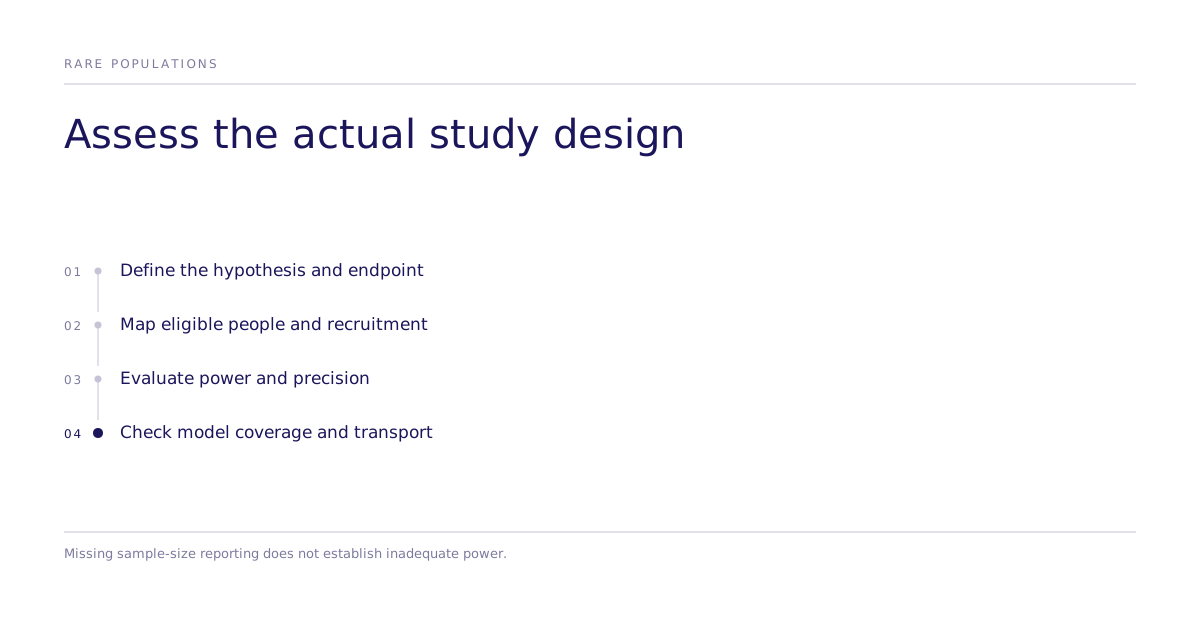
For a human DCE, specify the contrast and effect size that would matter, the estimator, alternatives, tasks, and any subgroup questions. Use pilot information and design simulation to assess the power or precision attainable within the recruitable frame. The 2015 practical guide warns that respondent-count rules of thumb are not strictly accurate or reliable for hypothesis-specific inference (de Bekker-Grob et al.). A small population may constrain a study, but its national count alone does not prove that every useful design is impossible.
Map the actual eligible frame, contact routes, consent requirements, and expected participation. Recruitment through clinical or advocacy networks may differ from recruitment through a general panel, so report coverage and selection rather than assuming the respondents are representative. More honorarium or field time can affect participation, but neither creates people outside the eligible population.
What can interviews and a small choice study establish?
Interviews can identify meaningful benefits, concerns, wording, and feasible alternatives. A small choice study may also estimate some contrasts, although precision and subgroup analysis can be limited. Assess those limits for the actual hypothesis instead of assuming that every small study produces no estimate. A simulated study supplies model-generated responses and conditional uncertainty; an interval around that result does not establish agreement with the unrecruited patients or prescribers.
What does the published evidence say about how DCE sample size is set?
The 2015 review describes reporting and sample sizes in 69 health DCEs published in 2012. It reports 32% with fewer than 100 respondents and 49 of 69, about 71%, without a clearly reported sample-size method. Those are different measures, not shares of one total, and neither establishes that most studies were underpowered. For a new study, document its own hypothesis and precision calculation (The Patient).
What does a simulated study add?
A simulated study can compare generated responses to specified clinical and demographic profiles. Random assignment can identify a task contrast within that setup under its assumptions; it does not verify that the profile represents the real population. McFadden choice models, mixed logit, and ICLV estimate the task responses with different modeling and measurement assumptions. Check realistic treatment alternatives, opt-out meaning, substitution behavior, and fit. More generated observations can reduce conditional Monte Carlo error while leaving model bias and coverage gaps unchanged.
How do you validate a simulated arm before trusting it for a launch decision?
The July 2026 Causal Fidelity paper reports mean Spearman rank correlations on estimated choice parameters of .73 across 43 design-filtered studies and .55 across roughly 300 replications. These aggregates concern past choice studies, not a certified accuracy for rare-disease treatment choices. Obtain independent evidence matched to the clinical area, respondents, attributes, and endpoint before assigning decision weight to a modeled result.
Training-data overlap remains a concern for published-study replication. A credible validation plan should distinguish tuning data from untouched tests, disclose model and task assumptions, and record failures as well as agreement. The current public paper does not provide per-study replication data or a public therapeutic-area lookup; the leaderboard summarizes aggregate evidence.
What the small recruited sample does that the simulation can't
| Recruited human study | Simulated study | |
|---|---|---|
| What it measures | Interviews, stated choices, or observed endpoints under the specified method | Generated task responses under the model and design |
| Main limits | Recruitment coverage, selection, precision, and hypothetical-task transport | Population coverage, model bias, and transport to humans or actual care |
| Design work | Eligibility, feasible recruitment, realistic attributes, and precision | Grounded profiles, realistic tasks, model documentation, and independent matched checks |
| Appropriate use | Questions the feasible design and evidence can support | Candidate exploration where its limits and independent checks fit the decision |
Where willingness-to-pay and preference-share questions need extra care
Human stated WTP can differ from consequential choices, and evidence from consumer goods does not provide a guaranteed direction or bound for rare-disease patients or prescribers. Do not treat a task estimate as a certified upper bound on real payment or payer concessions. Validate the relevant clinical and decision context, and examine substitution assumptions when predicting movement among treatment options.
What to do with this before the next planning cycle
Start with the intended decision and map the available clinical evidence, eligible respondents, and feasible designs. Use interviews where attribute discovery or comprehension is uncertain, and assess an efficient human choice design before declaring recruitment insufficient. If a modeled screen is proposed, define the matched independent check and retain poorly covered alternatives. See methods and validation, or bring the indication, hypothesis, frame, and precision question to the team.