5 Best Practices of Online Survey Design
An online-survey buyer needs a usable instrument, credible respondents, and evidence that the measured endpoint answers the decision. Five practical checks are neutral wording, a deliberate question order, single-concept questions and readable layouts, testing on the intended devices, and a pilot. These improve the survey; predicting actual behavior still requires validation against that behavior.
- Use neutral wording, a deliberate question order, single-concept questions, readable layouts on the intended devices, and pilot testing.
- These practices reduce noise in what a respondent says; they do not close the gap between stated intent and actual behavior.
- In Pew's 2020 study, 84% of cases classified as bogus passed its attention check, and 87% passed its speeding criterion. These are scoped results, not a current universal fraud rate.
- Schmidt and Bijmolt's meta-analysis reports average hypothetical WTP overstatement of 21% for consumer goods, with variation across methods and studies; it is not a universal intent-versus-action gap.
- Randomization can identify contrasts on the measured survey endpoint. Actual behavior and model-generated responses need distinct validation.
What are the five best practices for online survey design?
Use this five-part checklist as a starting point, then adapt it to the population, device, language, and endpoint. Practitioner agreement on a useful checklist does not prove that every format has the same effect or that the instrument predicts a purchase.
Neutral wording and balanced response options help limit question-induced bias (Pew's question-writing guide). Examine question order so an earlier item does not unintentionally prime a later one. A double-barreled question combines distinct concepts; split them. A matrix is a layout, not necessarily a double-barreled question, and needs checks for readability, burden, and straightlining. Test the questionnaire on the devices respondents will use, then pilot comprehension, logic, timing, and answer patterns.
An instrument pilot can detect wording, layout, and routing problems. Record its changes and any unresolved difficulties alongside the sample and quality procedures; a polished questionnaire alone does not establish valid inference.
Why instrument quality is not the same as respondent authenticity
Gordon and colleagues' 2024 letter describes a US survey of Japanese speakers recruited through professional and community networks. The team approved an organization's social-media outreach; this was not a leaked closed-panel link. It classified 12 of 69 early responses, about 17.4%, as suspected fraud and 1,475 of 1,774 responses after the social posting, 83.1%, using specified consistency and response-quality criteria. These are suspected classifications in that particular study, rather than a panel fraud base rate (Health Expectations).
Why passing the fraud screen still isn't validation
An attention check and speed threshold can help flag some response problems, but neither establishes respondent identity or authenticity alone. Define the quality criteria, inspect patterns, and assess false-positive as well as missed-case costs.
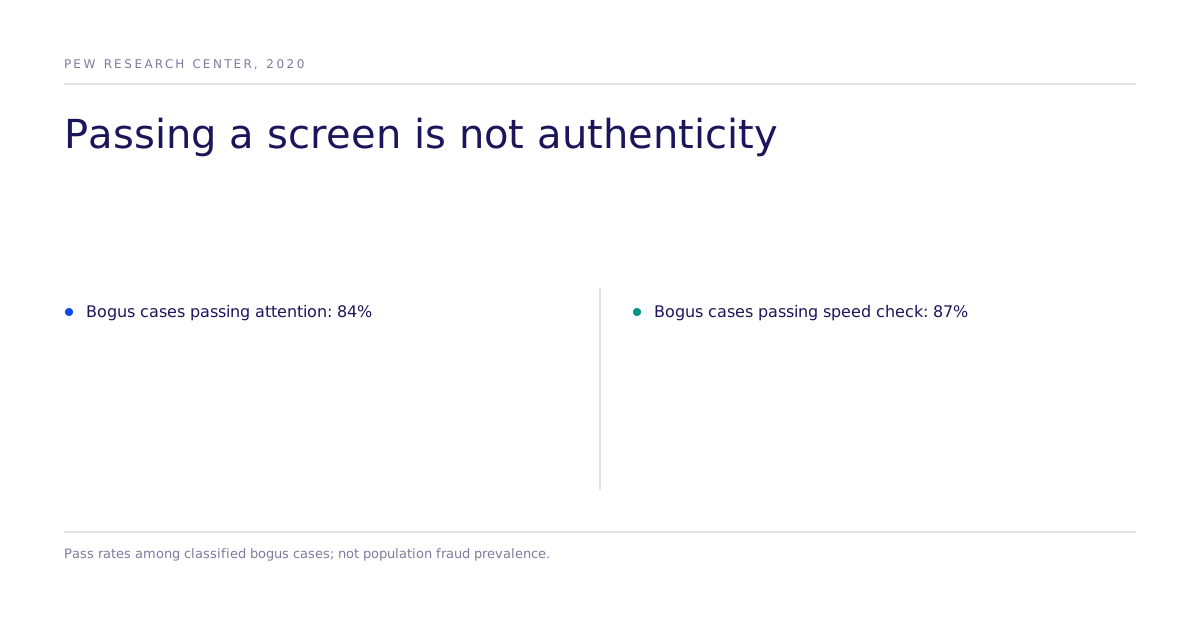
Pew's 2020 analysis classified bogus cases using specified behaviors and examined six online sources. The attention item asked for a particular color, and the speed criterion used under three minutes against a seven-minute median. Passing both checks still did not establish authenticity (Pew study chapter). Use this as evidence about those checks and settings, rather than declare that every modern quality process misses almost all fraud.
Can a well-designed, fraud-screened survey predict what people actually do?
A survey can have predictive value, but the relationship must be checked against the relevant observed outcome. A question about future purchase measures a stated response; recall, attitudes, comprehension, and randomized task choices are other possible survey endpoints. None automatically becomes an observed purchase.
Schmidt and Bijmolt analyzed hypothetical versus real willingness to pay for consumer goods across 77 studies reported in 47 papers. The mean hypothetical overstatement was 21%, with method and study differences (primary research record). That result does not define a generic 21% gap between intentions and actions, nor a guaranteed bias for every estimate. Calibrate the survey endpoint using matched actual behavior when the decision requires it.
What does randomization establish?
Random assignment can identify an effect on a specified task endpoint under the study's assumptions. A randomized survey remains a survey: a human hypothetical choice can still differ from a real purchase, while a simulated choice is model-generated. McFadden choice models, mixed logit, and ICLV estimate the responses; their names do not establish causality or remove hypothetical bias. For purchase, assess a consequential task or live design and its transport to the intended market.
For a simulated comparison, request independent evidence matched to the population, alternatives, and endpoint. The public Causal Fidelity paper reports estimated choice-parameter rank correlations, not universal survey accuracy or actual purchase calibration. It does not publish per-study replication data. Training-data overlap, coverage, and transport remain concerns to assess; the leaderboard summarizes aggregate evidence.
Survey quality and endpoint validation
| Instrument and response quality | Experimental endpoint validation | |
|---|---|---|
| What it measures | Comprehension, routing, answer quality, and specified responses | The contrast and outcome defined in the design |
| What it improves | Wording, layout, question order, usability, and quality screening | Credible attribution and assessment of the tested contrast |
| Main limit | Does not by itself establish identity, representativeness, or purchase prediction | Does not automatically remove task bias or establish market transport |
| Evidence to inspect | Pilot observations, recruitment and quality criteria, retained exclusions | Design, sample, model assumptions, uncertainty, and independent matched outcomes |
| Best use | Every fielded instrument | Decisions needing a specific contrast or validated behavioral prediction |
What a senior buyer should decide before fielding the next survey
Start from the decision and endpoint. For a support-flow label, human comprehension testing may be the key evidence. For a price change, a stated-choice study may inform trade-offs while actual conversion and margin require market evidence. Legal claims, facts, and feasibility can require records or professional review rather than a preference experiment. Choose the smallest study that resolves the relevant uncertainty and document what it cannot establish. See methods and validation.
Before fielding, write down the decision, target population, endpoint, quality procedures, and what would change the action. If actual behavior matters, define the independent calibration or live check. Bring that brief to meet to discuss the design.