Between Brand Tracking Waves: How to Test a Brand Action Before the Next Report
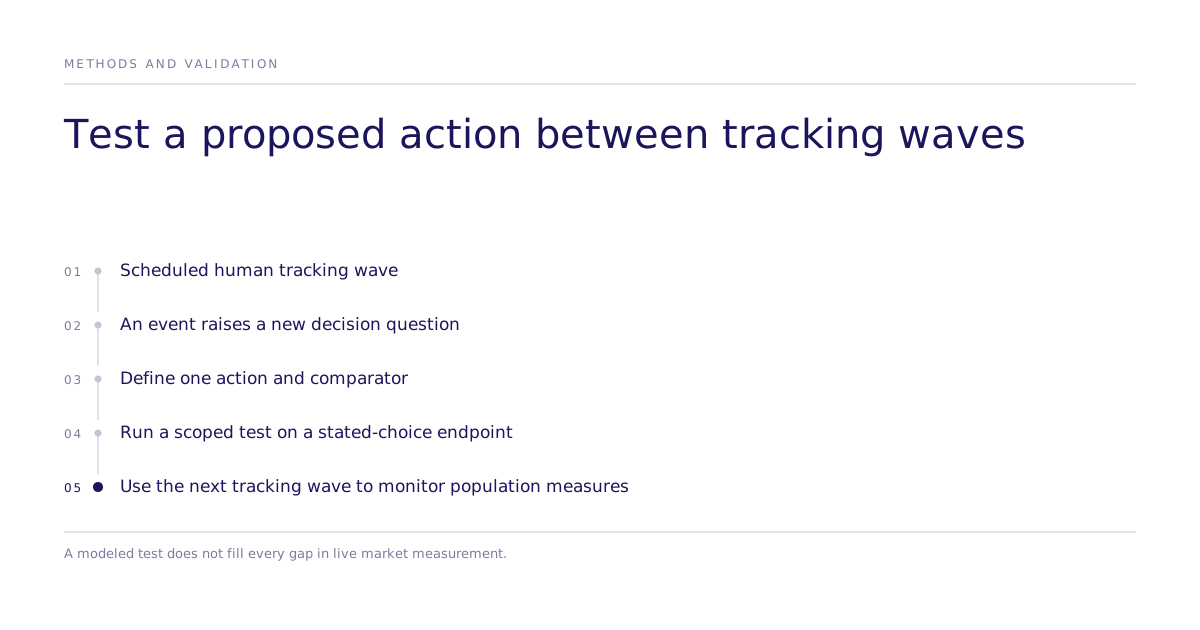
A brand or marketing leader who commissions a quarterly tracking wave knows its worst failure mode: a competitor moves, a message lands badly, or a public event shifts perception, and the next scheduled report arrives weeks after it mattered. The real choice is not whether to keep the quarterly wave, but what to do with the gap a wave-based program cannot answer when a specific event lands.
Why the wave still leaves a gap
A wave-based tracking program uses a sampling plan and repeated questions to compare brand measures over time. The questionnaire might cover awareness, consideration or brand associations. Its defensibility depends on recruitment, weighting, question consistency and uncertainty, not on the reporting schedule alone.
A shift after fieldwork may not appear until the next scheduled wave. Segment estimates also carry more uncertainty than the total-market estimate when fewer respondents belong to that segment. A fixed questionnaire may miss a new competitor action that the design did not anticipate.
None of this argues for dropping the wave; a well-designed human survey provides a measured baseline. It argues for a second instrument covering the interval the wave misses.
What goes in the gap
The interval between survey waves may lack a comparable survey measure. Filling it with an unvalidated always-on feed trades one risk for another: acting on noise costs budget on a reaction that never happened, and a genuine shift missed because nobody looked still ships a response months late. The better fit is a bounded, decision-specific test: pick the one action, such as a campaign concept, a repositioning message, or a response to a competitor's move, and run it as a controlled experiment rather than a running feed.
Subconscious runs that kind of test as a causal behavioral experiment against a simulated audience configured to reflect the buyer segment. The output is an estimated effect within that simulated population, with an interval scoped to it, not a claim to have read the market's mind. Human transfer requires matched evidence; confirm the scope and availability of a human comparison before commissioning the study. See how we work for the design.
What can a between-wave test measure?
Which outcomes a test covers depends on how the study is configured, and the scope should be confirmed before it is commissioned. Define candidate endpoints before selecting a provider; this list is a study-design menu, not a claim that every endpoint is currently offered:
- Relative standing. Where the brand sits against a named alternative once a buyer chooses. This is the stated choice a designed experiment measures most directly.
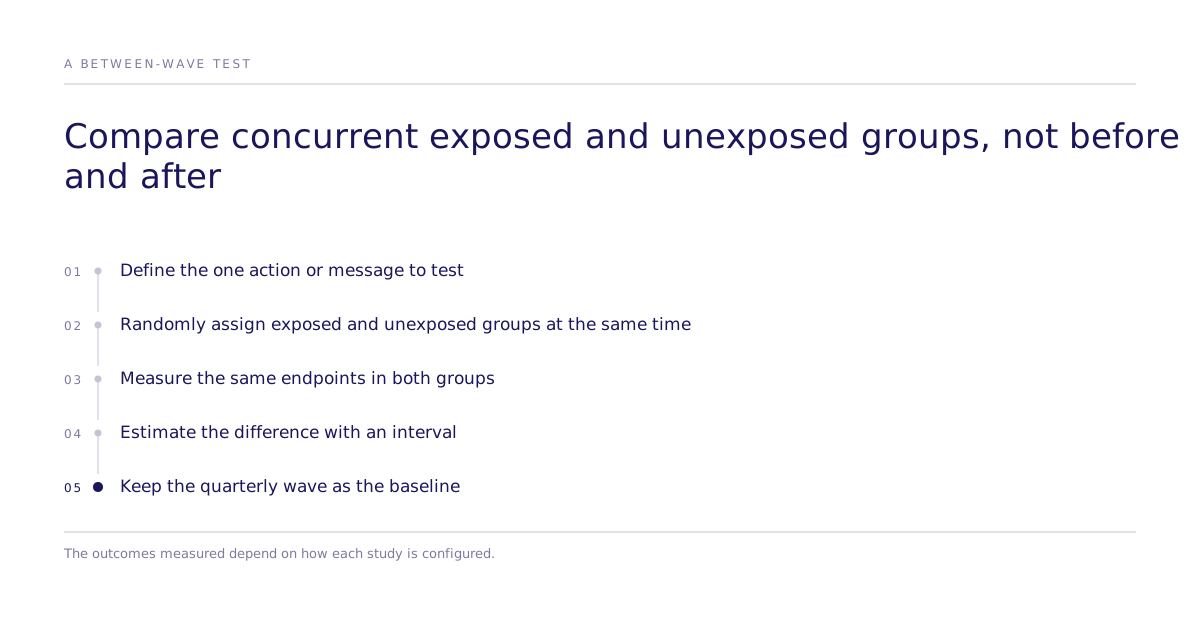
- Message effect. Whether an exposed group differs from an unexposed one on stated choice or attribute association, with random assignment between the groups.
- Attribute association. Which qualities attach to the brand, and whether they still match the intended position.
- Unaided recall and language. Which brands a respondent names first, and what words they reach for, if the study includes a separate open-ended step. In a simulated population these are signals about prominence and wording, not a population awareness estimate.
When should you run the check?
A scoped test is usually triggered by one of three things: a competitor launches something, a message or creative concept needs a read before it ships, or a segment-specific question comes up that the total-market wave can't answer alone, such as how Gen Z buyers read a positioning differently from an older cohort.
Compare conditions that run at the same time. A before-and-after read around a launch cannot separate the launch from unrelated events, audience changes, or shifts in model inputs. Concurrent random assignment balances shared conditions in expectation. In a simulated test, the assigned contrast is identified inside the configured model; transfer to human responses requires matched evidence. Monitoring an event, such as watching how a competitor move is discussed, is a different job from estimating what an intervention changes, and it needs different evidence.
What does this test not replace?
A scoped causal test between waves is not a substitute for the quarterly program's sampling and its defensible report to leadership, nor a persona-based conversational panel standing in for it; a conversation with a simulated respondent answers a specific question, not the population-level number a board expects. The experiment described here answers an action-specific modeled question; it does not establish a continuous population-level tracking series.
Use the survey for a measured baseline and the experiment for an assigned contrast. The July 2026 causal fidelity working paper, not peer reviewed, reports parameter-rank comparisons between simulated and human choice studies. Those comparisons do not validate unaided recall, live awareness or sales effects for a new brand test. When the decision is worth the rigor, a case study or a decision review shows the design applied to a specific brand action.