How to Pressure-Test a PRD Before the Engineering Kickoff
A PRD flaw can consume engineering time before the team learns that the feature does not solve the target buyer’s problem. The cost includes rework and the roadmap opportunity that the build displaced. Treat any schedule or loss estimate as specific to the project rather than a universal outcome.
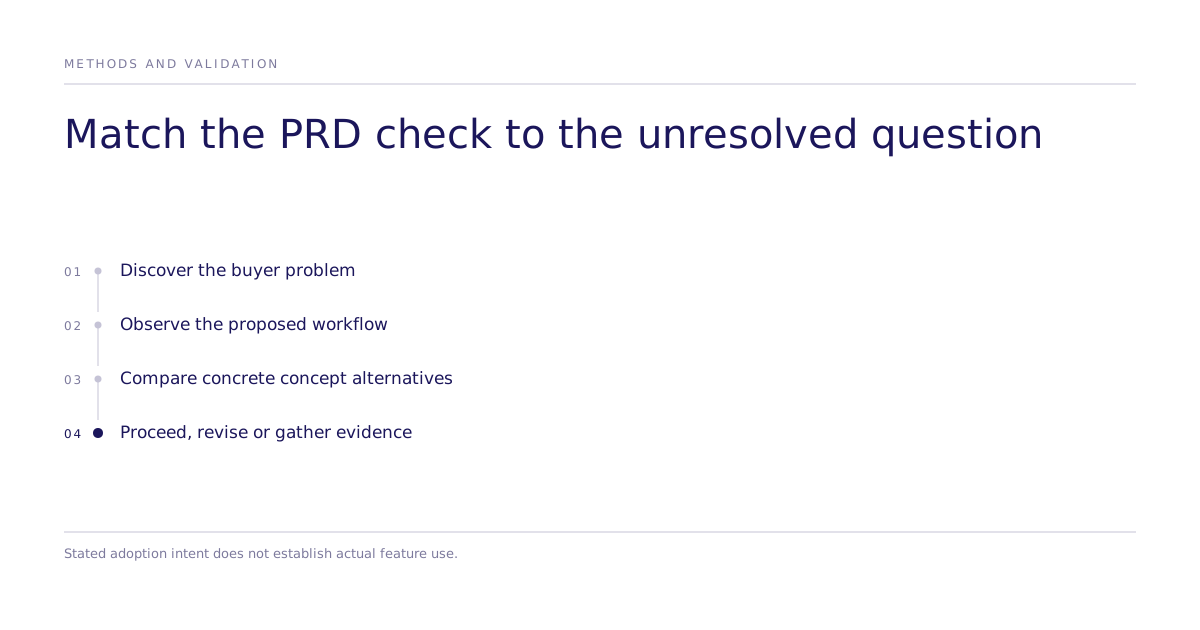
Before an engineering kickoff, decide whether to proceed, revise scope or gather more evidence. Choose a review that fits the remaining uncertainty: interviews for problem discovery, usability testing for workflow friction, and a randomized concept comparison for stated choice between the feature and the status quo.
Why the decision matters
Every PRD that reaches an engineering kickoff carries an assumption about who will use it and why. When that assumption is wrong, the team does not find out until adoption data comes back, by which point the cost is already spent: engineering time on a feature the target segment does not adopt, and the roadmap slot that feature occupied instead of something buyers would have used.
Where does an ad hoc review break down?
A hallway review or a standing kickoff meeting can catch obvious problems, but it has a structural weakness: everyone in the room helped write or approve the spec, so they share the author's blind spots.
Wrong-segment bets
As an illustration, suppose a segment representing 60 percent of the active base finds little use for a feature while a segment representing 15 percent values it highly. Those invented shares show why population weights matter. Verify the actual segment composition and compare measured responses before deciding whether serving the minority is commercially worthwhile.
Hidden first-mile friction
A PRD may assume that the buyer already understands the workflow. Test entry points and onboarding with unfamiliar target users before treating that assumption as settled. The 2026 digital-persona study evaluates survey-response fidelity, with stronger aggregate agreement than individual recovery; it does not establish an onboarding-failure rate or validate a PRD usability diagnosis.
Scope nobody will use
A feature can ship with 7 capabilities when buyers only ever touch 2. The pattern is visible before launch if someone walks a fresh reader through the spec and asks what they would use, ignore, and actively turn off, but a review room rarely runs that exercise.
Competitive blind spots
A PRD that stays silent on the alternative a buyer is already using gets outflanked at the sales conversation. It needs a differentiation section, or it needs to be cut.
How does Subconscious test a PRD before kickoff?
A configured randomized concept comparison can present a feature alternative and the status quo to a defined simulated buyer population. Name the assignment, stimuli and stated-choice or adoption-intent endpoint. Differences in that endpoint do not establish actual feature use or completion of the intended workflow.
Use the modeled result to prioritize hypotheses for further testing. Validate workflow claims through observed usability or a bounded live pilot; use research to inspect the method’s public evidence and limits.
For a matched human check, agree on recruitment, study ownership, stimuli, endpoint and deliverables with the provider. A generated-choice comparison, human stated response and observed workflow measure different outcomes; document any instrument or population adaptations. The research process provides context for that scope discussion.
Comparing the options
| Method | Question it answers | When it fits | Main limitation |
|---|---|---|---|
| Ad hoc review room | Does this look right to the people who already wrote it? | A quick gut check on a low-stakes spec | Everyone present shares the author's blind spots |
| Randomized concept comparison | Which described alternative changes stated choice or adoption intent? | Comparing concrete options before build | Hypothetical choice, model validity and transfer to actual adoption require checks |
| Small real-user alpha | Does this break a habit already built into someone's workflow? | Habit-breaking or workflow-disrupting changes | Slow and expensive to run before every spec |
| Structured pricing interviews | What constraints and stated price reactions do buyers report? | Pricing discovery tied to the PRD | Sampling and hypothetical bias; interviews do not establish exact transaction willingness to pay |
Limitations
Subconscious’s modeled comparison does not replace direct usability testing or an alpha with actual users for a habit-breaking workflow. Sample those studies to the user groups and failure modes that matter. Pricing interviews can explore constraints and stated willingness to pay; transaction or appropriately incentive-aligned evidence is needed to assess actual payment.
A modeled concept choice does not verify a migration inside a real account. Confirm data access, controls, integrations and test responsibilities for the engagement, then exercise the actual migration and relevant failure paths. Choose discovery, concept comparison or direct workflow testing from the uncertainty; the modeled response alone cannot establish feature adoption.
Next step
Pick the next PRD on the roadmap. Define the segment it targets, the status quo it replaces or the competitor it is up against, and the result that would tell the team to proceed, cut scope, or kill it. Run that comparison before the kickoff, not after the sprint starts. Book a demo to scope the first comparison.