LLM-Simulated Panels: When a Persona-Conditioned Survey Result Is Enough to Act On
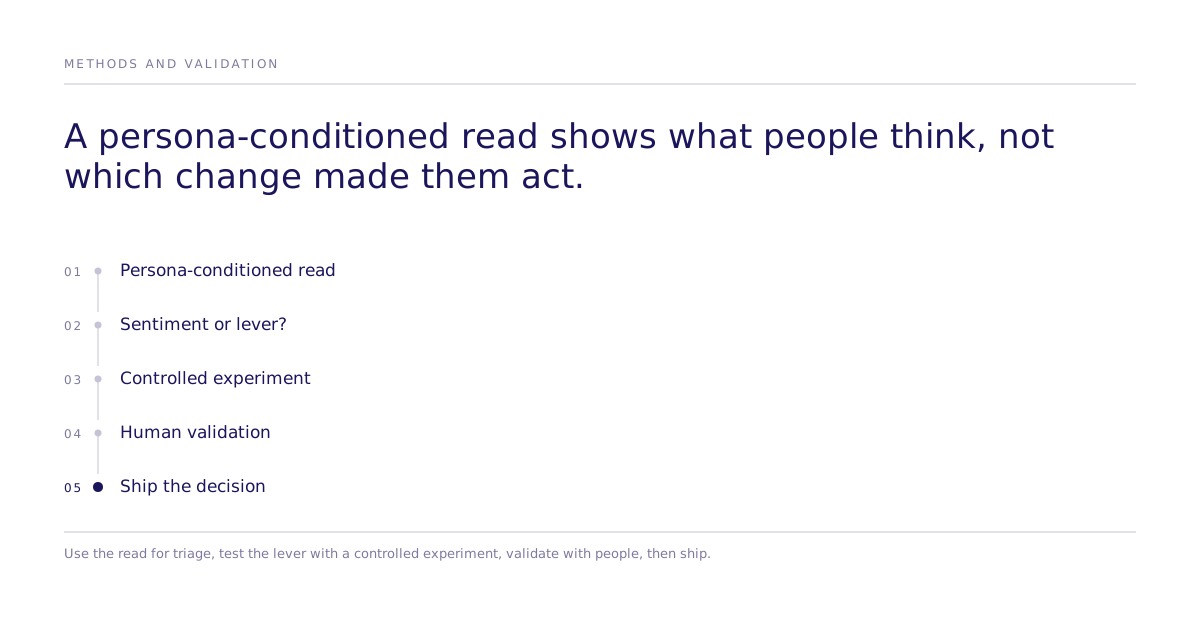
A persona-conditioned survey result is enough to act on as a triage signal for general sentiment on common opinion questions among well-represented groups, before a causal experiment is needed to identify which specific change drives behavior. A method is only as trustworthy as the limits published alongside it. Conditioning a large language model on a demographic or psychographic backstory and asking survey questions produces an opinion distribution, not a causal answer. Argyle et al. (2023) showed that persona-conditioned sampling can track real survey distributions at the population level for common opinion and preference questions. That is a useful triage signal, not evidence about which specific change in a message, price, or product moves a decision, because nothing was varied and observed under controlled conditions.
The question a buyer is actually asking
A research, insights, or product leader facing a launch, price change, or repositioning decision needs one of two answers: what an audience thinks about an idea, or which version of that idea changes behavior. A persona-conditioned LLM read answers the first quickly; it cannot answer the second, because it was never designed to isolate one variable's effect on a choice.
Naming a failure mode here is what lets a buyer check it before acting on a read. Treating a directionally-plausible read as proof that a specific message, price, or feature caused a shift is a mistake: it can look right in aggregate and still miss the lever that actually moved people, a gap that surfaces after launch, when the metric that was supposed to move doesn't.
Where does the founding research draw its own line?
A method's misses belong on the record next to its hits. [Bisbee et al. (2024) re-ran the same persona-conditioned sampling and found it overfits toward majority opinion, systematically under-representing minority subgroups, low-incidence intersections, and novel-category behavior. That narrows the method's claim rather than rejecting it: strong for reading common sentiment in well-represented groups, weak where a launch, pricing, or repositioning decision tends to be riskiest, in the segments most likely to drive real switching, churn, or backlash.
What question does a controlled experiment answer?
A controlled discrete-choice experiment presents a defined audience with systematically varied versions of an offer, price, or message and observes which version people choose. Because the variation is designed and randomized, the resulting difference in choice can be attributed to the variable that changed, with uncertainty reported over the simulated population the study design supports, not sampling error about the human population.
| Research need | Persona-conditioned opinion read | Controlled causal experiment | Recruited human-panel research |
|---|---|---|---|
| Reading general sentiment on a known idea | Strong | Not the right tool | Reliable but slower |
| Identifying which offer change drives a decision | Not designed for this | Strong, uncertainty reported where supported | Reliable but costly at variant scale |
| Predicting novel-category or unfamiliar purchase behavior | Weak, per the tail-failure evidence above | Requires a defined audience and real stakes | Required |
| Exploring many variants before committing budget | Fast for triage | Fast for the variants worth testing | Cost-prohibitive at scale |
How does Subconscious test the causal question?
Subconscious runs randomized, controlled experiments against a simulation of a defined audience, establishing causal attribution within that simulation, then validates the same study design with real human participants to confirm the effect transports to human choice before a consequential decision, without re-deriving the study or changing the causal question being asked. See how that validation step works.
Subconscious can also run controlled studies against a person-level audience graph covering 800 million real people. That figure describes the pool a study can be run against, not a recruitable panel of 800 million respondents, and it matters only when audience scale, not method, is the constraint on a study; a larger pool narrows simulator variance, not bias against real human behavior.
What still has to hold before you trust a result
- A simulated experiment or a persona-conditioned opinion read estimates likely behavior; neither substitutes for observing what real people actually do.
- Real-human validation confirms the same causal question. It does not turn a causal action test into a usability session, a clinical trial, or automatic proof of market performance.
- No method here executes the resulting business action. A confirmed causal effect still has to be shipped, priced, or messaged by the team that owns the decision.
- Stating a limit plainly is what turns a number into something a buyer can act on. The tail-failure evidence above applies regardless of which vendor or platform runs a persona-conditioned read, including the persona-conditioned choice tasks inside a simulated causal experiment: treat conclusions about novel categories, minority subgroups, and rapid attitude shifts as provisional.
A sequence for the next decision
- Name the specific action being decided: a message, a price point, a feature, a positioning claim.
- Ask whether the open question is "what does this audience think" or "which version of this offer changes behavior." The first calls for a fast opinion read; the second calls for a causal experiment.
- Run the causal experiment against a defined audience simulation, with uncertainty reported where the study design supports it.
- Where the decision is consequential, validate the same study design with real human participants before committing budget, without changing the underlying causal question.
- Treat the result as one input into the launch decision, not a substitute for observing what happens after the action ships, and see how a study gets scoped or browse how the method has been applied before starting one.