Do LLMs Understand Real-World Prices? A Pricing Benchmark for Synthetic Consumers
An LLM-based synthetic panel can produce fluent, plausible-sounding survey answers without ever grounding those answers in real prices. Before a pricing or packaging decision leans on that kind of panel, the panel's price reasoning needs its own check.
The decision this bears on
A brand or insights team weighing an LLM-persona panel against a calibrated, validated experimental design is really deciding how much price-sensitive risk to accept. An uncalibrated panel that sounds confident about cost can still produce systematically biased demand or willingness-to-pay estimates. Shipping a pricing decision on that basis risks wasted research spend and a go-to-market call built on a number the panel never actually understood.
How does this benchmark test price reasoning?
Allen Downey’s July 23, 2025 PyMC Labs benchmark adapted a pricing-showcase game. Models bid on consumer packaged goods worth roughly $20 in total. The closest bid without exceeding the actual retail value wins; if both overbid, neither wins. The case records its historical model versions and tournament results.
Each round follows the same five steps: generate a random showcase of three items, hand each model ten example prices from similar products as calibration reference, send the identical prompt to two models, parse the bid and its rationale from a strict JSON response, then compare both bids to the actual retail price to score the round.
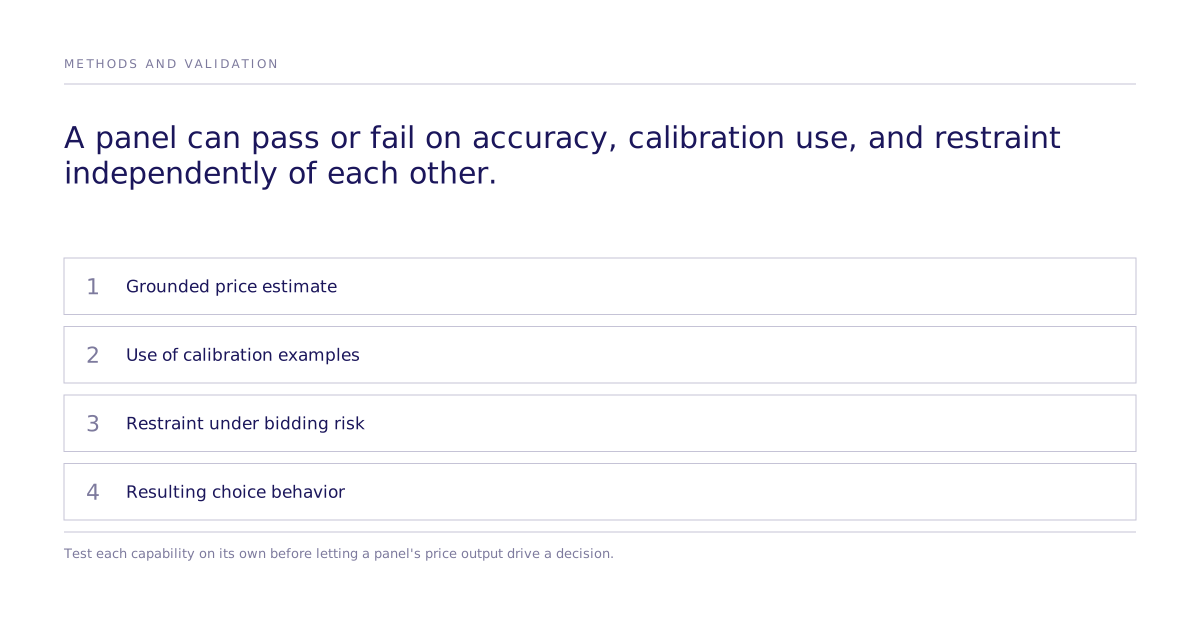
Naming this failure mode up front is what lets a buyer test each capability on its own. The design targets three related capabilities: estimating a real-world price, using reference examples to calibrate that estimate, and deciding how aggressively to act on it, though a single bid does not cleanly separate estimation from shading.
Accuracy and restraint are not the same skill
Dozens of models entered the tournament; two preliminary rounds narrowed the field to a small group of finalists competing across fifty rounds. The best-performing model in the finals estimated prices with an error noticeably below the error rate of human contestants on the original televised game, though the comparison is confounded: models bid on roughly $20 CPG showcases while contestants bid on showcases worth tens of thousands under real stakes; the weakest model's price estimates were only marginally better than random guessing, with almost no relationship between its bids and the actual prices.
Accuracy alone did not decide the outcome. Overbidding disqualifies a bid, so a cautious lower bid can reduce that risk. The optimal bid also depends on the opponent and payoff structure; no fixed price-belief quantile is universally optimal. Human contestants overbid about 25% in a different, real-stakes setting. The finalist models’ observed overbid rates ranged from 2% to 72%; those rates describe this historical tournament.
Use of reference prices and bidding performance varied across models. That association does not isolate the effect of supplying reference examples. Sfeir and colleagues’ choice-modelling paper, revised August 25, 2026, evaluates assistance with utility specification and estimation, rather than consumer price calibration. A calibration claim needs a controlled price-estimation comparison with and without the reference information.
"Our findings reveal that proprietary LLMs can generate valid and behaviourally sound utility specifications, particularly when guided by structured prompts (CoT)."
Sfeir, Nova, Hess, and van Cranenburgh, Journal of Choice Modelling (source)
What this means for evaluating a synthetic-consumer method
The historical benchmark numbers above describe one study's models and prompts at one point in time. They are not a live leaderboard and not a claim about any specific vendor's current product. Read them as evidence that price reasoning splits into distinct, testable parts, not as a ranking to shop from.
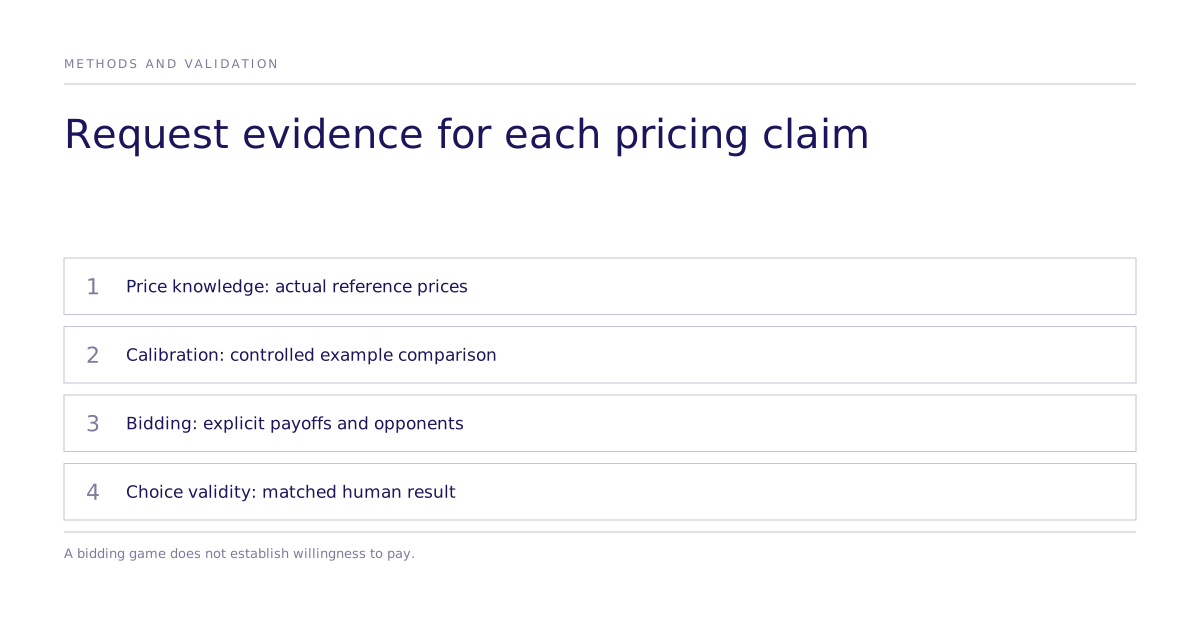
Require separate evidence for price knowledge, use of reference examples, risk-sensitive bidding, and human choice agreement. A vendor’s randomized choice design does not automatically demonstrate all four. For Subconscious or another method, request a pricing protocol and matched result for the checks that matter to the decision.
What are the limits of this benchmark?
A number without its limits is marketing. This benchmark measures price estimation and bidding restraint in one bidding game. It does not measure willingness-to-pay in a real purchase context, brand-specific price perception, or how a synthetic panel performs on a causal question outside pricing. A team evaluating a synthetic-consumer method for its own pricing or packaging question still needs evidence specific to that question and, when the decision is large enough, a way to check a simulated result against real-human testing. For that human check, specify recruitment, fieldwork ownership, protocol, endpoint and deliverables with the research provider. A matched price-estimation task checks that estimate; a purchase study measures a different outcome and requires its own design.
Next step
Teams comparing synthetic-consumer methods for a pricing decision can see current published comparisons on the leaderboard or read about the validated experiment workflow on how we work.