New data quality safeguards against fraudulent survey responses
A research director needs to know what a fraud screen detects and what it misses. Device, location, response-pattern, and text checks provide probabilistic evidence about suspicious responses. They do not conclusively verify human identity, attention, or future behavior.
- Screening flags possible duplicates, implausible locations, and response anomalies; false positives and evasion remain possible.
- NORC’s April 2026 brief reviews heterogeneous fraud reports; it does not provide a 13-study pooled fraud estimate.
- A roughly 800-person study reported self-disclosed AI writing assistance. That is not a direct bot rate or a test of every fraud screen.
- Passing every fraud filter still leaves the say-do gap: a verified, attentive human giving a fast, sincere answer to a hypothetical question can still fail to predict what they do in the real market.
- Human or behavioral validation evaluates the measured endpoint; it is separate from intake screening.
What do fraud safeguards actually verify?
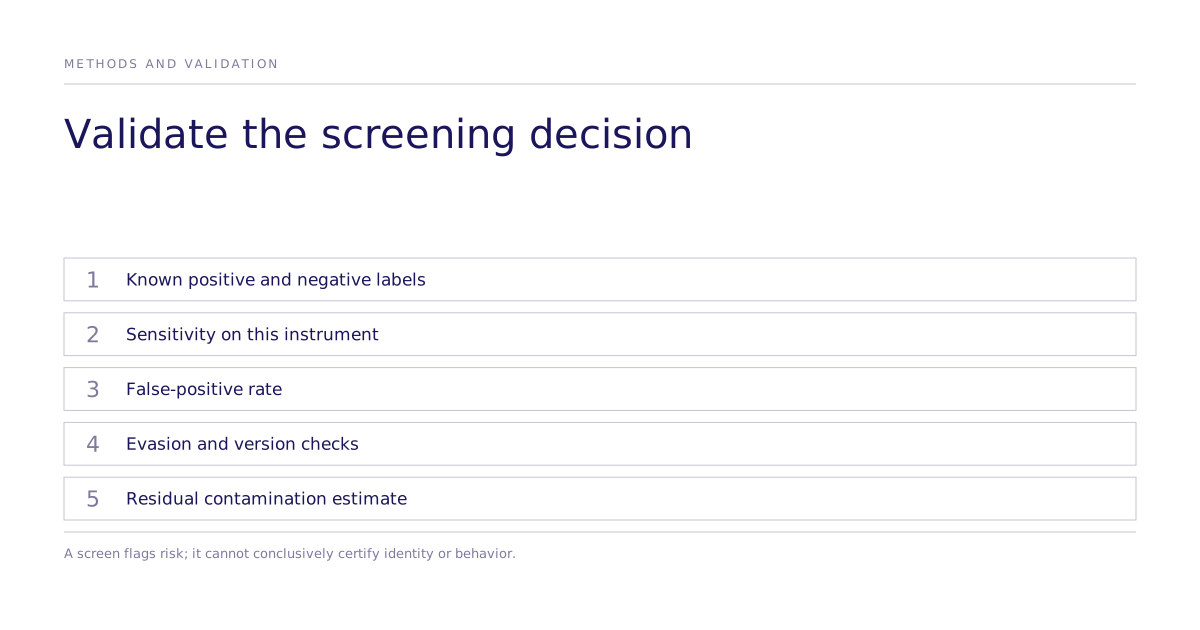
Treat each safeguard as a noisy indicator. A device fingerprint may flag duplicates; IP and location checks may flag inconsistent access; behavioral patterns can flag low effort; classifiers can flag generated text. Legitimate respondents may trigger those flags, and sophisticated bots may evade them. Validate combined decisions on the actual instrument and recruitment channel.
How big is the fraud problem right now?
NORC’s April 2026 literature review summarizes studies and industry reports with different recruitment channels, fraud definitions, and detection methods. It is a narrative review, not a pooled estimate of a universal fraud rate. The proposed survey needs its own labeled screening validation and an assessment of residual contamination.
Generative AI raised the bar for what "fluent" means
A November 2024 Stanford report describes roughly 800 Prolific participants, nearly one-third of whom reported AI assistance, and differences in open-text content. It does not establish that those responses passed all timing and straight-lining checks. Writing assistance and replacement of a respondent’s preferences are different uses; consent rules and measurement objectives should distinguish them.
Screening and behavioral validity need different evidence
An attentive human can sincerely answer a hypothetical question in a way that differs from later purchases. A screened sample can therefore retain a say-do gap. Conversely, a validation score does not establish that the sample contains no bots. Evaluate both boundaries using the target population and instrument.
What does a matched validation test measure?
A human stated-choice comparison evaluates agreement with that task. Observed transactions evaluate a different behavioral endpoint. Parameter-rank correlation does not itself establish purchase replication, identity, or interval coverage. Ask which measure and dataset support the intended decision.
Public historical validation can overlap training data. A prospective or otherwise held-out test needs explicit overlap assessment, predeclared agreement criteria, and uncertainty. Inspect the validation approach.
DCE is an experimental design. Choice models and estimation frameworks analyze its responses. Randomization can identify contrasts within the task under design assumptions; human and market transport require separate evidence.
Inspect results by study and endpoint rather than a single generic replication headline.
Fraud screening vs. replication validation: what each proves
| Approach | What it verifies | What it cannot verify | Best for |
|---|---|---|---|
| Device, IP/location, and response-pattern checks | Flags for duplication, inconsistent access, or unusual patterns | Conclusive human identity, attention, or behavioral validity | Layered screening with instrument-specific validation |
| Generated-text classifiers | Probabilistic text-origin flags | All writing assistance, preference replacement, or authentic human intent | Screening with false-positive and evasion assessment |
| Matched human or behavioral comparison | Agreement on a specified task and metric | Respondent identity or other untested outcomes | Evaluating whether evidence supports the decision endpoint |
What should a research director check before trusting a sample?
Request labeled validation, sensitivity, specificity, and residual contamination for the screen. Separately request agreement and uncertainty against the intended human or behavioral endpoint. Browse the research and methods hub with those distinctions in mind.
The next study you run
For the next survey, date the safeguard specifications and record the following in the vendor scorecard:
| Safeguard | Validation to request | Operational check |
|---|---|---|
| Device and location signals | Known duplicate and legitimate-response labels | Retention policy and legitimate shared-device handling |
| Response-pattern checks | Sensitivity and false positives on this questionnaire | Accessibility and unusually fast expert respondents |
| Text classifiers | Generated, assisted, and human-written examples | Model version, evasion tests, and appeal path |
| Combined exclusion rule | Residual contamination and excluded-valid-response estimate | Predeclared decision rule and audit trail |
These requirements follow the risks in NORC’s review; they do not imply that every safeguard is new or universally effective. Add a separate column for matched endpoint validation. Discuss the instrument before treating a clean-sample claim as proof of a business outcome.