Simulated Marketing Panels: What They Test Well, and Where Real Buyers Still Decide
Marketing teams increasingly run early positioning, pricing, and messaging questions through a simulated panel before committing production or media budget. The method has a well-documented shape: build a panel of AI personas calibrated to a target audience, present a stimulus, and read back a distribution of reactions. Independent research points toward this approach being useful for some marketing decisions and unreliable for others, though the closest available studies evaluate political-survey replication and persona approximation rather than marketing stimulus testing directly, and knowing the difference is the whole game.
What is the buyer actually deciding?
A brand or marketing leader choosing between several concepts, headlines, or pricing structures faces a specific risk. A variant that reads well internally can still fail with the target segment once real budget is behind it, and shipping the wrong one wastes production and media spend, sometimes forcing a mid-campaign reversal. The opposite failure matters just as much: treating a directional read as a firm purchase-behavior forecast and building a revenue plan on a number the method was never built to produce.
Which screening uses need matched evidence?
Relative rankings can be useful when errors do not differ across alternatives, but that condition needs evidence. Political-survey and persona studies do not establish reliability for every marketing stimulus.
| Candidate use | Evidence needed before action |
|---|---|
| Headline and copy screening | Matched human preference or conversion comparison |
| Concept screening | Conservative shortlist rule retaining uncertain options |
| Comparing campaigns across geographies | Human evidence for each market, stimulus, and outcome |
| Objection exploration | Human interviews or observed customer evidence |
| Naming and pricing-fairness screens | Matched task validity and segment coverage |
Each row shares a shape: comparing options against each other, not predicting an absolute number.
Where the method is honest about its limits
The same research base is explicit about where these panels underperform:
- Sensory testing. If a respondent needs to taste, smell, touch, or wear something, a simulated respondent cannot substitute for a real one.
- Novel categories. Limited relevant information can make representation uncertain; performance needs task-specific evidence.
- Precise purchase-behavior prediction. A simulated panel can show that a concept resonates. It should not be the basis for a claim about what percentage of an audience will pay a given price next month.
- Legal or regulatory claims. Required substantiation depends on the claim and jurisdiction and may involve transactions, testing, or qualified review.
- Recent events. Supplied retrieval can provide new information, but does not establish contemporaneous audience reactions.
Research on when digital personas can approximate human survey findings and a related evaluation of the perils of large language models as survey-data replacements both describe this divide, and both flag demographic flattening as a known failure mode worth watching for.
A workflow that keeps the test question intact
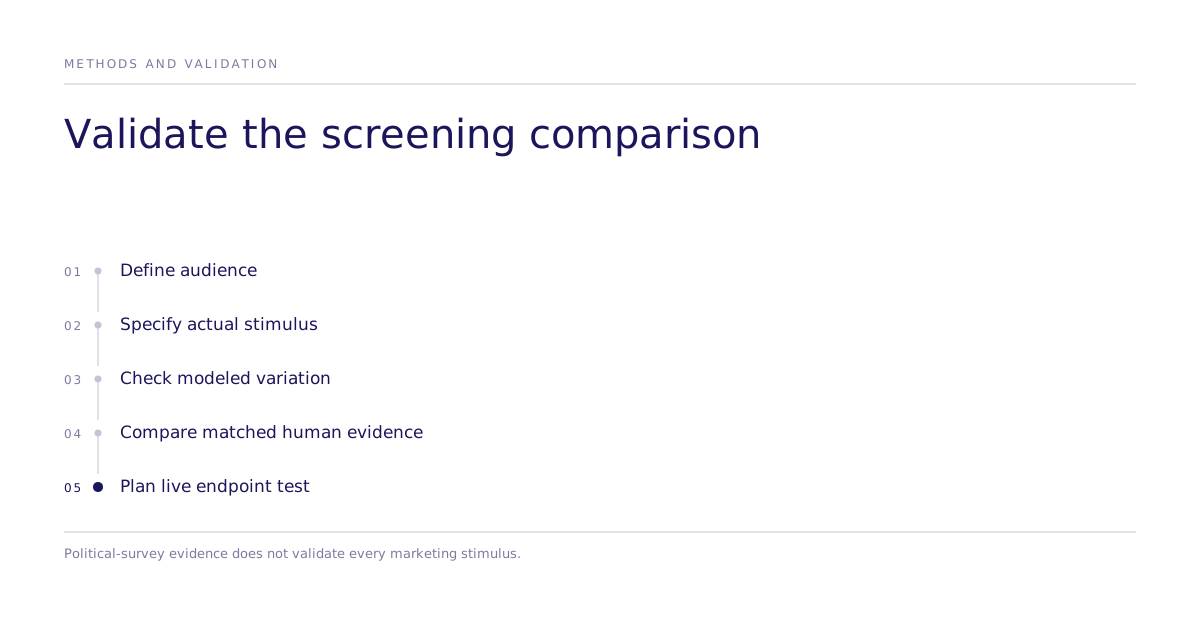
A five-step workflow holds up in practice:
- Define the panel. Specify the audience as precisely as a traditional recruited panel: demographics, psychographics, market, segment composition, persona count.
- Frame the stimulus concretely. Provide the actual headline, body copy, or pricing structure being tested rather than a description of it. Response quality tracks stimulus quality.
- Run the panel and capture the distribution. Read results as a distribution with segment cross-tabs read as directional only, not a single top-line score.
- Use matched evidence. Evaluate rank, effect magnitude, and uncertainty for the actual stimulus and audience.
- Choose the next test. Retain the baseline and uncertain candidates; seek a matched human comparison or live behavioral pilot before consequential rollout.
For the fifth step, define a matched human population, stimulus, treatment, endpoint and agreement criterion. Confirm recruitment, fieldwork ownership and deliverables with the provider. Document any protocol adaptations: a human stated-choice comparison checks task agreement, while a live purchase or conversion test measures a different outcome.
How is the audience different from the panel?
Independent repeated draws can quantify Monte Carlo or conditional simulator uncertainty when their sampling assumptions hold. That uncertainty is not representative-human sampling error or simulator-to-human mismatch. The count of synthetic respondents does not establish coverage of the target population.
Limitations and failure conditions
- The method is a comparative tool first. Treat any single-number probability output as directional, not as a forecast to plan revenue against.
- Generated reactions do not observe sensory experience. Novel-category representation and any required substantiation need evidence appropriate to the claim.
- Fresh retrieval or supplied context can extend available information beyond pretraining. Check its provenance and date and validate recency-sensitive reactions with contemporaneous human evidence.
- Moving to real-human validation should preserve the same test question the simulated round tested. A validation round that quietly turns into an unrelated usability session or clinical-style trial answers a different question, not a stronger version of the same one.
Next step
For a positioning or pricing decision, scope the actual audience, stimuli, response protocol and comparator. Request lead time, cost and deliverables for that study, and retain uncertain candidates until the evidence supports elimination. Discuss the comparison or inspect a case study for its measured outcome and limitations.