Synthetic Consumer Research: 4 Steps to Check Before You Trust the Result
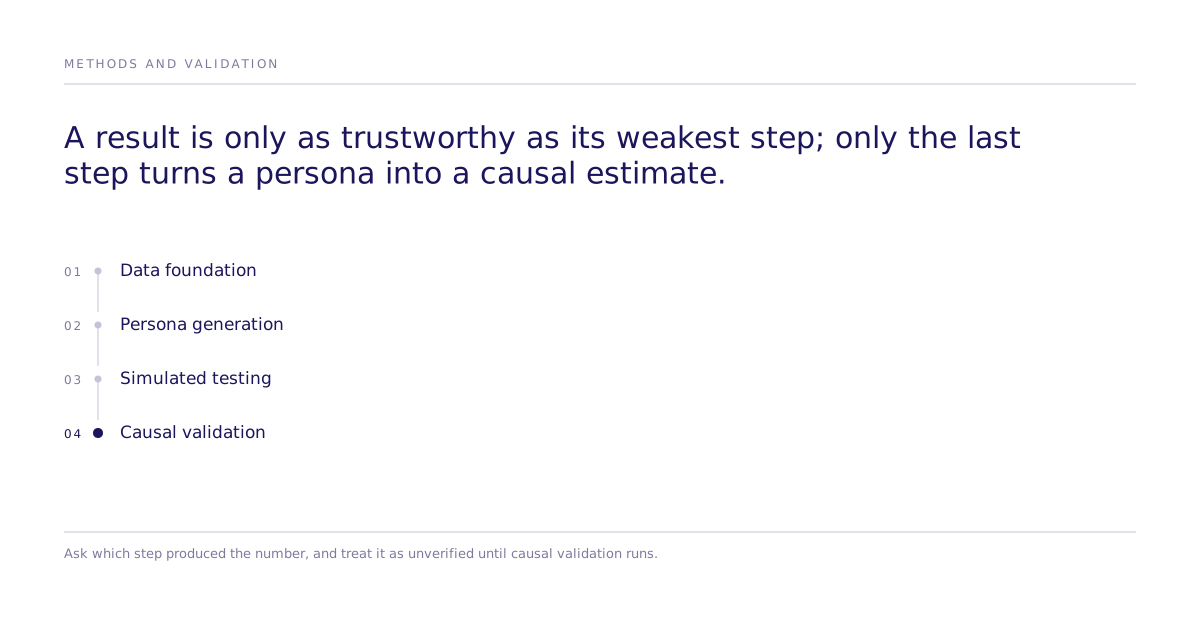
A synthetic-consumer result is trustworthy only as far as its weakest step. Before a pricing, concept, or message decision moves from a simulated study to real budget, a buyer needs to know which of four steps produced the number in front of them, and which step is a proxy for a person rather than an estimate of cause.
What a synthetic consumer actually is
A synthetic consumer is an AI persona built from real behavioral and demographic data, used to stand in for a human respondent in an early round of concept, pricing, or message testing. It answers questions the way a target segment might, before fieldwork starts and before launch or campaign budget is committed.
The label covers a range of methods. General-purpose synthetic respondents answer social or policy survey questions. Digital twins update continuously from live data and sit closer to CX and personalization work. Synthetic consumers sit in between: purpose-built for market research, evaluating a concept, a price point, or a piece of messaging rather than modeling open-ended social behavior.
None of that matters if a team cannot tell which part of the process produces a plausible-sounding persona and which part produces a causal estimate: an answer to which action moved which outcome, for which segment, with uncertainty attached where the study design supports it. Those are different claims, and the pipeline below separates them.
The four-step pipeline
What is the data foundation step in synthetic consumer research?
For LLM-based synthetic consumers, the pretraining corpus defines the range of behavior the model can represent; survey history, purchase records, CRM data, or public datasets condition prompts or reweight personas within that range. A model trained on a narrow or stale dataset produces personas that sound plausible and answer poorly, because the population it draws from does not match the market being tested.
2. Persona generation
A language model or probabilistic system turns the data foundation into individual profiles, each carrying attributes such as age, income, and stated motivations. Because personas are generated programmatically, a team can produce hundreds to stand in for a market segment. This step produces a population to test against, not yet a result. A well-built persona can still answer a poorly designed question.
What happens during simulated testing?
Personas are placed against a stimulus, a price, a concept, a message, and asked to respond. This is the step most synthetic-consumer vendors show off, because it produces a large volume of numbers with little setup. It is also the step most likely to be confused with a finished answer. A simulated response to a single price point is a data point, not evidence that the price causes a change in purchase intent, unless the test was built to isolate that relationship.
4. Benchmark validation
The step that decides whether the first three were worth running: checking the simulated output against a real benchmark, whether that is a held-out human sample, a known market result, or a randomized, orthogonal factorial design that varies attributes simultaneously to isolate each causal driver. Reporting a confidence interval or an error bar here is a design choice, not a courtesy, but an interval computed across generated personas describes variation within the simulated population, not human population uncertainty, unless anchored to a human benchmark. Benchmarking here confirms the synthetic population reproduces observed responses; causal validity comes from the randomized, orthogonal design in step 3, not from this comparison. Absent this step, a synthetic-consumer result is an unverified guess with a persuasive interface.
Where the method holds up, and where it doesn't
A 2025 study using semantic similarity elicitation tested synthetic respondents against 57 real consumer surveys covering roughly 9,300 participants and found the method reproduced human purchase-intent distributions closely enough to be useful for concept work, though pricing decisions depend on the price coefficient and willingness-to-pay, an estimand intent-distribution agreement does not establish, with performance varying by task type and demographic setting. A separate methods review in Psychology & Marketing reached a more cautious conclusion: silicon-sampling studies are scattered across enough fields and methods that no single accuracy figure describes the technique, and results depend heavily on task design and evaluation choices.
| Where synthetic consumers tend to hold up | Where they tend to fall short |
|---|---|
| Ranking concepts and estimating relative price sensitivity | Emotional nuance and cultural subtlety |
| Preserving response variability instead of collapsing to an average, when elicitation is designed to recover it | Subgroup effects such as regional or gender differences |
| Producing interpretable rationale alongside a rating | Sensitivity to how a reference scale or prompt anchor is worded |
| Replicating known demographic patterns (age, income) in purchase intent | Serving as a stand-alone substitute for fieldwork on a high-stakes decision |
Both sources point to the split the four-step pipeline is built to catch: strongest at structured, rankable tasks; weakest wherever the answer depends on lived context a training set cannot supply.
Can synthetic consumer studies be validated with real people?
Step 4 does not require ending with only a synthetic benchmark. Subconscious can validate studies with real human participants, so a team can move from a simulated study to a real-human validation round without changing the underlying causal question. That matters because rebuilding the question from scratch at validation is where most of the earlier simulation's value gets lost.
Real-human validation is worth adding when the decision is expensive enough that being wrong costs more than the time saved by skipping it, not as a default step on every test.
Limitations to weigh before acting on a result
- No single accuracy percentage applies across tasks, industries, or vendors. A number reported for one study's task and population does not transfer to a different concept, price range, or segment.
- The validation step is a design requirement, not something a vendor demo has already solved for a given use case. Ask what the synthetic output was benchmarked against and how recently.
- Structured tasks (ranking, pricing, sentiment) are where the method is best supported. Open-ended emotional, cultural, or group-dynamic questions are where it is least supported.
- A simulated result is a starting hypothesis for a launch, price, or message decision, not a substitute for the fieldwork or experiment that decision's size warrants.
Before committing budget on the strength of a synthetic-consumer result, a buyer can check current research on synthetic and human comparison methods or review how a study moves from design to validation. For a sense of where causal methods hold up and where they don't across published comparisons, the leaderboard tracks that record directly rather than asserting it.