What is TURF Analysis and When to Use It?
TURF, Total Unduplicated Reach and Frequency, finds candidate subsets with the greatest unique reach under a defined reach rule and budget or size constraint. It counts observed overlap rather than assuming statistically independent respondents or items. Reach does not estimate which product displaces another’s sales.
- TURF counts each respondent reached by at least one selected item once.
- It's a good fit for a first-pass shortlist from a fixed candidate list under a budget or reach target.
- Its fixed input appeal or reach rule may not remain valid when assortment, prices, availability, or context change.
- A choice design can estimate modeled substitution; actual incremental units require additional behavioral and volume evidence.
- Suitable inference can report uncertainty conditional on the studied response process; it does not automatically cover human-population error.
What is TURF analysis, and where did it come from?
TURF is a reach-maximization method that started in 1960s media planning, where it answered a simple question: which set of ad placements reaches the most unique viewers without wasting frequency on people already reached. It migrated into product line, flavor and SKU research, and messaging testing, where it still answers a narrow, useful question: given a fixed list of candidates, which subset maximizes the unduplicated share of respondents who'd pick at least one? Sawtooth Software, Qualtrics, quantilope, and Decision Analyst all ship or support dedicated TURF modules today, and it's routinely run right after a MaxDiff study to shortlist flavors or claims for the next stage of testing.
When does TURF actually answer the question you're asking?
TURF fits a fixed-list reach objective: media placements reaching viewers, claims appealing to respondents, or an assortment covering stated interest. Candidates need not be close substitutes. Specify the reach threshold, budget or item-count constraint, and whether item-level appeal is assumed invariant to the selected set.
What does TURF assume, and where does that assumption break?
TRC’s implementation guide accounts for overlapping respondent preference sets and discusses choice-based extensions. Fixed standalone appeal may not capture context-dependent selection. Decision Analyst also discusses awareness and distribution assumptions. These are scope assumptions for the reach projection, not proof that all real launches have full distribution.
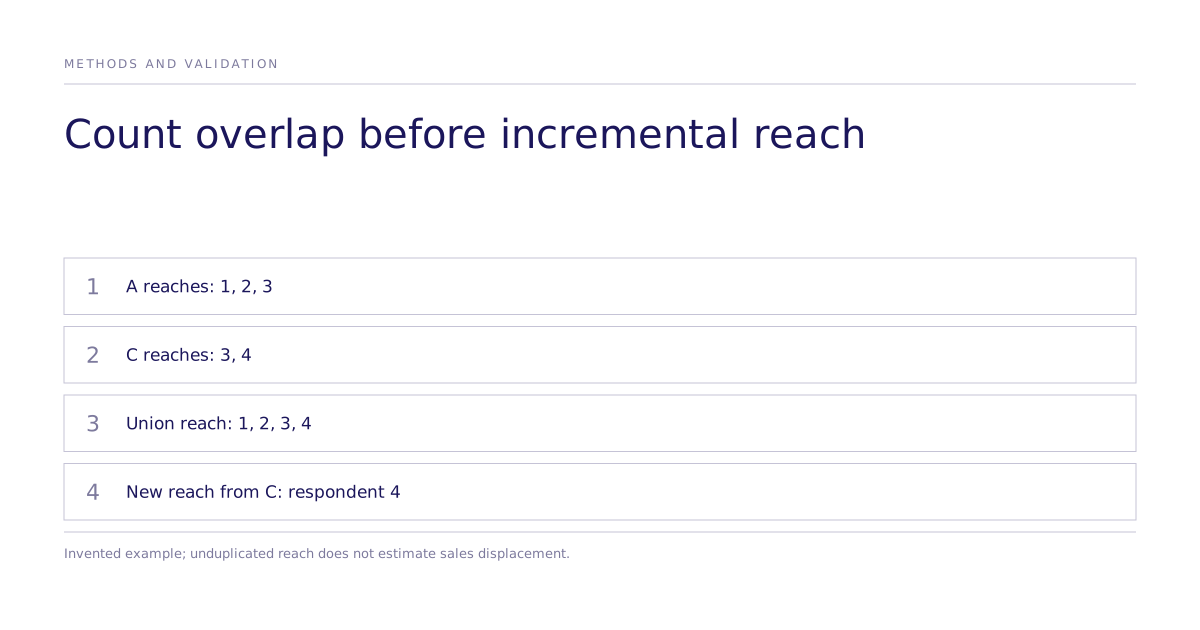
In an invented example, A reaches respondents {1, 2, 3} and C reaches {3, 4}. Together they reach four unique respondents; C adds only respondent 4. Respondent 3 is already counted. This overlap calculation still does not tell how many units A loses to C.
TURF vs. discrete choice modeling: two different questions
Reach and choice models answer different quantities. A richer choice model can represent attribute trade-offs and set-dependent selection, but requires specification and validation. It does not automatically explain psychological reasons or produce more accurate market outcomes.
| Dimension | TURF analysis | Discrete choice modeling |
|---|---|---|
| Question | Which subset maximizes the specified unique reach | How modeled choices change with defined alternatives or attributes |
| Assumption | Fixed reach definition and context support | Utility and error structure with identified task variation |
| What breaks it | Cannibalization, partial distribution or awareness, no live validation | Requires more design and analysis effort up front |
| Output | Reach and frequency for candidate subsets | Task-specific choice effects or shares with justified uncertainty |
| Best for | A first-pass shortlist from a fixed candidate list under a reach or budget constraint | Any decision where trade-offs, pricing, or cannibalization decide the outcome |
When does a choice experiment answer a different question?
A randomized choice task can estimate substitution within its respondent process under design and model assumptions. Include an outside option when nonpurchase matters. Converting shares to sales cannibalization requires incidence, quantity, availability, and matched human or market calibration. DCE is the design; utility models and estimation frameworks analyze its observations.
Multinomial logit imposes independence of irrelevant alternatives: removing one alternative redistributes its share in proportion to the modeled shares of the remaining alternatives. This can misrepresent close substitutes. Mixed logit can represent heterogeneous substitution, but still needs relevant held-out checks. Neither implies uniform share changes or guarantees a particular direction of cannibalization error.
For this portfolio, request held-out reach or choice calibration and uncertainty. A choice-parameter rank benchmark does not establish incremental units, and public historical comparisons may overlap pretraining. Inspect the methods hub and research for scope.
Is TURF analysis still worth using?
Use TURF for a specified fixed-list reach objective under supported context assumptions. Use a suitable choice or market design when the target is substitution, price response, or incremental units. Neither output should be relabeled as the other.
What to do next
Write the reach definition and constraints, then check whether the proposed set changes the appeal inputs. If the decision concerns sales displacement, request choice and volume evidence for that endpoint. Discuss the portfolio brief.