Validating a Multi-Step Onboarding Flow Before Engineering Builds It
A Head of Product can evaluate a redesigned sign-up-to-first-action sequence with storyboards and human prototypes before engineering builds it. A simulated wording comparison may help prioritize variants, but validation of a multi-step flow needs evidence about carryover, eligibility and end-to-end completion. A person who reaches step four is a selected subset of the people who started.
Why onboarding rewards evaluation before it ships
Onboarding has a specific shape that rewards pre-build evaluation:
- It is sequential. A step cannot be judged alone: what a person believes after step 2 changes how they read step 3.
- Drop-off compounds. In an invented three-step example with 80 percent continuation at each step, about 51 percent of starters finish. Measure your own step rates and denominators.
- Live tests need an appropriate design. Signup volume, the target effect, variance and eligibility determine the time and sample required.
- Friction has several possible causes. Copy, functionality, trust, accessibility and performance can each affect continuation.
Nielsen Norman Group recommends iterative usability testing with actual users to discover problems. That argument does not validate synthetic continuation choices or estimate conversion effects. Use human observation for discovery and a suitable quantitative design for effect estimates.
How do you storyboard an onboarding flow before testing it?
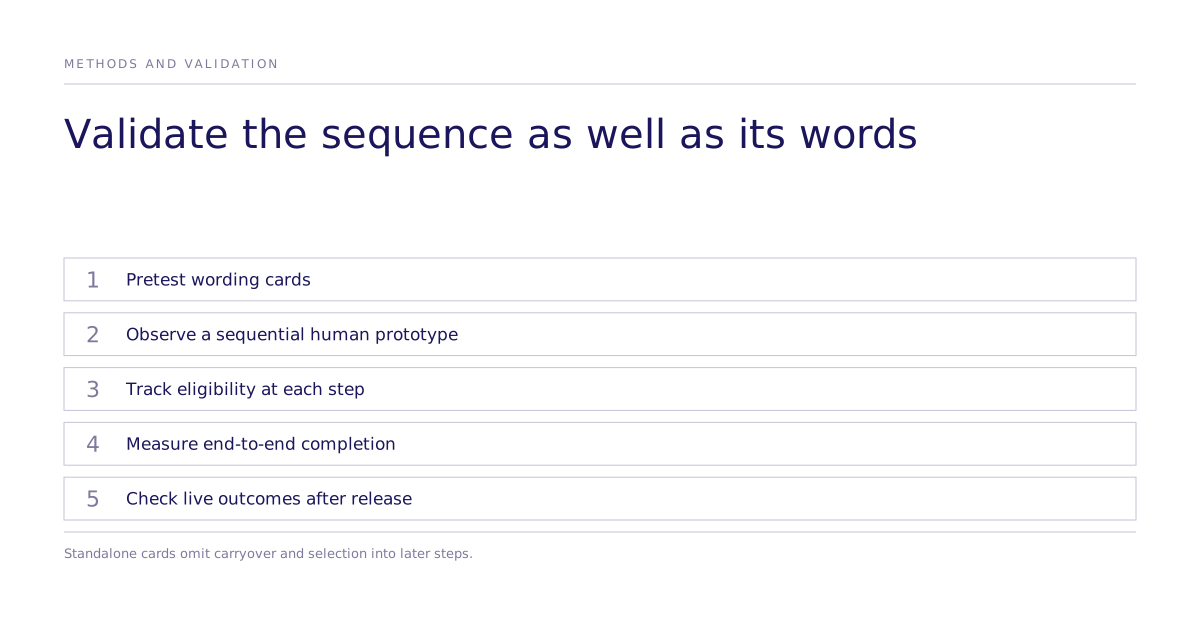
Storyboard each step: what a person sees, what they must do and how prior actions change the next screen. Standalone cards can pretest wording, but omit carryover and selection into later steps. Then put the cards or prototype into the intended sequence for human task testing. Record who starts, who is eligible for each step, completion, errors and time. Randomize full sequences or defined changes when estimating their effects.
What should you test at each onboarding step?
Different step types fail for different reasons, so the question asked has to match the step:
| Step type | What to ask | What it catches |
|---|---|---|
| Form fields | What information is requested, and can the participant complete the task? | Comprehension and completion problems |
| Permission requests | What access does the participant think this grants? | Misunderstanding or trust concerns |
| Empty states | Can the participant find and perform the next action? | Navigation or instruction problems |
| Value-prop screens | How does the participant interpret the benefit? | Comprehension gaps |
| Upgrade prompts | What does the participant expect to receive for the price? | Benefit or price misunderstanding; actual payment needs a behavioral test |
| Tours and hotspots | Which prompts help the participant complete the task? | Task interruptions or skipped guidance |
Self-report questions provide a first pass and can differ from behavior. A randomized choice experiment can compare stated preferences for wording alternatives; multinomial logit, mixed logit and ICLV are possible model families for analyzing choices, rather than names for the design itself. A simulated continuation response is modeled preference, not observed progression through a functioning funnel. See the methods and validation hub.
Where this method stops, and what has to pick up
A simulated comparison does not observe device rendering, response time or actual retention. Human prototypes can reveal interaction problems before a complete build; production telemetry and experiments measure behavior in the live environment.
Validate the sequential prototype as well as individual wording. Compare human task behavior with the modeled prediction, preserve the original eligibility rules and inspect where attrition changes the audience. The study must support the completion claim the team intends to make.
When should you evaluate onboarding before it ships?
Use wording pretests to prioritize variants, sequential human prototypes to discover flow problems and live experiments to estimate production outcomes. Choose the next check from the risk and uncertainty in the redesign. Review a study or discuss an onboarding decision.