What Are Synthetic Consumers? Knowing When to Trust the Answer
Synthetic consumers are modeled personas that attempt to approximate a consumer audience's responses. Consider a packaging decision: a model can rank three label concepts under specified prompts, but the buyer needs evidence that the ranking matches the target consumers and the outcome that matters.
The harder question isn't what the persona is. It's whether the answer it just gave is solid enough to move money against: a media buy, a packaging change, a launch date.
What decides whether a synthetic consumer's answer can be trusted?
Trust depends on matched validation, population coverage and the cost of error. Question type helps identify risks, but does not determine validity by itself.
Record the response model, supplied persona information and any calibration data. Profile conditioning and calibration are different: a prompt can specify a consumer without establishing that the responses represent that consumer group.
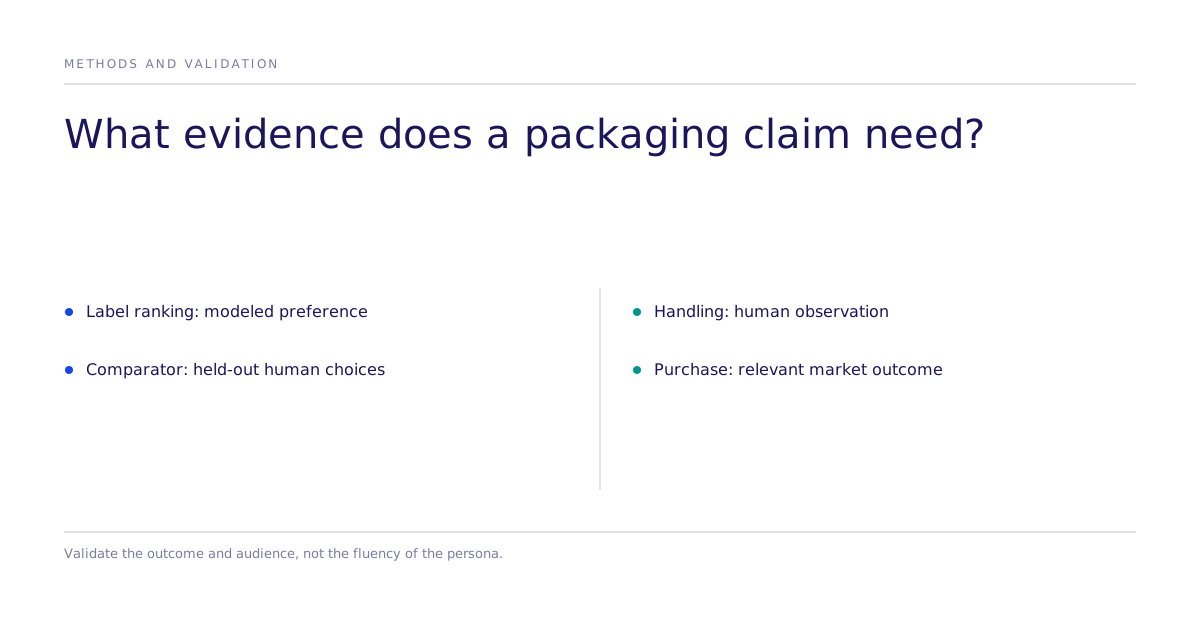
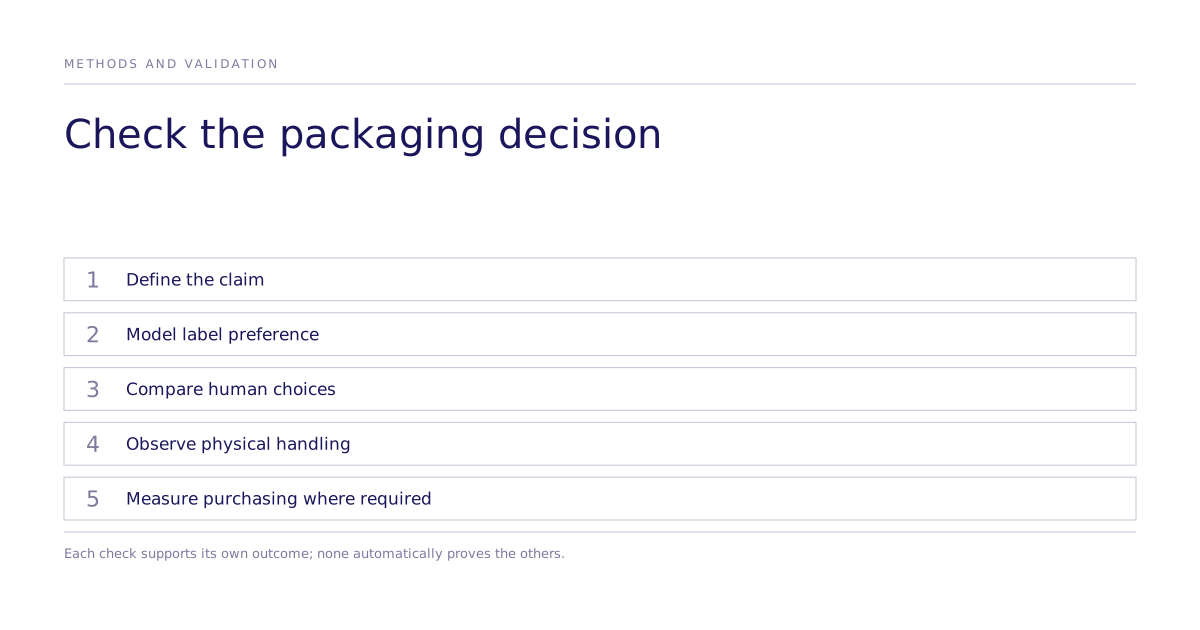
For the packaging example, separate interpretation of the label, stated preference, physical usability and realized purchase. Each requires a suitable comparator.
Testing the label ranking. Prespecify the concepts, randomize presentation where appropriate and compare modeled choices with held-out human choices from the intended audience. Inspect segment results and variation as well as the aggregate. A political-survey benchmark does not establish validity for brand perception or message effects.
Testing the experience. Opening the package, reading small text and making an actual purchase require human or market observation. A generated personal story is not a record of lived experience.
Use the modeled comparison to prioritize hypotheses until task-matched evidence supports the intended use. High-stakes preference or pricing decisions also need relevant external checks.
Why isn't a vendor's own accuracy figure the number to anchor on?
Vendors in this category frequently cite a high correlation between synthetic and real-consumer answers on directional questions. That figure comes from each vendor's own validation work: its own personas, calibration data, and definition of a directional match. It measures the vendor's model of the world, not any specific decision a buyer is about to make.
The open research question isn't whether language models can approximate human survey responses in aggregate. It's under which conditions that approximation holds, and how a buyer would know before spending money whether their question falls inside or outside the calibrated range. Argyle et al.'s foundational work simulating human samples with language models frames this directly: the technique can reproduce population-level patterns on certain questions, but the calibration and validation boundary is still being mapped, not settled.[^1]
Argyle and colleagues examine conditioned GPT-3 responses on political-survey tasks. Their findings support testing specific configurations against specific human comparators; they do not certify every consumer use.
See Out of One, Many, later published in Political Analysis.
[^1]: Argyle and colleagues, Out of One, Many, investigates silicon sampling on political-survey tasks.
Where does Subconscious fit in this decision?
Subconscious uses controlled comparisons between actions on simulated populations. Those estimates describe modeled choice under the tested design. Relevant human or market evidence must establish whether the effect transfers to the packaging decision.
Plan external validation according to the consequence of error, held-out agreement and model/population mismatch. For the packaging decision, a human choice task can check stated preference; handling tests can check usability; a live experiment can check purchasing. These outcomes should remain distinct.
What this doesn't fix
A matched human comparison supports its tested protocol and endpoint. A usability session, clinical trial or purchase test may answer another question; document that change and assess the evidence for the outcome the business intends to use.
Generated text does not observe a person tasting, handling or using the package. For unfamiliar categories, document any fresh supplied context and its provenance, then seek matched task and audience evidence. Choose a human or market check for the remaining claim: perception, preference, usability or purchase.
The next question to ask
Before spending, name the packaging claim and outcome. What held-out evidence supports the audience and stimulus? What could a wrong ranking cost? Choose the next human or market check from those answers. Discuss a validation design.